Should you repair or replace a commercial roof?
Repair is usually enough when the roof is well within its expected service life, the problem is confined to specific seams, flashings, or punctures, and the insulation below is dry. Replacement is usually the better decision when the membrane is deteriorating across the whole roof, leaks keep returning in new places, a large share of the insulation is wet, or the deck is damaged. Between the two sits restoration, most often a coating system, which can extend the life of a roof that is aging but still sound and dry.
The decision should rest on evidence from the roof itself.
How old is the roof compared with its expected service life?
Age alone does not condemn a roof, but it frames every other finding. Single-ply membranes such as TPO, EPDM, and PVC are commonly expected to serve roughly 20 to 30 years. Standing-seam metal can last considerably longer. Asphalt shingles on steep-slope multifamily buildings are often quoted at 20 to 30 years. Real results vary with installation quality, drainage, foot traffic, and maintenance.
In Georgia, long summers with strong sun and high rooftop temperatures are hard on membranes, sealants, and flashings. A roof that has not been maintained can age faster than the ranges above suggest.
- Early or mid-life roof with a specific defect: repair is normally the sensible choice.
- Late-life roof with a first leak: repair now, and start planning and budgeting for replacement.
- Roof past its expected life with recurring problems: money spent on repairs is unlikely to buy much more time.
If you do not know the roof's age, look for warranty paperwork, permits, or closing documents. An inspection can also estimate age and identify the system.
How much of the insulation is wet?
This is often the deciding factor on flat and low-slope roofs, and it cannot be judged from the surface. Water that gets under the membrane soaks into the insulation and stays there.
Wet insulation matters for three reasons:
- It loses insulating value, so the building costs more to heat and cool.
- It holds water against the deck, which can rust steel and rot wood.
- It limits your options. Model building codes generally do not allow a new roof to be installed over an existing roof that is water-soaked, and coating manufacturers require wet areas to be removed first.
A moisture survey, using infrared scanning or other moisture-detection tools and confirmed with core cuts, shows where the wet areas are and how large they are. Small, isolated wet areas can be cut out and replaced as part of a repair. When wet insulation is spread across much of the roof, a full tear-off and replacement is usually the only sound answer.
How many leaks, and do they keep coming back?
One leak with a clear cause, such as a puncture near a rooftop unit or a failed pipe boot, is a repair. The pattern matters more than the count:
- Same spot, repeatedly: the earlier repair probably missed the true source. This calls for better diagnosis and does not by itself mean the roof needs replacing. Our guide on how to spot a commercial roof leak explains why the drip and the entry point are often far apart.
- New spots after each storm: the roof is failing as a system, usually at seams or flashings across the whole area.
- Leaks in dry weather: check HVAC condensate and plumbing before blaming the roof.
Keep a simple log of dates, locations, weather, and what was done. It is the most useful record you can hand an inspector.
What condition is the membrane in?
A repairable membrane is still flexible, still bonded or fastened as designed, and able to accept a patch or weld. Signs that a membrane is beyond economical repair include:
- Seams opening in many places across the roof, not in one area
- Widespread cracking, crazing, or surface erosion that exposes the reinforcement
- Shrinkage that pulls flashings away from walls and curbs
- Brittleness, so that new patches will not bond or weld reliably
- Many old patches of different ages spread over the roof
- Heavy granule loss or blistering on modified bitumen and built-up roofs
What condition is the deck in?
The deck is the structural surface under the roof system. Rusted steel deck, rotted wood, or deteriorated gypsum or concrete cannot be fixed from above without removing the roof over it. Soft or spongy areas underfoot, rust visible from inside the building, and sagging between supports are warning signs. Confirmed deck damage over more than a small area normally means that section has to be torn off down to the deck, and it often tips the whole roof toward replacement.
Is a coating or restoration a middle option?
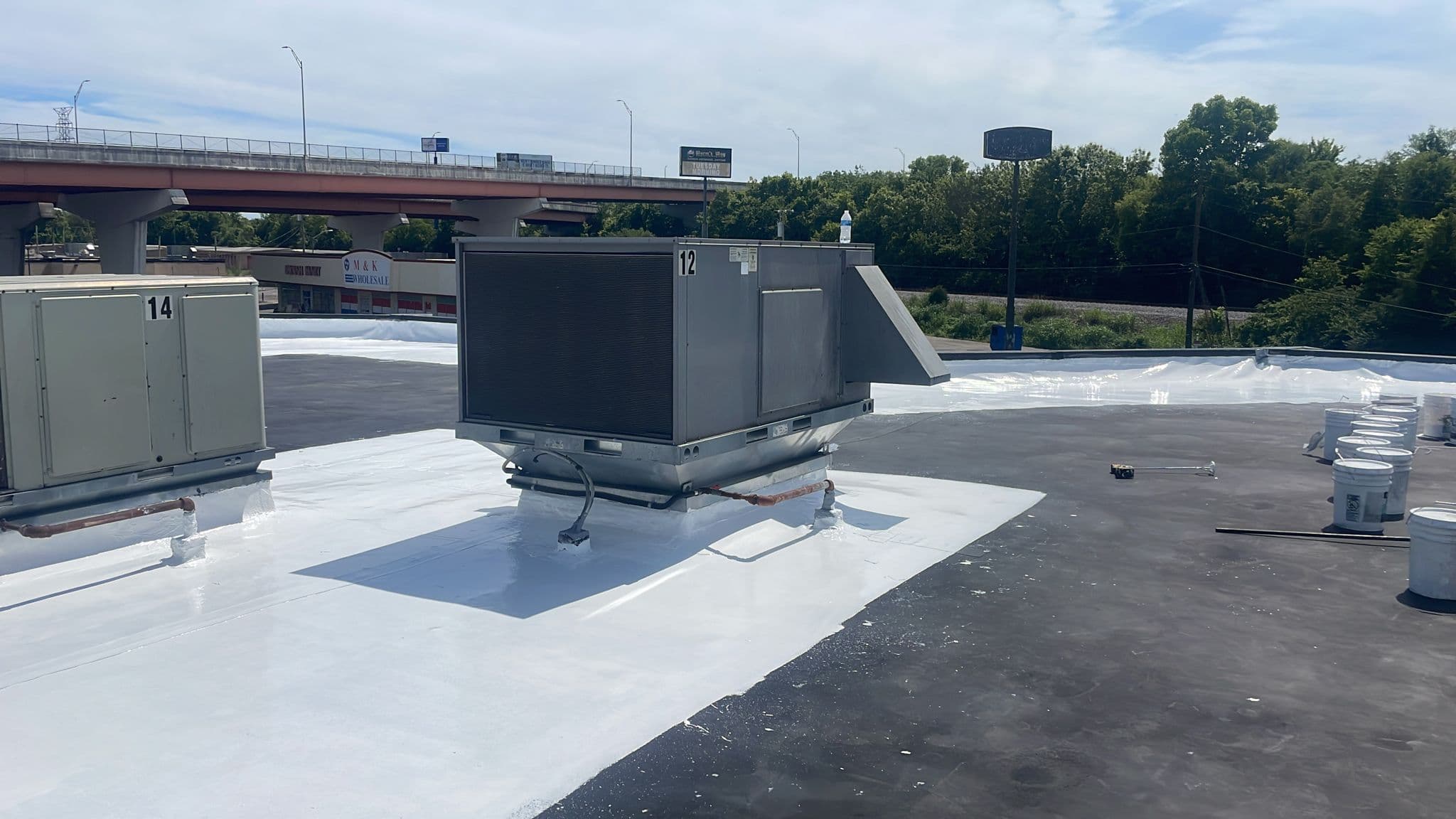
It can be. A roof coating or restoration system is a fluid-applied layer installed over the existing roof after seams, flashings, and defects have been repaired. On the right roof it restores waterproofing, adds a reflective surface that helps in Georgia heat, and defers the cost and disruption of a tear-off.
It is the wrong choice when:
- The insulation is wet over more than small, removable areas
- The membrane has lost its strength or is poorly attached
- The deck is damaged
- Water ponds heavily and the chosen coating is not rated for it
How do insurance and budgets figure in?
Insurance. Property policies generally respond to sudden damage from events such as hail, wind, or falling trees, and generally exclude wear, age, and lack of maintenance. Whether a claim results in a repair, a partial replacement, or a full replacement is the carrier's decision under your policy. Document the date of the event and the damage, and notify your carrier or broker promptly. No contractor can guarantee how a claim will be decided.
Budget. Compare cost per year of remaining service, not just the invoice. An inexpensive repair that buys one year can cost more over time than a larger project that buys many. Owners also weigh how long they plan to hold the property, lease obligations, tenant disruption, energy performance, and warranty coverage. A new roof system typically carries a new manufacturer warranty, and repairs on a roof that is still under warranty should follow the manufacturer's approved methods. For what drives the price of a new roof, see our guide to commercial roof replacement cost factors.
Repair, restore, or replace: a plain decision table
| Factor | Repair | Restore or coat | Replace |
|---|---|---|---|
| Age vs. expected life | Early or mid-life | Mid to late life | At or past expected life |
| Wet insulation | None, or small isolated areas | Small areas that can be cut out | Widespread |
| Leak history | One or two, clear cause | Occasional, at seams and details | Recurring, in new locations |
| Membrane condition | Sound, accepts patches | Aging but intact and attached | Brittle, shrinking, failing widely |
| Deck condition | Sound | Sound | Rusted, rotted, or deflecting |
| Existing roof layers | Not a factor | Not usually a factor | Two roofs already in place means tear-off |
| Ownership horizon | Any | Medium term | Long term, or selling with a clean report |
If your answers fall mostly in one column, that is the likely direction. If they are split, an inspection with moisture testing will settle it.
When to call a roofer
Call when you have had more than one leak in a year, when the roof is in the last third of its expected life, or when you need a defensible number for next year's capital budget. Red Door Roofing provides commercial roof repair and commercial roof replacement in Georgia and neighboring states, so the recommendation is not tied to selling one or the other. We document what we find with photos and explain the options, and the decision stays with you.
Next step: request a no-obligation inspection and ask for a repair-versus-replace assessment. We reply within 1 business day.
Frequently Asked Questions
How do I know if my commercial roof needs repair or replacement?
How long should a commercial roof last?
Can you coat a commercial roof instead of replacing it?
Why does wet insulation matter so much?
Will insurance pay to replace my commercial roof?
Is it worth repairing a roof that is near the end of its life?
Related Guides
- ACV vs RCV Cheat Sheet for Commercial PoliciesPlain-language ACV vs RCV on commercial roof insurance - how carriers calculate depreciation, when R…
- Roof Certification vs Roof InspectionWhat insurance underwriters, lenders, and asset managers actually want from a roof certification - a…
- Commercial Roof Inspection ChecklistWhat a commercial roof inspection includes: the areas an inspector checks, moisture scans and core c…