Who This Is For
Multifamily roofing is for owners, asset managers, regional property managers, and operations directors responsible for apartment communities, student housing, senior living, condominium portfolios, and mixed-use multifamily buildings across the Southeast. Our process is built around tenants in place - phased installs, clear notices per building, and operations-team-ready documentation. If you manage a 50-plus-unit multifamily portfolio across Georgia, Alabama, Tennessee, South Carolina, or the broader 16-state Red Door footprint, this page is for you.
The multifamily roof replacement conversation is different from single-building commercial. It's a project-management discipline layered on top of a trade discipline. Tenant disruption, noise windows, parking logistics, walkway safety, leasing and operations coordination, carrier documentation per building - none of those show up on a typical commercial roof estimate, but all of them determine whether a multifamily replacement succeeds or fails from the property manager's perspective.
Why Multifamily Roof Replacement Is Different
A multifamily property is not a single roof with one scope and one install timeline. A 300-unit garden-style property commonly sits on eight to twelve separate buildings, each with its own roof, its own gutter and drainage system, its own HVAC curb layout, and its own relationship to tenant-facing walkways, parking, and trash-enclosure logistics. Storm damage frequently concentrates on a subset of those buildings - two of eight, three of twelve - because hail and wind tracks through a property with geometric specificity rather than uniform coverage. That per-building reality means multifamily roof work requires per-building documentation, per-building scope, per-building production sequencing, and per-building tenant communication.
Multifamily tenants also don't tolerate the kind of disruption commercial tenants absorb as a cost of doing business. Residents are trying to sleep, work from home, care for children, and live their lives through what is fundamentally a construction project happening over their heads. The property manager who green-lights a replacement without a disciplined phasing plan invites maintenance tickets, leasing-office complaints, unit-turn coordination failures, and reputational damage that persists past the project. Our multifamily process is built to prevent all of that by treating tenant and operations coordination as a first-class project discipline.
Multifamily Roof Systems - What We Install and Why
Multifamily properties across the Southeast run on several roof-system families, and the system choice interacts with the building type, climate zone, tenant mix, and budget.
Architectural Asphalt Shingle
Architectural asphalt shingle is the dominant pitched-roof system on garden-style multifamily across the Southeast. Lifespans typically run 20 to 30 years with impact-rated (UL 2218 Class 4) premium shingles extending that, particularly in the hail-prone Georgia and Alabama markets we serve. Strengths: broad manufacturer availability, moderate installed cost, familiar aesthetic, and manageable repair scope. Failure modes: granule loss under sustained UV exposure, blistering from trapped moisture at attic-ventilation deficiencies, nail pops, and end-of-life brittleness that makes individual-shingle repairs impractical once granular loss reaches a certain threshold. Multifamily shingle work also interacts with local code requirements on attic ventilation and ice-and-water shield underlayment.
TPO (Thermoplastic Polyolefin) - Low-Slope and Clubhouses
TPO is the default single-ply membrane on low-slope multifamily sections - clubhouses, fitness centers, mixed-use retail-below-residential, and mid-rise and high-rise apartment flat roofs. Reinforced TPO with factory-laminated fleece-back offers improved puncture resistance and wind-uplift performance. White TPO's high Solar Reflectance Index measurably reduces HVAC cooling load on common-area buildings, which directly affects property-level operating expense. Lifespans typically run 15 to 30 years per NRCA guidance, with thicker membranes (80-mil+) at the long end of that range.
EPDM (Ethylene Propylene Diene Terpolymer)
EPDM still appears across older multifamily stock, particularly on clubhouse and breezeway flat roofs installed in the 1990s and 2000s. Strengths: excellent hail-impact performance thanks to the rubber's elasticity, proven long-service life across diverse climates. Failure modes: seam-adhesive degradation on older systems, membrane shrinkage pulling away from parapets and drains over decades. EPDM remains a valid replacement specification where hail exposure is the dominant concern.
PVC (Polyvinyl Chloride)
PVC membrane shows up on multifamily with rooftop food-service tenants (commercial kitchens on ground-floor retail) or heavy HVAC exhaust grease exposure. Less common on pure-multifamily apartment communities, more common on mixed-use properties with ground-floor commercial.
Metal Standing-Seam
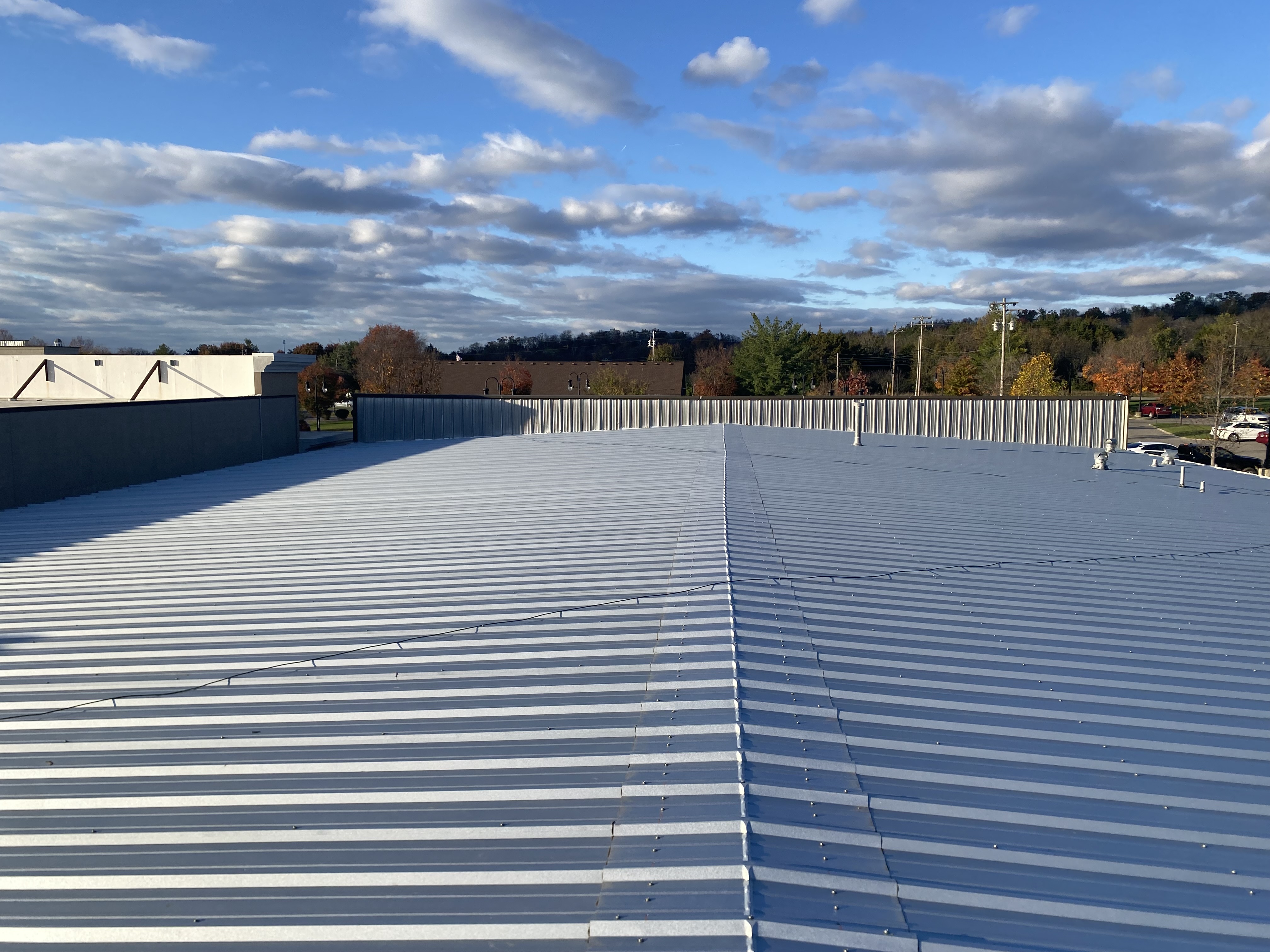
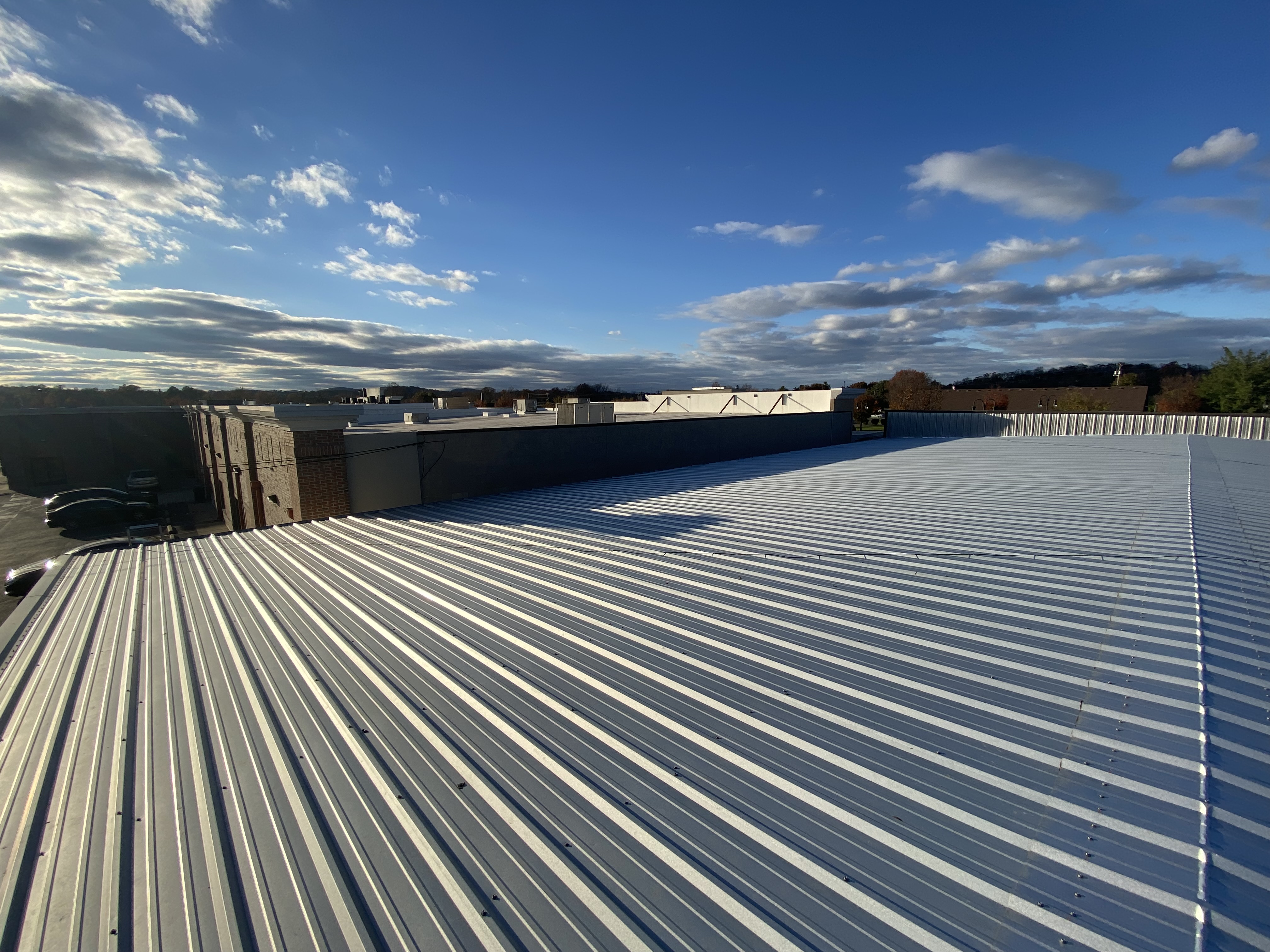
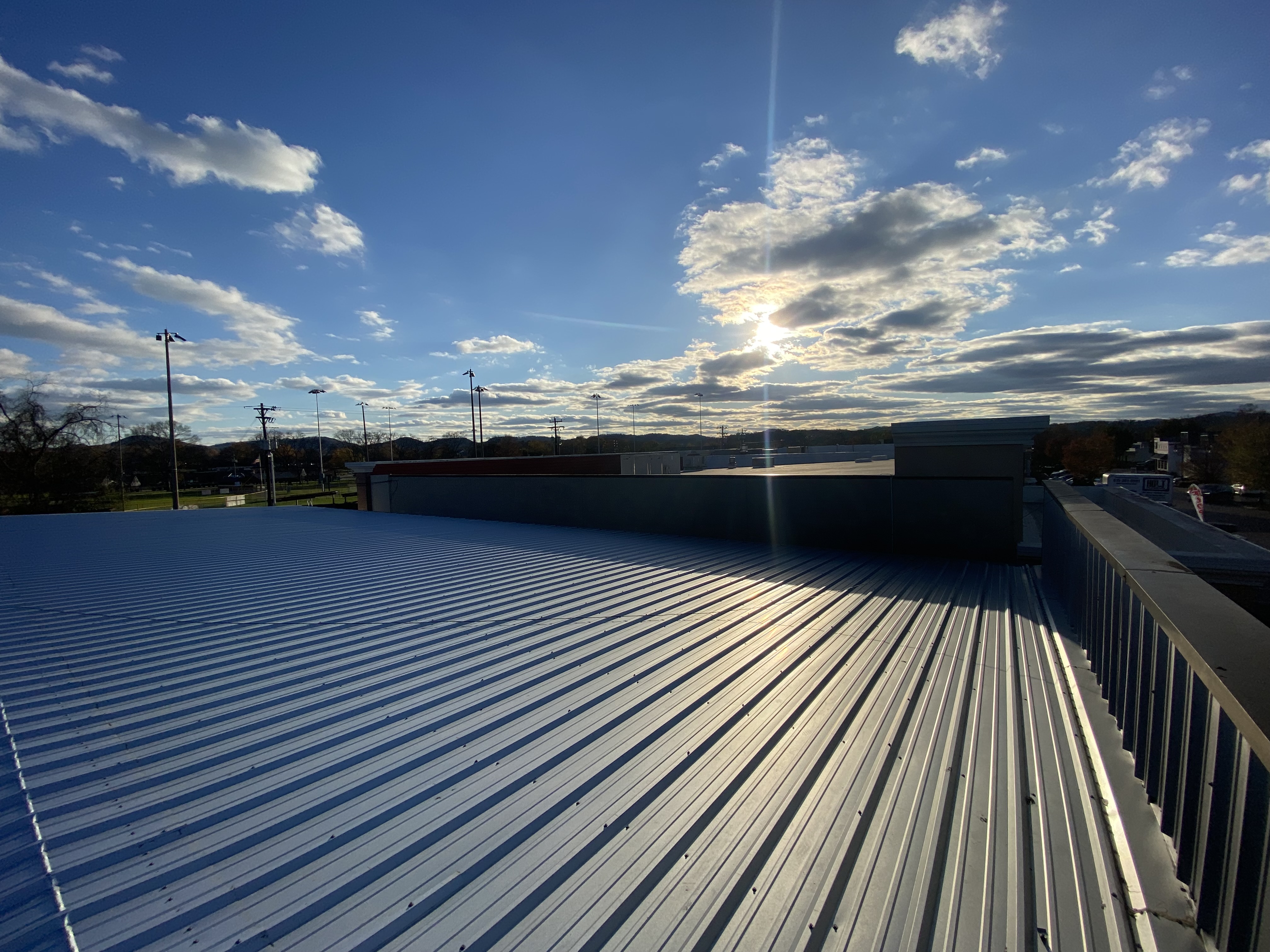
Metal standing-seam is increasingly specified on newer suburban multifamily - particularly on clubhouses, carriage-house garages, and accent-roof elements where the premium aesthetic justifies the premium cost. Lifespans exceed 40 years with periodic maintenance; UL 580 Class 90 wind-uplift ratings are common on quality installations.
The Red Door Roofing Multifamily Process
Our multifamily process runs through six coordinated phases. Each phase produces documentation that feeds the next phase and ends in portfolio-level closeout deliverables your lender, asset manager, and insurance carrier can work with.
Phase 1 - Portfolio Walk and Baseline Condition Report
Every multifamily engagement starts with a building-by-building portfolio walk. We deploy drone-assisted aerial documentation across the full property, producing an overhead schematic that catalogues every roof section on every building. Ground-level inspection documents flashing, drains, gutters, parapets, walkway integrity, HVAC curb condition, and any observed damage with photo-keyed references to specific building numbers. The baseline condition report identifies the existing roof systems per building, estimates remaining useful life per section, flags priority repairs versus replacement candidates, and provides a portfolio-level summary your asset manager can share internally.
For portfolios that don't have an existing date-of-loss claim driving a replacement, the portfolio walk feeds a capital-planning conversation - which buildings need replacement in the next 12 months, which can defer 24 to 60 months, which require interim repair investment, and what the projected 10-year capital cycle looks like across the portfolio. That reserve-study alignment is what our multifamily asset-manager clients value most.
Phase 2 - Per-Building Damage Documentation
When a portfolio walk identifies observed storm damage, we transition into per-building damage documentation. Every damaged building gets its own evidence package: overhead schematic with damage mapping, photo-keyed ground-level documentation, date-of-loss cross-reference to NOAA/NWS storm records for the property's ZIP code, core-sample data where replacement scope is being developed, and moisture-survey findings. The per-building structure is deliberate: a 300-unit multifamily claim involves N separate roofs, each with its own evidence burden, and adjusters want that per-building granularity to evaluate claim scope building-by-building rather than accepting a blanket portfolio-level scope.
Phase 3 - Carrier Engagement and Scope Development
With per-building documentation in hand, we support the owner through carrier engagement. That typically means attending the on-roof walk with the assigned adjuster, providing our documentation package in the format the carrier's field team actually uses, and developing a priced scope against local labor and material norms per building. When initial adjuster scopes miss legitimate work - underlayment, code-required insulation upgrades under Ordinance and Law coverage, perimeter metal, rotten deck replacement, additional penetrations - we file supplements backed by photo evidence and code citations. We don't file speculative supplements; we file documented ones. Multifamily supplements tend to run higher in dollar value than single-building commercial because the per-building scope adds up across the portfolio.
Outcomes still depend on the carrier's determination - we never guarantee approval on multifamily claims any more than we do on single-building commercial. But the per-building documentation discipline we bring gives the carrier what they need to evaluate fairly.
Phase 4 - Phased Production Schedule and Tenant Communication
Once scope is approved, we build a phased production schedule that sequences each building's replacement window in a logical order. That order considers weather windows, material lead times (which stagger arrivals so tear-off on Building 1 doesn't start before Building 2's materials are on-site), parking-lot staging constraints, tenant-turnover calendars (student-housing near universities has absolute no-fly periods around move-in weekends and exam weeks), and leasing-calendar event coordination. The phased Gantt schedule lives as a shared document your operations, leasing, and regional property manager teams all work from.
Tenant communication is where multifamily projects distinguish themselves from commercial. We distribute tenant-notice templates seven-plus days ahead of each building's turn, in English and Spanish, describing the work, the dates, the noise expectations, the walkway-safety plan, and the point-of-contact for resident questions. Residents get predictability, property managers get a documented communication trail, and operations teams get a weekly update as the schedule moves forward.
Phase 5 - Per-Building Tear-Off, Replacement, and Daily Documentation
Production runs per-building on the schedule. Every active building has its daily dry-in protocol so the structure is never exposed to overnight weather. Walkway-safety fencing, debris chutes, and ground-level containment apply on every active site. Daily progress photography goes into the closeout package. OSHA-compliant fall protection, noise-window discipline, and pedestrian-safety protocols are standard.
Phase 6 - Per-Building Closeout and Portfolio-Level Deliverables
Closeout runs per-building (final walk, punch list, photo records, warranty registration) and rolls up to portfolio-level deliverables: a portfolio-level condition report with before/during/after photography, as-built documentation per building, manufacturer No Dollar Limit (NDL) warranty registration, workmanship warranties, Roof Condition Certifications suitable for lender compliance, and a unified closeout binder your asset manager can archive for the property's reserve study and future acquisition documentation.
Multifamily Roof Replacement Across Georgia, Alabama, and the Southeast
Our multifamily work concentrates heavily in the Georgia and Alabama focus markets. Metro Atlanta multifamily spans Buford Highway, Vinings, Brookhaven, Sandy Springs, Roswell, Johns Creek, Alpharetta, and the broader Perimeter corridor - garden-style, mid-rise, and high-rise portfolios all regular engagements. Birmingham multifamily runs across Hoover, Vestavia Hills, Homewood, Mountain Brook, and Trussville. Huntsville multifamily clusters near Cummings Research Park and Redstone-adjacent housing. Mobile and Baldwin County multifamily carries named-storm exposure and specifications that reflect Gulf Coast wind-uplift requirements.
Beyond our core markets, our Nashville multifamily work concentrates in Cool Springs, Franklin, Donelson, Bellevue, and Antioch. Charleston multifamily spans Daniel Island, Mount Pleasant, James Island, and West Ashley. Greenville multifamily runs the Woodruff Road and I-85 corridor. Every multifamily market has its own submarket dynamics - tenant mix, roof-system defaults, storm exposure, academic-calendar overlays for student-housing - and our project-management layer adapts to each.
For related service-area context, see our pages on Atlanta commercial roofing, Birmingham commercial roofing, Huntsville commercial roofing, and Savannah commercial roofing. For the adjacent service conversations, see our commercial roof replacement service and insurance claim support service.
Our 5-Step Multifamily Roofing Process
Every multifamily roofing engagement follows the same five-step process. The process is built around photo-keyed documentation at each stage - documented work protects the owner through claim, production, and closeout, and gives carriers, lenders, and asset managers the evidence they need without follow-up requests.
Step 1
On-Site Assessment
Photo-keyed inspection across every slope, drain, flashing, and penetration - not a cursory walk-by.
Step 2
Damage Evaluation
Qualification determination, or Certificate of Clearance if no damage. No obligation either way.
Step 3
Claims Support
Carrier coordination, adjuster documentation delivery, and scope-supplement support where warranted.
Step 4
Project Management
Phased production schedule, tenant-notice distribution, material procurement, and daily operations.
Step 5
Installation & Restoration
On-roof production with daily photo documentation, punch-list completion, and closeout records.
What Multifamily Roofing Documentation Looks Like
Every multifamily roofing engagement produces a photo-keyed PDF report suitable for carrier, lender, and asset-manager review. The report identifies the roof system on your property (TPO, EPDM, PVC, modified bitumen, BUR, metal, architectural shingle, or a mixed portfolio), estimates remaining useful life, flags flashing and penetration condition, and documents any observed damage with date-of-loss alignment where applicable. We also call out situations where we recommend repair rather than replacement - our business is built on honest scoping, not upselling.
On multifamily buildings we document building-by-building, which matters because a 300-unit complex may show damage concentrated on two of eight roofs. Adjusters want that granularity, and the documentation protects owners from blanket-scope claims that get pared back in review. For portfolio owners with multiple commercial properties, we deliver portfolio-level summaries that asset-management teams can file without re-formatting.
Multifamily Roofing Across 16 States
Red Door Roofing delivers multifamily roofing across a 16-state footprint spanning the Southeast, South, Midwest, and Gulf. Most of our crews run out of Georgia, Tennessee, Alabama, and South Carolina, where we know the local storm history and code requirements firsthand, and our coverage extends across Georgia, North Carolina, South Carolina, Alabama, Kentucky, Tennessee, Texas, Oklahoma, Louisiana, Mississippi, Florida, Arkansas, Missouri, Kansas, Iowa, Indiana. Commercial and multifamily property owners in any served state can request an inspection through our contact form or by calling 1-855-GO4REDD.
Why Property Managers Choose Red Door Roofing for Multifamily Roofing
Commercial and multifamily property owners face a common problem: roof damage often hides in plain sight, claim windows close faster than tenant-reported symptoms, and storm-chaser crews flood markets promising everything and delivering inconsistently. Red Door Roofing is built on the opposite approach - inspect first, document with photo-keyed evidence, support the claim paperwork without guaranteeing outcomes, and manage installation with tenant-in-place phasing. Our multifamily roofingwork draws on 30 years of Red Door family experience across the Southeast, including commercial projects for Best Western, Harbor Freight, Tractor Supply, Vanderbilt Medical Clinic, Food Land, Hope Church, Impact Church, and Milan Inn and Suites.
30+ years of Red Door family experience
Built on 30 years of commercial and multifamily work across the Southeast. Commercial clients include Best Western, Harbor Freight, Tractor Supply, and Vanderbilt Medical Clinic.
Carrier-ready documentation
Photo-keyed inspection reports formatted for adjuster and lender review. We match the documentation standards carriers actually request post-event.
Tenant-in-place multifamily phasing
Multifamily work phased by building block with tenant-notice templates, noise windows, and operations-team documentation. Tenants stay in place.
No-obligation inspection
If our inspection finds no qualifying damage, we issue a Certificate of Clearance at no cost or commitment.
Industry certifications
NRCA member, BOMA member, Licensed General Contractor in multiple states.
Honest scoping
We recommend repair over replacement when the building supports it. Our business is built on credibility with property managers - not upselling.
Frequently Asked Questions
Will tenants need to relocate during a multifamily roof replacement?
How long does a multifamily project take?
Do you work with property management software?
What flat-roof system is best on multifamily buildings?
What happens if damage is not found on inspection?
Can Red Door Roofing handle properties with 500+ units?
How does multifamily roofing documentation differ from single-building commercial?
Do you handle student-housing multifamily near UA, UAB, or UGA?
What's different about multifamily storm-claim documentation?
Which states does Red Door Roofing serve for multifamily work?
What time of day do you work on apartment roofs?
How much notice do tenants get before work starts on their building?
Will my renters lose power or water during roof work?
What about pets living in the apartment during roof work?
How do you protect cars, pools, and playgrounds during the job?
Do you do apartment roofs during winter months?
What if there's a leak in only one building of my property?
How do you keep tenants happy during a big roof project?
Can you handle HUD or LIHTC apartment properties?
What happens to the old roof when you tear it off?
Still have questions about multifamily roofing? Our inspections are no-obligation - if no damage is found, we issue a Certificate of Clearance at no cost.
Request InspectionRelated Services
Multifamily Roofing rarely exists in isolation - most commercial roof engagements touch two or three adjacent services (inspection → storm-damage → replacement, or inspection → certification, or replacement → insurance-claim-support). Here are the services most commonly paired with Multifamily Roofing.
Ready to start?
Call 1-855-GO4REDD or request a no-obligation inspection online. Most inspections are scheduled within days of the request.