Commercial Roofing in Georgia
Georgia is Red Door Roofing's home market. We serve commercial and multifamily property owners across metro Atlanta, Savannah, Augusta, Columbus, Macon, Athens, and the surrounding Georgia corridor - from storm-damage inspections to insurance-backed full roof replacements on TPO, EPDM, metal, and asphalt systems.
About Commercial Roofing in Georgia
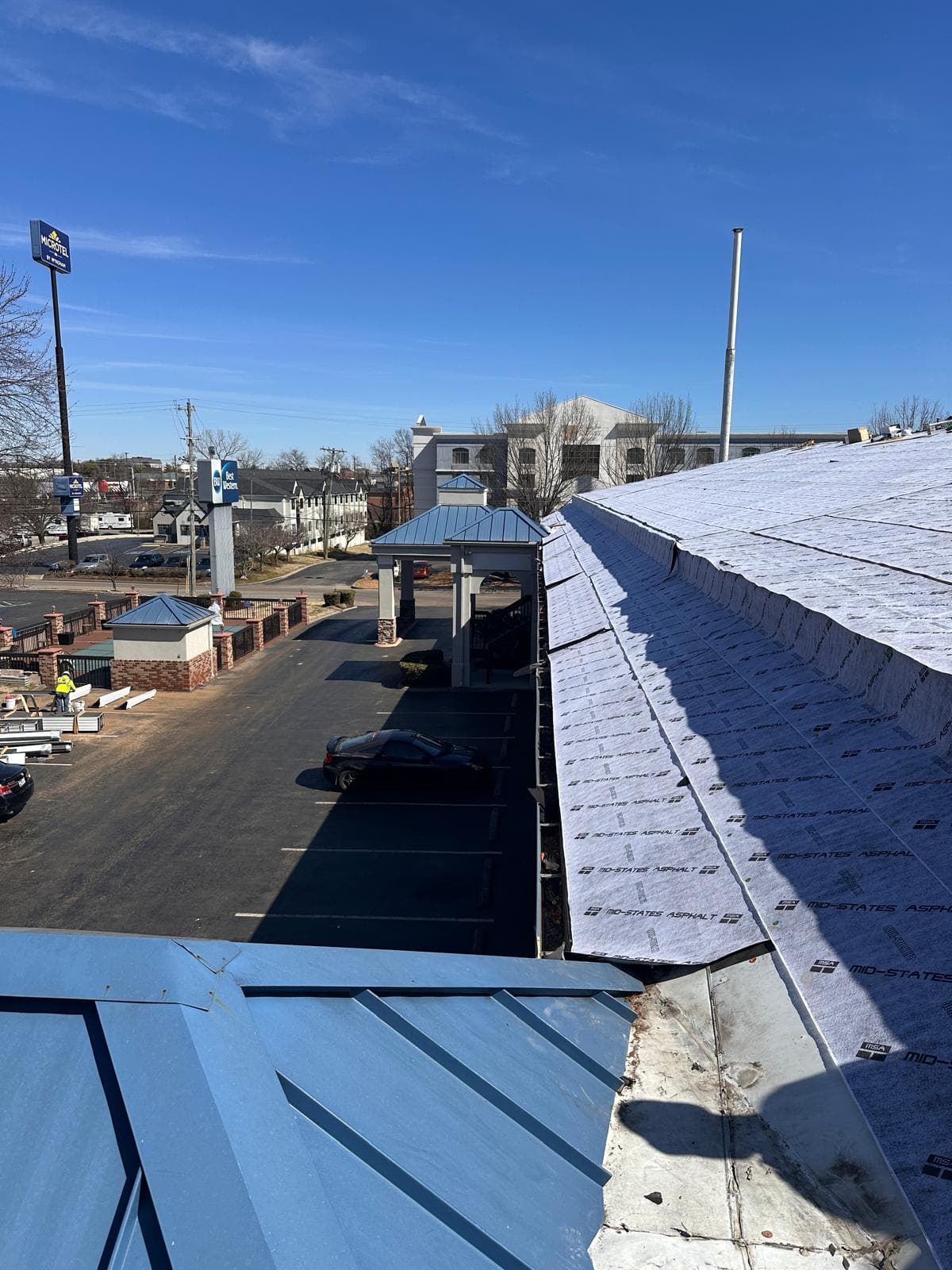
Georgia anchors our 16-state footprint. Headquartered in Atlanta, we operate across the Southeast's largest commercial and multifamily market - from Metro Atlanta's 5.9 million-resident MSA through Savannah's Lowcountry, Augusta's Fort Eisenhower and medical-district corridors, and the West Georgia Columbus / Fort Moore commercial zone. Georgia commercial roof stock spans TPO and EPDM on office-park and multifamily flat roofs, architectural asphalt shingle on pitched multifamily, PVC on restaurant and hospitality, and metal standing-seam on newer suburban and industrial builds.
Georgia Climate & Severe-Weather Patterns
Georgia's severe-weather calendar centers on March–May hail and wind activity, with a secondary late-summer peak and occasional tropical-storm activity reaching the Georgia coast. NOAA SPC records show metro Atlanta, the Piedmont corridor, and Savannah's coast each experience distinct storm patterns. Commercial and multifamily owners across Georgia benefit from documented annual inspections plus prompt post-event inspections during the spring severe-weather window.
Georgia Commercial Roof Market Segments We Serve
Our Georgia commercial and multifamily work concentrates in five market segments: (1) Metro Atlanta office parks and multifamily across the I-285 Perimeter and Buford Highway corridors; (2) Savannah coastal hospitality and historic-district commercial; (3) Augusta medical-district and Fort Eisenhower-adjacent commercial; (4) Columbus military-adjacent housing and commercial; (5) Macon and Albany regional commercial and multifamily stock along I-75 and U.S. 19.
- Multifamily portfolios 50–500 units
- Office parks along I-285 and I-75 North
- Hospitality (national chain + independent) across Savannah, Augusta, Atlanta
- Industrial stock along Fulton Industrial and I-20
- Medical campuses near MCG (Augusta), Emory (Atlanta), and Piedmont (Metro)
- Institutional: churches, schools, government-adjacent commercial
Georgia Licensing & Insurance Notes
Georgia requires contractor licensing for commercial work. Red Door Roofing operates under the Red Door family of companies' Georgia General Contractor licensure, which covers commercial, multifamily, and mixed-use work statewide. Georgia commercial property insurance typically uses wind/hail percentage deductibles; coastal policies (Savannah, Brunswick, Tybee) add named-storm deductibles.
Georgia Commercial Roofing Market Overview
Georgia is the Southeast's largest commercial and multifamily roofing market by inventory and by claim volume. The Atlanta-Sandy Springs-Roswell MSA alone accounts for the majority of Georgia commercial roof activity - roughly 6 million residents across Fulton, DeKalb, Cobb, Gwinnett, Clayton, and the broader 29-county MSA per U.S. Census Bureau 2020 estimates. Beyond metro Atlanta, Savannah anchors coastal Georgia commercial activity with its port-driven logistics and Lowcountry hospitality stock; Augusta supports the Medical College of Georgia / Wellstar campus and Fort Eisenhower-adjacent commercial; Columbus services Fort Moore and the broader Chattahoochee Valley; and Macon-Bibb, Albany, Athens, and Valdosta each anchor regional commercial and multifamily inventory.
The Georgia commercial roof inventory includes tens of thousands of office-park buildings, multifamily complexes, retail centers, industrial distribution facilities, and hospitality properties. Metro Atlanta's Perimeter, Cumberland-Galleria, North Arc (Alpharetta, Roswell, Johns Creek), Midtown, Buckhead, and West Midtown submarkets each carry distinct commercial roof-system defaults. Savannah's historic district and coastal resort properties demand wind-uplift-rated systems and hurricane-resilience detailing. Augusta's medical-district commercial carries high HVAC mechanical density and associated curb-flashing complexity. Columbus, Macon, Athens, and Albany commercial stock span a mix of older modified-bitumen, built-up, and newer single-ply systems approaching staged replacement cycles.
- Atlanta-Sandy Springs-Roswell MSA - roughly 6 million residents; largest commercial/multifamily market in Georgia.
- Savannah MSA - coastal hospitality, historic-district commercial, port-adjacent logistics.
- Augusta MSA - Medical College of Georgia, Wellstar, Fort Eisenhower-adjacent commercial.
- Columbus MSA - Fort Moore adjacency, Chattahoochee Valley industrial.
- Macon-Bibb, Athens-Clarke, Albany, Valdosta - regional commercial and multifamily anchors.
Georgia Severe-Weather Climatology and the Commercial Claim Cycle
Georgia sits firmly in the Southeast's spring severe-weather corridor. The National Oceanic and Atmospheric Administration (NOAA) Storm Prediction Center records Fulton, DeKalb, Cobb, Gwinnett, Clayton, and Paulding counties consistently among the higher-frequency hail-report counties in the metro Atlanta corridor, with concentrated activity during the March-through-May convective window. A secondary late-summer peak brings additional hail, wind, and tropical-remnant activity, and the Georgia coast faces direct tropical-storm exposure June through November through the Atlantic hurricane season.
That climatology drives a predictable commercial claim cycle. Metro Atlanta commercial property owners typically file the bulk of their hail-documented claims between April and July, with supplemental claim activity extending into early fall. Savannah and Brunswick coastal commercial owners face a separate named-storm claim pattern tied to tropical activity. Understanding the Georgia severe-weather calendar is the foundation of any Georgia commercial roof capital-planning cycle - annual post-winter inspections preserve the spring-claim documentation window, and post-event inspections within two-to-four weeks of any named storm routinely separate approved claims from denied ones.
ASHRAE climate zones across Georgia are predominantly 3A (warm-humid, covering metro Atlanta through most of the state) with the southern tier (below roughly I-16) falling into 2A. That climate-zone classification drives commercial-roof insulation minimums under ASHRAE 90.1, typically requiring R-25 to R-30 continuous insulation on commercial replacement scopes. The combination of high UV load, summer thermal cycling, and spring severe-weather exposure compresses commercial roof lifecycles toward the lower end of published manufacturer ranges across Georgia's commercial inventory.
- Spring severe-weather window: March through May - peak commercial hail and wind claim activity.
- Secondary peak: late summer convection and tropical remnants (Irma 2017, Helene 2024 remnants).
- Gulf Coast tropical exposure: Atlantic hurricane season, June through November for Savannah and Brunswick coastal commercial.
- ASHRAE climate zone 3A (most of state) and 2A (southern tier) - dictates R-25 to R-30 continuous-insulation minimums on commercial replacement scope.
- Commercial claim documentation windows of two to four weeks post-event materially affect carrier scope outcomes.
Georgia Commercial Insurance Landscape
Commercial property insurance in Georgia is regulated by the Georgia Office of Insurance and Safety Fire Commissioner. The Georgia Unfair Claims Settlement Practices Act establishes statutory timelines for carriers to acknowledge, investigate, and reach liability determinations on commercial claims - which matters practically because Georgia's severe-weather seasons routinely overload adjuster rosters and slow response. Knowing the statutory timelines is procedural leverage for property managers pursuing timely claim resolution on commercial roof losses.
Georgia commercial policies have largely moved to percentage-based wind/hail deductibles on insured value - commonly 1 percent to 5 percent - replacing flat-dollar deductibles on commercial accounts. A 2 percent wind/hail deductible on a $15 million Atlanta office property is $300,000; a 3 percent deductible on a $4 million multifamily building is $120,000. Understanding the actual deductible dollar figure before engaging a contractor on a storm claim is foundational. We walk the declaration page with property managers in plain English so there are no surprise carve-outs during claim execution.
Ordinance-and-Law coverage unlocks reimbursement for code-required upgrades that a replacement scope triggers - continuous-insulation R-value increases to ASHRAE 90.1 minimums, updated fastening patterns, perimeter edge-metal upgrades, and fire-rated assembly requirements. Matching clauses, where applicable under Georgia case law and specific policy endorsements, may require carriers to replace undamaged roof sections to maintain system integrity when damage is partial. Commercial claim strategy in Georgia starts with a policy-endorsement review and builds from there.
Georgia Commercial Roof Systems by Submarket
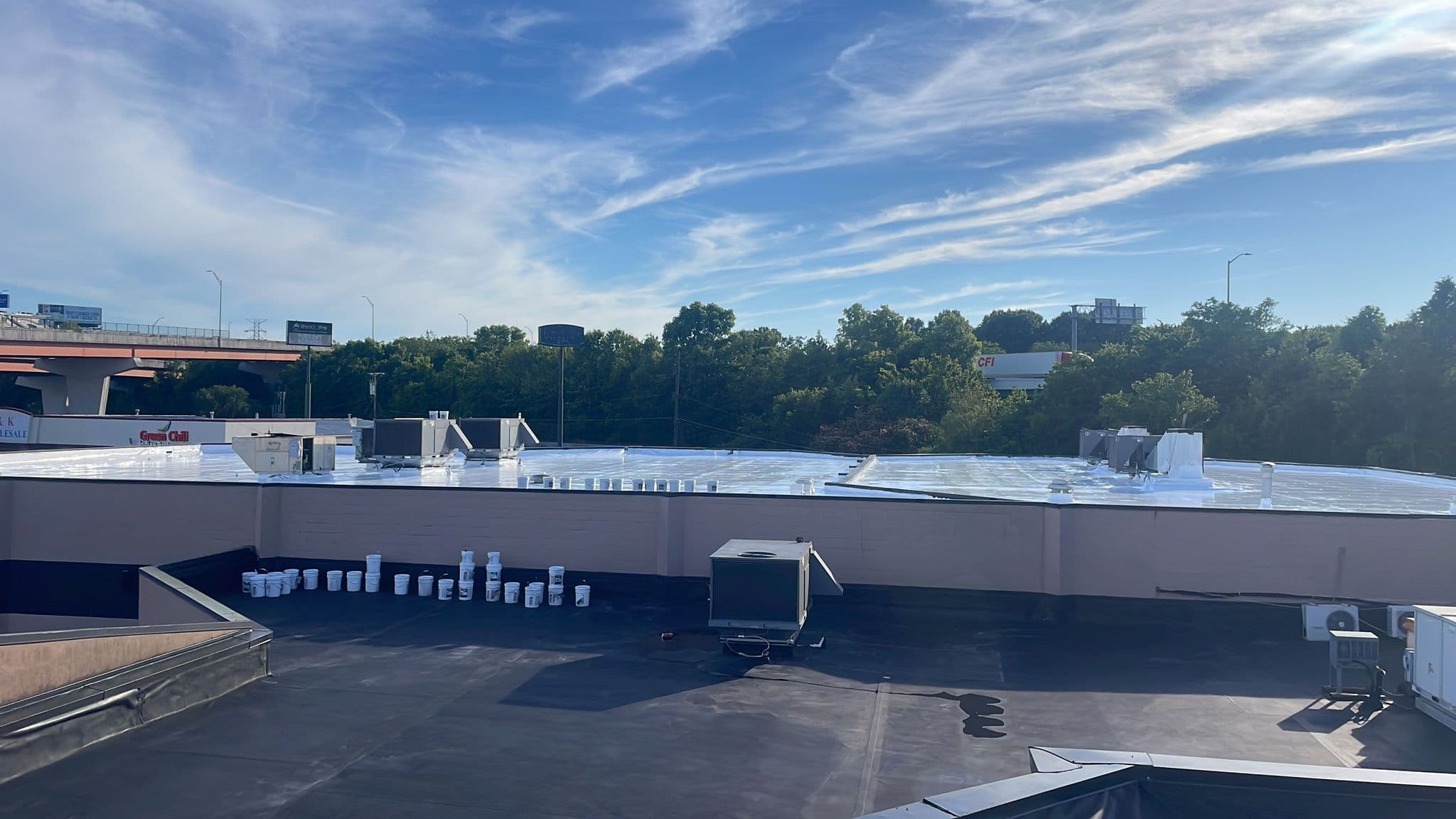
Commercial roof systems across Georgia's submarkets are not uniform. Metro Atlanta office parks and corporate campuses - Perimeter, Cumberland, Concourse, Ravinia - default to reinforced white TPO for its solar-reflectance-index HVAC savings and ease of wide-roll installation across sprawling flat roofs. Multifamily garden-style and mid-rise across Buford Highway, Vinings, Brookhaven, and Sandy Springs runs architectural asphalt shingle on pitched sections with TPO or EPDM on common-area breezeways and clubhouses. Retail centers and restaurant pads along Peachtree, Buford Highway, and the I-85 corridor specify PVC for chemical-and-grease tolerance near food-service tenants.
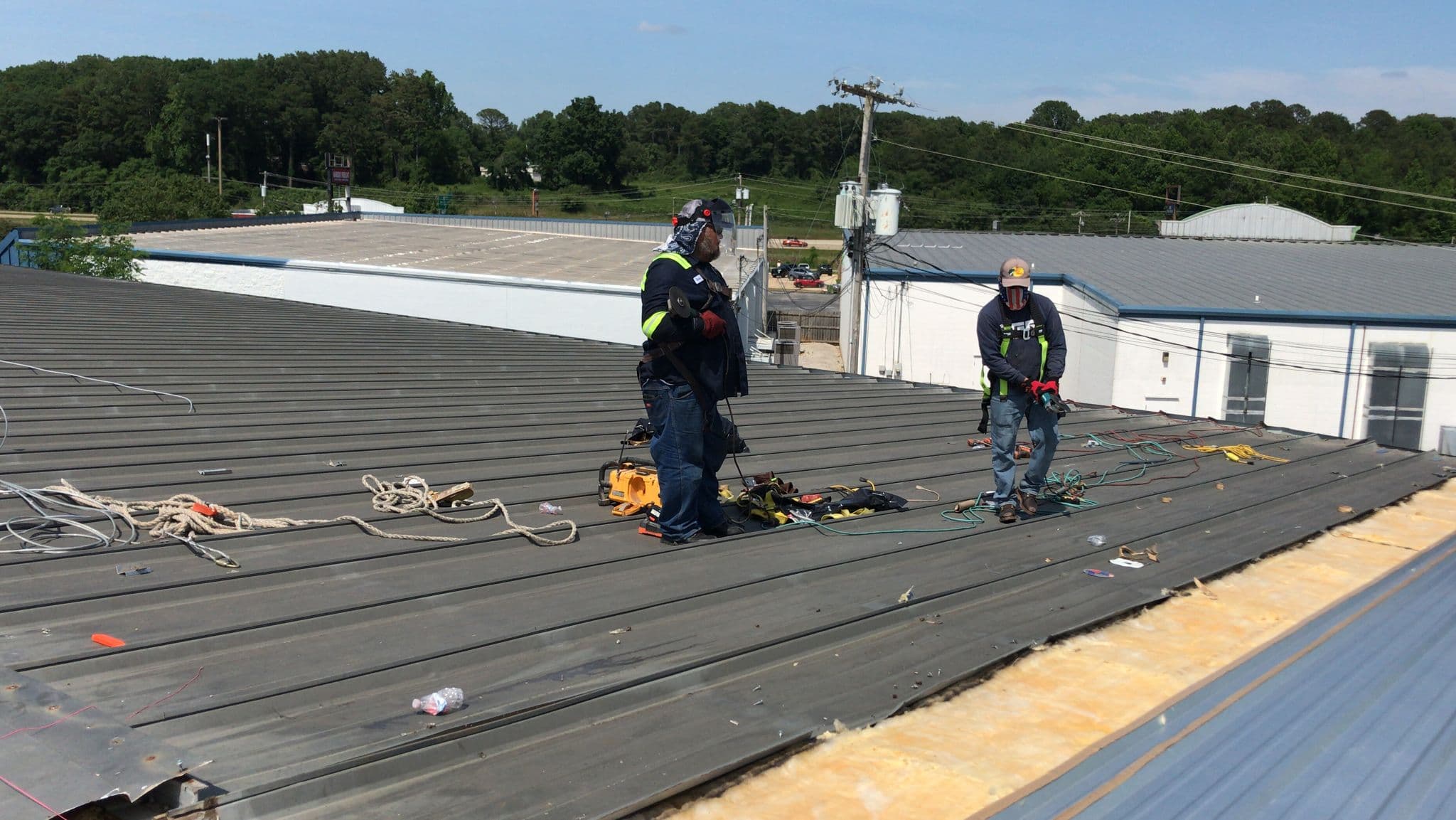
Industrial and distribution inventory along Fulton Industrial Boulevard, I-285, and I-20 West runs on wide-roll TPO, modified bitumen on older stock moving into replacement cycles, and increasingly metal standing-seam on newer builds. Savannah coastal commercial - hospitality along River Street and the historic district, tourism properties across Tybee and Hilton Head, port-adjacent industrial along the Savannah River - defaults to wind-uplift-rated reinforced TPO, PVC, or standing-seam metal with enhanced perimeter-metal detailing to meet coastal code requirements. Augusta medical-district commercial favors PVC or reinforced TPO with high-performance flashing around the dense rooftop HVAC footprint typical of medical campuses.
Columbus and Macon commercial stock spans an older mix of built-up, modified bitumen, and metal on institutional and industrial properties, with newer single-ply TPO on recent commercial builds. The state's secondary cities - Athens, Albany, Valdosta, Dalton - run on similar mixes of older legacy systems and newer single-ply replacements. Our inspections always start with identifying the existing system, estimating remaining useful life, and recommending replacement systems that fit the submarket, the climate zone, and the tenant mix rather than pushing a one-size-fits-all specification.
Portfolio-Level Commercial Roof Planning Across Georgia
Multi-property commercial and multifamily owners across Georgia benefit from a portfolio-level roof capital-planning cadence. Annual baseline inspections preserve the spring-claim documentation window, post-event inspections within weeks of any named severe-weather activity keep the supplemental claim window open, and a documented 10-year replacement-cycle projection across the portfolio aligns with standard reserve-study timelines. Red Door Roofing provides portfolio-level closeout binders, consistent documentation formatting across properties, and a single point-of-contact for multi-property asset managers.
REITs, private equity commercial real estate owners, and institutional multifamily operators across Georgia increasingly require consistent roof-documentation standards across their portfolios - photo-keyed condition reports, remaining-useful-life estimates per property, storm-event documentation anchored to NOAA/NWS records by ZIP code, and reserve-study alignment on budgeted replacement cycles. Our Georgia portfolio work delivers all of those standard artifacts without custom reconfiguration per property. The documentation is standardized, the delivery cadence is predictable, and the closeout formatting travels cleanly across portfolios.
Tenant Operations and Phased Production Across Georgia Multifamily and Commercial
Commercial roof replacement on occupied Georgia properties lives or dies on tenant and operations coordination as much as on roof craft. Multifamily garden-style properties across Atlanta, Savannah, Augusta, and Columbus run on phased per-building production schedules with tenant-notice templates distributed seven-plus days ahead of each building's turn. Mid-rise and high-rise multifamily in Midtown and Buckhead require crane-lift coordination with property management, tenant-notice distribution to commercial and residential tenants alike, and careful scheduling around event calendars.
Office parks and corporate campuses across the Perimeter, Cumberland, and North Arc allow more flexibility on laydown areas but still require careful coordination around executive-access loops, loading-dock traffic, and the after-hours windows that minimize disruption to tenant operations. Retail and hospitality properties in Atlantic Station, Cumberland (The Battery), and the I-85 airport-adjacent hotel cluster run on after-hours high-decibel work windows - decking and tear-off during shoulder hours, quieter finish work during business hours. Savannah's historic-district hospitality has the tightest operational constraints, with strict municipal compliance requirements and minimal tolerance for work that interferes with tourism patterns.
55 Georgia Cities We Cover
Pick your city below for local detail - the business corridors and multifamily districts we work in, the storm history we've tracked, the roof systems common in the area, and how the local insurance and lender climate tends to play out.
Albany, GA
Storm risk: medium · 3 landmarks
Alpharetta, GA
Storm risk: medium · 3 landmarks
Americus, GA
Storm risk: medium · 4 landmarks
Athens, GA
Storm risk: medium · 3 landmarks
Atlanta, GA
Storm risk: medium · 3 landmarks
Augusta, GA
Storm risk: medium · 3 landmarks
Braselton, GA
Storm risk: high · 4 landmarks
Brunswick, GA
Storm risk: high · 6 landmarks
Buford, GA
Storm risk: high · 4 landmarks
Calhoun, GA
Storm risk: high · 4 landmarks
Canton, GA
Storm risk: high · 4 landmarks
Carrollton, GA
Storm risk: high · 4 landmarks
Cartersville, GA
Storm risk: high · 5 landmarks
Columbus, GA
Storm risk: medium · 3 landmarks
Conyers, GA
Storm risk: high · 4 landmarks
Covington, GA
Storm risk: high · 4 landmarks
Cumming, GA
Storm risk: high · 4 landmarks
Dalton, GA
Storm risk: high · 4 landmarks
Douglasville, GA
Storm risk: medium · 3 landmarks
Duluth, GA
Storm risk: medium · 3 landmarks
Dunwoody, GA
Storm risk: medium · 3 landmarks
Fayetteville, GA
Storm risk: high · 4 landmarks
Flowery Branch, GA
Storm risk: high · 4 landmarks
Gainesville, GA
Storm risk: medium · 4 landmarks
Griffin, GA
Storm risk: high · 4 landmarks
Hinesville, GA
Storm risk: high · 4 landmarks
Johns Creek, GA
Storm risk: medium · 3 landmarks
Kennesaw, GA
Storm risk: medium · 3 landmarks
LaGrange, GA
Storm risk: medium · 4 landmarks
Lawrenceville, GA
Storm risk: medium · 3 landmarks
Macon, GA
Storm risk: medium · 3 landmarks
Marietta, GA
Storm risk: medium · 3 landmarks
McDonough, GA
Storm risk: high · 4 landmarks
Milledgeville, GA
Storm risk: medium · 4 landmarks
Moultrie, GA
Storm risk: high · 4 landmarks
Newnan, GA
Storm risk: high · 4 landmarks
Oakwood, GA
Storm risk: high · 4 landmarks
Peachtree City, GA
Storm risk: medium · 3 landmarks
Pooler, GA
Storm risk: high · 4 landmarks
Richmond Hill, GA
Storm risk: high · 4 landmarks
Rome, GA
Storm risk: high · 5 landmarks
Roswell, GA
Storm risk: medium · 3 landmarks
Sandy Springs, GA
Storm risk: medium · 3 landmarks
Savannah, GA
Storm risk: high · 3 landmarks
Smyrna, GA
Storm risk: medium · 3 landmarks
Statesboro, GA
Storm risk: high · 4 landmarks
Stockbridge, GA
Storm risk: high · 4 landmarks
Suwanee, GA
Storm risk: high · 4 landmarks
Thomasville, GA
Storm risk: high · 4 landmarks
Tifton, GA
Storm risk: high · 4 landmarks
Valdosta, GA
Storm risk: high · 4 landmarks
Warner Robins, GA
Storm risk: medium · 4 landmarks
Waycross, GA
Storm risk: high · 4 landmarks
Winder, GA
Storm risk: high · 4 landmarks
Woodstock, GA
Storm risk: medium · 3 landmarks
Quick Start
Most Georgia commercial inspections are scheduled within days. No obligation - if no damage is found, we issue a Certificate of Clearance at no cost.
Request InspectionWhy Georgia Property Owners Choose Red Door Roofing
Commercial and multifamily property owners across Georgia face a common problem: storm damage is often invisible from the ground; claim windows close faster than tenant-reported symptoms; and storm-chaser crews flood affected markets promising everything and delivering inconsistently. Red Door Roofing is built on the opposite approach - inspect first, document with photo-keyed evidence, support the claim paperwork without guaranteeing outcomes, and manage installation with tenant-in-place phasing. Our Georgiacommercial work draws on 30 years of Red Door family experience across the Southeast.
30+ years of commercial experience
Built on 30 years of Red Door family commercial and multifamily work across the Southeast. Notable clients include Best Western, Harbor Freight, Tractor Supply, and Vanderbilt Medical Clinic.
Carrier-ready documentation
Photo-keyed inspection reports formatted for Georgia-area adjuster and lender workflows. We match the documentation standards local adjusters expect post-event.
Tenant-in-place multifamily phasing
Multifamily work phased by building block with tenant- notice templates and noise-window coordination. Tenants stay in place throughout the project.
Industry certifications
NRCA member, BOMA member, and Licensed General Contractor in multiple states. Credentials the carriers and lenders know.
Georgia Commercial Roofing FAQs
Does commercial roof storm damage qualify for insurance replacement in Georgia?
What commercial roof systems are most common in Georgia?
Are Georgia commercial roof inspections no-obligation?
How quickly can Red Door Roofing respond to a Georgia post-storm inspection request?
Which Georgia cities does Red Door Roofing cover?
What counties in Georgia has Red Door Roofing served most often for commercial roof claims?
How does Georgia's building code affect commercial roof replacement scope?
Do Georgia coastal properties need different roof systems than inland commercial stock?
What does a Georgia commercial roof inspection usually cost?
How quickly can Georgia commercial property owners expect a replacement after an approved scope?
Does Red Door Roofing work with Georgia property-management software for documentation?
Need a Georgia commercial inspection?
Call us directly at 1-855-GO4REDD or request a no-obligation inspection online. Most Georgia-area inspections are scheduled within days of the request.
Request InspectionCommercial Roof Inspection in Georgia
We inspect, document, and walk you through next steps.
30+ Years of Red Door Family Experience · 16 States
Free · No obligation · No follow-up sales calls