
What Is TPO Roofing?
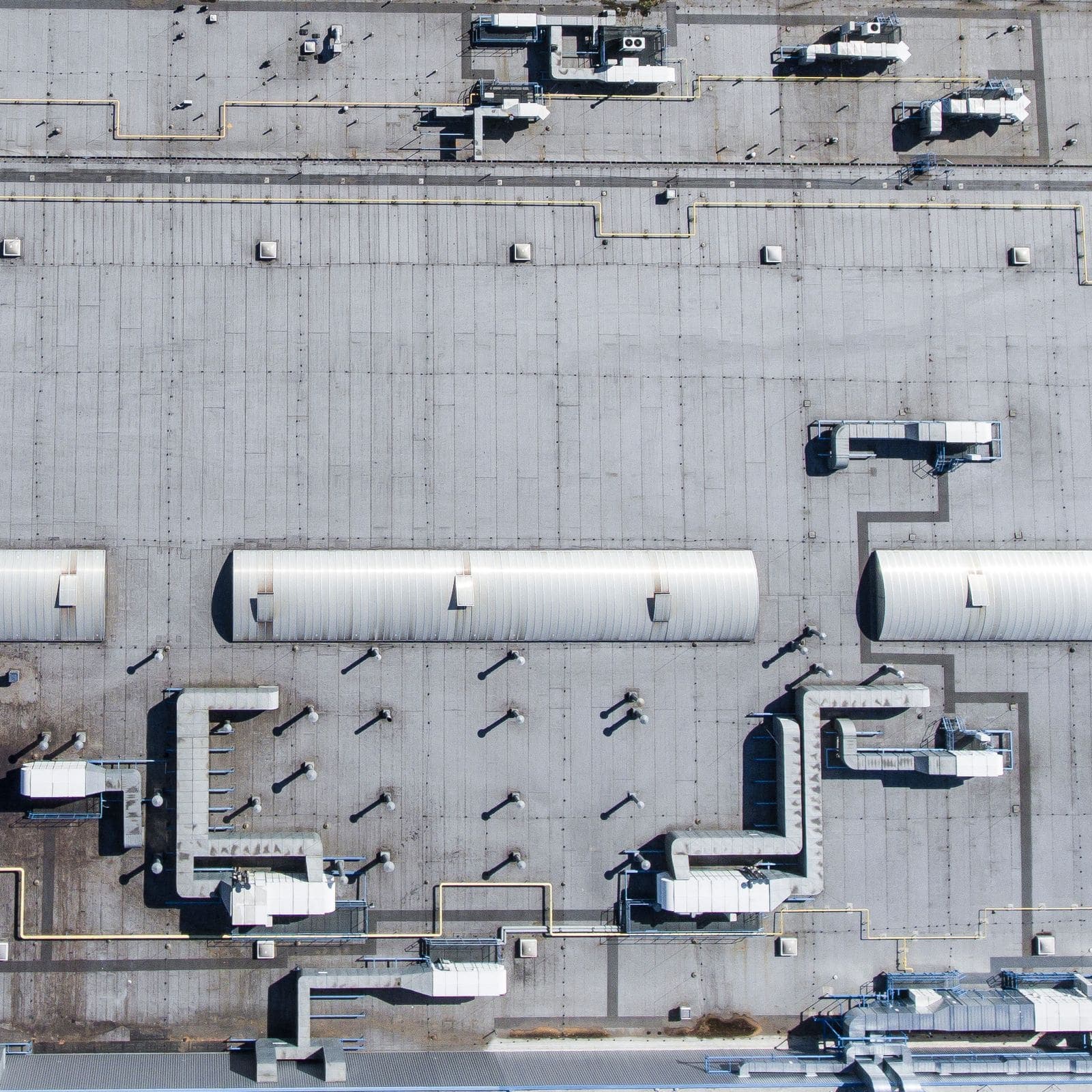
TPO - thermoplastic polyolefin - is a single-ply commercial roofing membrane manufactured from a blend of polypropylene and ethylene-propylene rubber, reinforced with a polyester scrim. It is installed in wide rolls (typically 6, 8, 10, or 12 feet), mechanically fastened or fully adhered to the insulation layer below, and heat-welded at the seams between sheets to create monolithic waterproofing. Welded TPO seams are the membrane's defining advantage: properly heat-welded seams are stronger than the membrane itself.
TPO is the dominant single-ply specification on new commercial flat-roof construction across the Southeast. Roughly half of new commercial single-ply specifications in the Atlanta metro are TPO, and similar patterns hold across Birmingham, Huntsville, Nashville, Charleston, Mobile, and Savannah. The specification leadership traces to four characteristics: cost-to-performance ratio better than EPDM or PVC on equivalent properties, high solar reflectance that reduces HVAC cooling load on sprawling office-park and multifamily roofs, installation speed across wide-roll application that compresses commercial project calendars, and broad manufacturer availability that keeps material lead times manageable across the markets where we run the most work.
How TPO Performs
Strengths:
- Heat-welded seams create monolithic waterproofing across the entire roof surface - properly welded seams remain intact for the full service life of the membrane.
- High solar reflectance (Solar Reflectance Index of 78 to 90+ on white TPO) reduces summer HVAC cooling load measurably on large commercial roofs. On a 50,000-square-foot office-park roof in metro Atlanta, the cooling-load reduction translates to documentable annual operating-expense savings.
- Reinforced thicker-mil TPO (80-mil and 90-mil) carries strong hail and wind-uplift performance - UL 2218 Class 3 and Class 4 impact ratings are available, and FM Global wind-uplift ratings are routine on quality installations.
- Installation speed across wide-roll application shortens commercial project calendars - a 100,000-square-foot warehouse roof can be replaced in days where a comparable modified-bitumen scope would take weeks.
- Broad manufacturer availability keeps material lead times manageable. Carlisle, GAF, Johns Manville, Firestone (now Holcim), Versico, and Mule-Hide all manufacture TPO with overlapping system warranties and credentialed-installer programs.
Failure modes:
- Long-term UV degradation and embrittlement - the trade-off for high initial solar reflectance is accelerated surface chemistry change. UV exposure progressively breaks down the membrane's surface, eventually reaching the reinforcement scrim. Higher-mil TPO and TPO with enhanced UV stabilization extend the timeline.
- Puncture vulnerability near rooftop mechanical traffic - HVAC service, telecommunications work, solar-array maintenance, and window-cleaning anchors can puncture thinner-mil TPO. Walking pads at high-traffic zones are a low-cost mitigation.
- Seam integrity loss when installation quality is poor - amateur installations with cold-welded or improperly-temperatured seams fail early. Manufacturer-credentialed installation matters; the difference between a good TPO installer and a marginal one shows up at the seven-to-ten-year mark.
TPO Mil Thickness - 45-Mil, 60-Mil, 80-Mil, 90-Mil
Mil thickness measures membrane thickness in thousandths of an inch. The four common TPO specifications:
- 45-mil: Entry specification. Acceptable on lower-exposure commercial properties with shorter expected service life. Lower upfront cost, shorter manufacturer warranty terms (typically 15 years), and reduced puncture and hail performance compared to thicker mils. Used most often on storage, light-industrial, and short-hold commercial assets.
- 60-mil: Volume default for most commercial replacement work. A balance of cost, durability, and warranty options (typically 20-year material warranty available). Used across the bulk of office, multifamily, retail, and standard industrial commercial.
- 80-mil: Reinforced thicker-mil specification used where puncture resistance, hail performance, or extended warranty terms are the priority. 25-year material warranty options. Common on Class-A commercial, multifamily with rooftop pool decks, and properties with high rooftop mechanical traffic.
- 90-mil: Premium specification for the longest service life and highest hail/puncture performance. Common on long-hold institutional commercial, hospitality, and high-value Gulf Coast properties where wind-uplift requirements are stringent.
The lifecycle calculation usually favors thicker specifications on long-hold commercial assets. The cost difference between 60-mil and 80-mil is typically less than 10 percent of installed cost; the service-life difference is meaningful. Short-hold commercial - properties expected to be sold or repositioned within 10 years - is often where 45-mil or 60-mil makes economic sense.
TPO Roofing Installation
TPO commercial installation uses three main attachment methods, each with a specific use case:
Mechanically Fastened
Screws and barbed plates secure the membrane through the insulation into the deck along the roll edges; subsequent rolls overlap and heat-weld at the seams. Mechanically fastened TPO is the fastest and lowest-cost installation, used on the volume of commercial replacement work. Wind-uplift ratings depend on fastener spacing, fastener type, and deck substrate.
Fully Adhered
Adhesive bonds the membrane directly to the insulation across the entire roof surface. Fully adhered TPO produces a smoother finished surface (no fastener-pattern stippling), improved wind-uplift performance, and better long-term seam integrity. Used on Class-A commercial, premium multifamily, properties with high aesthetic requirements, and Gulf Coast specifications where enhanced wind-uplift is required.
Ballasted
Stone ballast holds an unfastened membrane in place. Older specification, less common on new commercial. Used primarily on existing-roof recover scopes where the underlying assembly cannot accept additional fasteners.
Seam-Welding Quality
The seam-welding step is where installer quality shows up. Heat-welded TPO seams require correct hot-air temperature, dwell time, and pressure. Improperly welded seams may pass initial inspection but fail at the seven-to-ten-year mark - typically the most expensive failure mode to remediate on TPO. Manufacturer-credentialed installers carry training and quality-control protocols specifically targeting seam-weld quality.
Detail Work - Penetrations, Curbs, Flashings
Membrane field installation is the easy part of a TPO project. The hard part is detail work - pipe boots, HVAC curbs, drain bowls, parapet flashings, and perimeter terminations. Detail-work quality determines whether the roof leaks at year three or year fifteen. Our installation scope on TPO commercial replacement always specifies detail components from the same manufacturer as the membrane to maintain warranty integrity.
TPO Roofing Cost
Installed TPO commercial pricing across the markets where we work most (Georgia, Alabama, South Carolina, Tennessee) runs roughly $8 to $14 per square foot on straightforward tear-off-and-replace scopes. Higher on properties with:
- Extensive insulation upgrades to meet current ASHRAE 90.1 R-value minimums
- Code-triggered tapered-insulation modifications to correct ponding-water drainage
- Complex perimeter detail (decorative parapets, multi-level transitions, dense rooftop mechanical)
- Multifamily phasing where work happens building-by-building with tenant-in-place coordination
- Gulf Coast wind-uplift specifications requiring enhanced fastening patterns
Cost drivers in roughly-decreasing order of impact: mil thickness (45-mil to 90-mil), insulation R-value (jumping from R-20 to R-30 adds material cost), attachment method (fully adhered costs more than mechanically fastened), tapered-insulation requirements (tapered polyiso to fix drainage adds 15 to 25 percent on properties with ponding), perimeter detail complexity, and local labor norms.
For property owners with documented storm damage, our inspection process documents the existing system and current condition for carrier review. Insurance-supported replacement scopes commonly cover code-upgrade triggers under Ordinance and Law coverage where the policy includes that endorsement. Out-of-pocket cost on insurance-supported replacement is often limited to the deductible - see our insurance claim support service for the documentation framework.
TPO Lifespan
TPO lifespans typically run 15 to 30 years per NRCA guidance, with the actual number driven by:
- Membrane thickness: 45-mil at the lower end, 80-mil and 90-mil at the upper end.
- Climate exposure: High-UV Southeast markets pull lifespans toward the lower end of the range. Moderate climates with less UV and less thermal cycling extend the service life.
- Installation quality: Manufacturer-credentialed installation with proper seam welding and detail work routinely reaches the upper end. Marginal installation fails early.
- Maintenance discipline: Documented annual inspections, prompt puncture repair, drainage clearing, and seam-integrity checks extend lifespan and preserve manufacturer warranty coverage.
- Rooftop activity: Properties with frequent HVAC service, telecommunications work, or rooftop solar maintenance experience more puncture damage. Walking pads and properly-routed service paths mitigate.
The historical baseline expectation - TPO lasts 20 years - was set on early-generation TPO formulations with thinner mils. Modern reinforced 80-mil and 90-mil TPO from credentialed installers routinely exceeds the historical expectation. The 15-year warranty product is no longer the de-facto standard; 20- and 25-year warranties are common.
TPO vs EPDM vs PVC
Three single-ply commercial flat-roof systems compete on the volume of new and replacement commercial work. Each has a specific sweet spot:
- TPO - Volume default for new commercial. Best cost-to-performance ratio. White membrane reduces HVAC cooling load on large roofs. Heat-welded seams. Strong on office, retail, multifamily, warehouse, and standard industrial.
- EPDM - Hail-performance leader because of rubber-membrane impact absorption. Long field-verified track record. Better choice on high-hail metro markets (north Alabama, central Alabama, north Georgia) where hail exposure dominates the specification conversation. See flat-roof systems comparison for the EPDM detail.
- PVC - Required specification near food-service tenants, restaurant pads, industrial chemical exhaust, and grease-laden rooftops. PVC tolerates chemical and grease exposure that ages TPO prematurely. More expensive than TPO on equivalent properties.
The decision framework that consistently produces good outcomes:
- Chemical, grease, or food-service exposure? PVC.
- Hail exposure dominates the specification? EPDM, or UL 2218 Class 4 reinforced TPO.
- Cooling-load operating expense is a concern? White reinforced TPO.
- Wind-uplift rating is the code-driving concern? Fully-adhered reinforced TPO or PVC with enhanced perimeter detail.
- Standard commercial, low exposure, budget-driven? TPO is typically the right choice.
For long-form reading on the three-way comparison, see our TPO vs EPDM vs PVC decision guide.
When TPO Is the Right Choice
The properties where TPO is consistently the right specification across our Georgia, Alabama, South Carolina, and Tennessee commercial work:
- Class-A and Class-B office parks - Perimeter (Sandy Springs), Cumberland (Cobb County), and the North Arc (Alpharetta, Roswell, Johns Creek, Duluth) in metro Atlanta; U.S. 280 corridor in Birmingham; Cummings Research Park in Huntsville; downtown commercial in Charleston, Columbia, and Greenville.
- Mid-rise and high-rise multifamily - Midtown, Buckhead, and Atlantic Station in Atlanta; downtown Birmingham; downtown Nashville; Charleston peninsula. White reinforced TPO over tapered polyiso insulation is the near-default on this property type.
- Industrial and distribution - Fulton Industrial Boulevard, I-285 distribution corridor in Atlanta; I-459 in Birmingham; Mobile port-adjacent industrial; I-26 corridor in South Carolina. Wide-roll TPO installation speed dominates the project economics on massive square footages.
- Standard retail centers - Without food-service tenants, TPO is the default. Mixed-tenant centers with restaurants typically split the spec - TPO across the standard retail, PVC over the food-service sections.
- Self-storage and light-industrial - Cost-driven specifications where 60-mil TPO with mechanically-fastened installation is the volume default.
- Class-A medical and institutional commercial - TPO with high-performance flashing around dense rooftop HVAC footprints. Emory, UAB, Vanderbilt, MUSC, and similar institutional campuses commonly specify TPO on new commercial.
Climate-Zone Considerations Across Georgia, Alabama, South Carolina, and Tennessee
ASHRAE 90.1 climate zones drive insulation minimums on commercial replacements:
- Zone 2A (south Alabama Gulf Coast: Mobile, Baldwin; coastal Georgia: Savannah, Brunswick, Tybee; coastal South Carolina: Charleston, Hilton Head, Beaufort): Current R-value minimums plus named-storm wind-uplift requirements. Reinforced fully-adhered TPO with enhanced perimeter detail and hurricane-rated fastening is the typical specification.
- Zone 3A (most of Georgia: Atlanta metro, Augusta, Macon, Columbus, Albany; central Alabama: Birmingham, Montgomery, Tuscaloosa, Auburn; central South Carolina: Columbia, Greenville, Spartanburg; west Tennessee: Memphis, Jackson): Typical R-25 continuous-insulation minimums on commercial replacements. Standard reinforced TPO specifications with mechanically-fastened or fully-adhered installation depending on building type.
- Zone 4A (north Alabama higher elevations: parts of Madison, Jackson, DeKalb counties; north Georgia: Dalton; middle and east Tennessee: Nashville, Knoxville, Chattanooga, Johnson City): Higher R-values (R-30+) on commercial replacements. Climate-adapted TPO with attention to thermal cycling.
TPO Roofing in the Southeast - Storm Season and Insurance Implications
The Southeast severe-weather pattern produces predictable insurance-claim windows that shape commercial TPO replacement work:
- Spring severe weather (March through May): Hail and tornado activity across the metro Atlanta corridor, north Alabama (Huntsville, Madison County), central Alabama (Birmingham, Tuscaloosa), and the Tennessee Valley. TPO commercial roofs in this corridor experience hail bruising, fractured-reinforcement damage at impact points, and occasional puncture. Reinforced 80-mil and 90-mil TPO with UL 2218 Class 3 or Class 4 impact ratings is the appropriate specification on new construction in this corridor.
- Late summer and fall tropical activity (July through October): Tropical-storm and hurricane remnants reach Mobile, Baldwin County, the Florida Panhandle border counties, the Georgia coast (Savannah, Brunswick), and the South Carolina coast (Charleston, Hilton Head, Myrtle Beach). Wind-uplift seam failure is the dominant TPO failure mode in named-storm events. Fully-adhered installation with enhanced perimeter detail is the appropriate Gulf Coast and Atlantic-coast specification.
- Winter ice events (December through February): North Tennessee and north Georgia experience occasional ice loading that stresses parapet flashings and drain bowls. Drainage discipline matters; clogged drains in ice events are a leading cause of interior water intrusion on commercial flat roofs.
For property owners with documented storm damage on commercial TPO roofs, our storm damage service describes the inspection-and-documentation framework. The carrier scope conversation goes faster on commercial TPO when the inspection report is photo-keyed by slope orientation and aligned with the format Southeast adjusters routinely request - which is the format we deliver on every inspection.
What's Next
If you own or manage a commercial or multifamily property with a TPO roof - or if you are evaluating TPO for a planned replacement - the next step is identifying what you have today, what condition it is in, and what your realistic options are. Three paths from here:
- Read "What Is TPO Roofing?" - the answer-first commercial-owner explainer covering composition, manufacture, installation methods, mil thicknesses, history, and the TPO vs EPDM vs PVC framework.
- Identify your current roof system - five-question quiz that narrows your existing system to the most likely candidate.
- Estimate replacement cost - high-level budget bracket for planning purposes (your final number comes from the inspection-and-proposal process, not a calculator).
- Request an inspection - no-obligation commercial TPO inspection. We deliver a photo-keyed report formatted for your asset-management workflow. If there is no qualifying damage, we issue a Certificate of Clearance suitable for lender, insurer, or asset-manager records.
For the adjacent service conversations, see our commercial roof replacement service, roof inspection service, storm damage service, insurance claim support service, and commercial roof coatings & restoration service. For market-specific TPO context, see our Atlanta commercial roofing, Birmingham commercial roofing, Huntsville commercial roofing, Charleston commercial roofing, and Nashville commercial roofing pages.
Not sure if this material is on your building?
Use our Roof Type Identifier to narrow it down, then request a no-obligation inspection for definitive identification.
Frequently Asked Questions
What is TPO roofing?
How long does a TPO roof last?
What is the difference between 45-mil, 60-mil, 80-mil, and 90-mil TPO?
How much does TPO roofing cost per square foot?
Is TPO better than EPDM for commercial roofs?
Is TPO better than PVC?
How is TPO installed?
Does TPO roofing handle hail damage?
Can TPO be installed over an existing roof?
What maintenance does a TPO roof require?
Does TPO commercial roof storm damage qualify for insurance replacement?
What is the warranty on a TPO commercial roof?
Thinking about TPO Roofing - Commercial Single-Ply Membrane Guide for your property? We inspect and document your current system - no-obligation, with a photo-keyed report for lender, carrier, or asset-manager review.
Request Inspection