
Short answer: A commercial roof maintenance program is a documented recurring service agreement - typically annual or semi-annual - that combines photo-keyed inspection, drainage and detail-work cleaning, minor repair labor, and written condition reporting to extend roof useful life and preserve manufacturer warranty coverage on commercial and multifamily properties.
The Economic Case for Commercial Roof Maintenance
Commercial roof maintenance pays for itself through three independent mechanisms - any one of which justifies the program economics on a commercial property of meaningful size. Together, the three mechanisms produce a typical 3-to-5-year payback on properties between 25,000 and 250,000 square feet.
Mechanism one: early failure detection. A seam separation caught at a maintenance visit costs labor-hours and a tube of manufacturer-approved sealant. The same seam separation discovered six months later - after winter freeze-thaw cycles have driven water into the insulation, after spring rains have saturated the deck, after the tenant below has documented water intrusion - costs replacement of wet insulation, deck remediation, interior repair coordination, and tenant-relations recovery. The cost ratio between the two scenarios is typically 5-to-1 or 10-to-1 in favor of early detection.
Mechanism two: extended useful life. A 60-mil TPO commercial roof installed by credentialed installers carries a 20-year manufacturer warranty. Under reactive-only maintenance - no scheduled inspections, no preventative work - the membrane often reaches the end of useful life at or before the warranty term, then gets replaced. Under an active maintenance program with documented annual inspections, drainage clearing, and prompt detail-work attention, the same membrane routinely exceeds the warranty term by 5 to 10 years. Deferring the next capital replacement event by a decade has obvious portfolio cap-ex implications for asset managers.
Mechanism three: preserved warranty coverage. Most commercial single-ply manufacturers (TPO, EPDM, PVC) require documented annual inspections by a credentialed contractor to keep the system warranty in force. Lapsed inspection documentation gives the manufacturer grounds to deny warranty claims regardless of the membrane's actual condition. A single denied warranty claim on a meaningful commercial property typically costs more than a decade of maintenance program fees. The arithmetic on this one is straightforward.
What a Commercial Roof Maintenance Visit Includes
Every scheduled maintenance visit follows the same checklist regardless of roof system or property type. The checklist scales with the property - larger commercial roofs take longer and document more findings - but the categories remain constant.
Drainage System
Drainage failure is the leading root cause of commercial flat-roof problems. Every maintenance visit clears drains, scuppers, gutters, downspouts, and overflow scuppers; tests drain flow under hose pressure; documents drain-flashing condition; and replaces drain screens where they have been removed or damaged. Drainage failures discovered before the next severe-weather event prevent the interior-damage cascade that makes drain-related leaks expensive.
Seam and Detail-Work Examination
Heat-welded seams on TPO and PVC, adhesive seams on EPDM, and lap seams on modified bitumen all have specific failure modes that show up at maintenance inspection: tenting, fish-mouthing, lifting, gap formation, sealant degradation. Visual examination by slope identifies high-risk seam areas; tactile inspection on suspect zones validates the visual findings. Findings get documented for action at the current visit (if within scope) or scoped for separate proposal (if beyond maintenance allotment).
Flashing and Penetration Checks
Parapet caps, HVAC curbs, pitch pans, expansion joints, skylight perimeters, vent stacks, communications-equipment penetrations, and rooftop-solar attachment details all carry distinct failure patterns. Maintenance inspection covers each: oxidation on metal flashings, gasket degradation on penetration boots, sealant failure at lap joints, fastener back-out at curb attachments. Detail-work failures are the leading cause of leaks that show up far from the obvious failure point - water travels along the underside of the membrane before manifesting at an interior location often dozens of feet from the actual entry.
Fastener and Mechanical Attachment
Mechanically-fastened single-ply systems develop fastener back-out over time - screws and plates pushing up under the membrane, creating tenting and puncture-risk points. Maintenance visits identify backed-out fasteners by visual scan and replace or re-seat them within the program allotment. On systems under active manufacturer warranty, replacement fasteners match the original specification exactly to preserve warranty integrity.
Debris Removal and Surface Cleaning
Leaves, branches, dropped tools, abandoned equipment, packaging material, and construction debris from previous work all accumulate on commercial roofs and create localized problems: drainage blockage, biological-growth substrate, foot-traffic puncture risk. Maintenance visits remove debris and document anything unusual that warrants attention.
Photo Documentation by Slope Orientation
Every finding gets photo-documented by slope orientation, with reference to a roof plan or building diagram. Photo discipline matters because the maintenance report is a working document for asset management - finding-to-photo cross-reference makes the report actionable, not just informational. Photo cadence also creates the longitudinal record that supports manufacturer warranty conversations and insurance-claim documentation when storm damage occurs.
Minor Repair Labor in Scope
Maintenance allotment typically covers minor sealant renewal, fastener replacement, drain-screen reinstallation, debris-related membrane patching, and small-area touch-ups within a defined labor-hours budget per visit. Repair work that exceeds the allotment gets scoped separately with fixed-fee proposals - no surprise scope expansions.
Written Condition Report
Every visit produces a PDF condition report including findings categorized as immediate (action required), near-term (action recommended within 6 to 12 months), or monitor (action not currently required); updated remaining-useful-life estimate; before-and-after documentation of any minor repair work performed; and warranty-continuation notes for systems under manufacturer coverage.
System-Specific Maintenance Focus
TPO Maintenance
TPO maintenance focus: heat-welded seam integrity (visual scan with tactile validation on suspect zones), perimeter-termination metal condition, drain-flashing integrity at scupper and drain locations, walking-pad condition at HVAC-service zones, and surface debris from rooftop mechanical work. Reinforced 80-mil and 90-mil TPO accumulates fewer maintenance findings than 45-mil or 60-mil over equivalent service intervals. See the TPO Roofing material guide for substrate context.
EPDM Maintenance
EPDM maintenance focus: adhesive seam integrity (the primary EPDM failure point), perimeter-attachment fastener condition on mechanically-fastened systems, ballast distribution on ballasted systems, parapet-flashing adhesive condition, and any signs of membrane shrinkage at perimeter terminations. EPDM tolerates aging well when maintenance discipline is consistent - many 25-year-plus EPDM commercial roofs remain in service across metro Atlanta and Birmingham.
PVC Maintenance
PVC maintenance focus: heat-welded seam integrity (similar to TPO), plasticizer condition on older PVC (decades-old PVC can lose plasticizer flexibility - checked tactilely at maintenance visits), chemical-exposure-zone condition on food-service-adjacent commercial, and any signs of membrane embrittlement that warrant accelerated replacement planning.
Metal Roof Maintenance
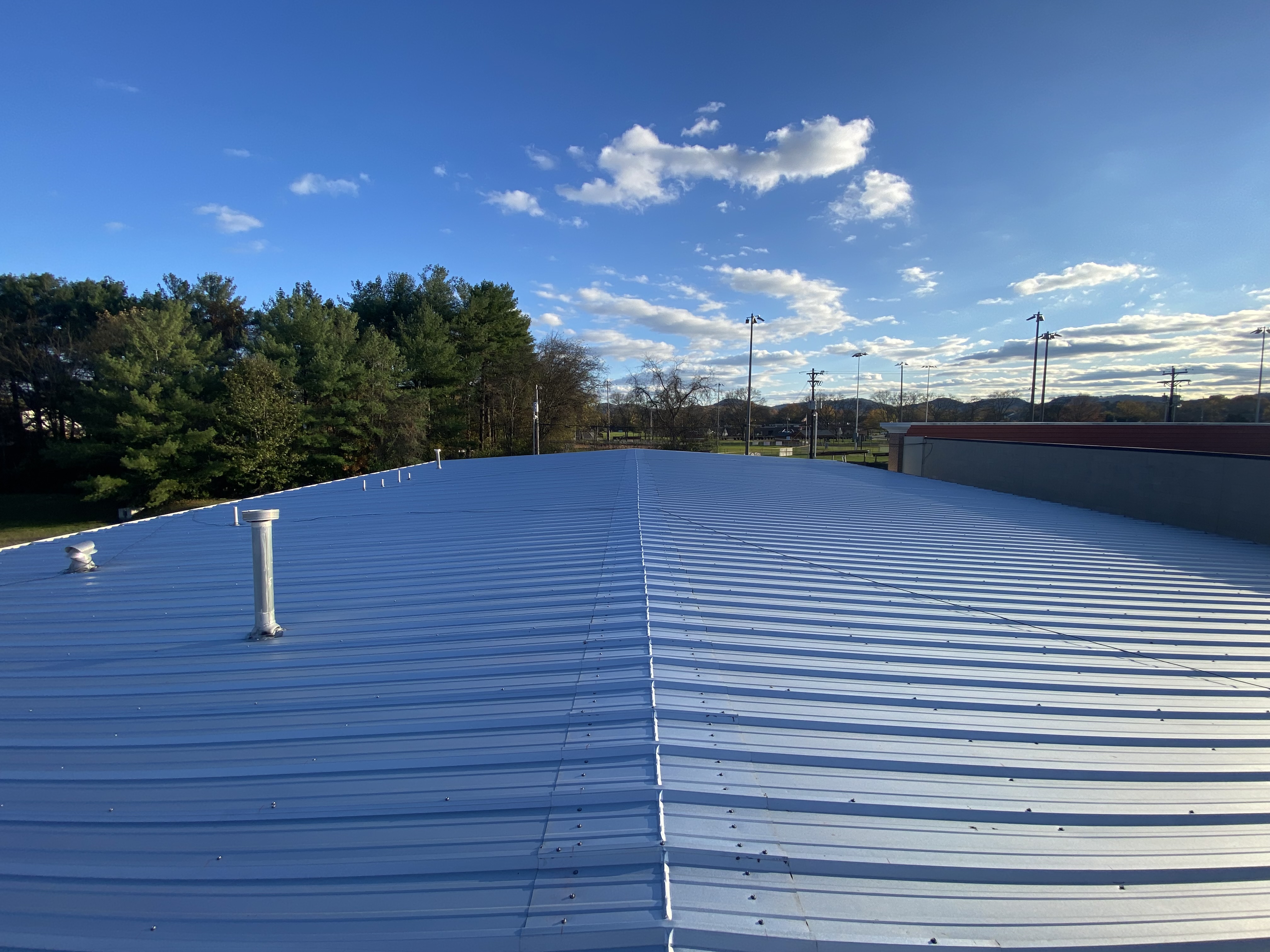
Metal maintenance focus: fastener-gasket condition on exposed-fastener systems (gaskets degrade and leak at fastener penetrations), seam-sealant condition on standing-seam systems, oxidation and finish-coating condition, snow-guard and gutter condition, and any signs of panel movement or attachment failure. See the Metal Roofing guide for substrate context.
Modified Bitumen and Built-Up Asphalt Maintenance
Modified bitumen maintenance focus: cap-sheet granule condition (granule loss accelerates UV degradation of the underlying asphalt), seam and lap condition on multi-ply assemblies, blistering or ridging from trapped moisture, parapet flashing condition, and surface coating condition where the property has previously been coated.
Maintenance Program Cadence Selection
The right cadence for your property depends on roof system, geographic exposure, asset value, and operational constraints.
- Annual visits suit: Standard commercial - office, retail, multifamily, light industrial - in moderate-exposure markets without persistent severe-weather concerns. Single visit timed for spring after severe-weather season works for most.
- Semi-annual visits suit: Gulf Coast commercial with named-storm exposure (Mobile, Baldwin County, coastal Georgia, Charleston, Hilton Head); spring-hail-corridor commercial in north Alabama, central Alabama, and metro Atlanta; commercial with rooftop solar arrays or dense rooftop mechanical; high-value institutional and Class-A commercial where early-detection economics justify two visits per year. Typical scheduling: spring post-severe-weather and fall pre-winter.
- Quarterly visits suit: Institutional commercial with operational-continuity requirements - medical campuses, manufacturing with chemical sensitivity, data-center-adjacent commercial. Quarterly cadence is uncommon and typically reserved for properties where roof failure has direct operational-cost implications beyond the roof scope itself.
Commercial Roof Maintenance Across the Southeast
Our commercial maintenance programs operate across the Georgia, Alabama, South Carolina, and Tennessee focus markets. Metro Atlanta maintenance accounts include office-park stock across Perimeter, Cumberland, and the North Arc; multifamily across Buford Highway and Vinings; medical-adjacent commercial around Emory and Piedmont; and warehouse-and-distribution along Fulton Industrial and the I-285 corridor. Birmingham maintenance accounts include U.S. 280 corridor commercial, Hoover and Vestavia multifamily, and UAB medical-adjacent commercial. Huntsville maintenance accounts include Cummings Research Park technical commercial and Redstone-adjacent housing. Mobile and Baldwin County maintenance accounts include Gulf Coast hospitality, port-adjacent industrial, and named-storm-exposure commercial. Charleston, Columbia, and Greenville maintenance accounts include downtown commercial and suburban office-park stock. Nashville, Memphis, Knoxville, and Chattanooga maintenance accounts include downtown commercial, suburban warehouse, and multifamily across the Tennessee corridor.
For the adjacent service conversations, see our commercial roof inspection service (the standalone-inspection scope that maintenance programs incorporate), commercial roof repair service (for repairs that exceed maintenance allotment), commercial roof leak repair service (for active water-intrusion emergencies between scheduled visits), commercial roof coatings & restoration service (for life-extension scopes that often follow years of maintenance discipline), commercial roof replacement service (for replacement when maintenance can no longer extend useful life), and storm damage service (for storm-event response). For material-specific maintenance context, see our TPO Roofing guide, Flat Roof Systems comparison, and Metal Roofing guide. For market-specific context, see our Atlanta commercial roofing, Birmingham commercial roofing, Huntsville commercial roofing, Charleston commercial roofing, and Nashville commercial roofing pages.
Commercial Roof Maintenance Programs Glossary
Insurance and roofing terms commonly encountered in commercial roof maintenance programs engagements. Definitions written for property owners and managers, not insurance underwriters.
- Preventative maintenance
- Scheduled inspection and minor repair work performed on a recurring cadence to prevent failures before they occur - opposite of reactive maintenance, which responds to failures after the fact.
- Manufacturer warranty inspection requirement
- Most commercial single-ply membrane manufacturers (TPO, EPDM, PVC) require documented annual inspections to keep the system warranty in force. Lapsed inspection documentation can void the warranty regardless of the membrane's actual condition.
- Remaining useful life (RUL)
- An estimate of the years of service remaining on the existing roof system based on current condition, original installation quality, climate exposure, and maintenance history. Updated at each maintenance visit.
- Reactive maintenance
- Repair work performed in response to failures, leaks, or storm damage - typically more expensive than preventative maintenance because problems caught early are cheaper to address than problems caught after interior damage.
- Maintenance allotment
- The labor and materials budget included in a maintenance program for minor repair work performed during scheduled visits without separate proposals - usually defined as a number of labor hours per visit plus materials within a specified dollar threshold.
Our 5-Step Commercial Roof Maintenance Programs Process
Every commercial roof maintenance programs engagement follows the same five-step process. The process is built around photo-keyed documentation at each stage - documented work protects the owner through claim, production, and closeout, and gives carriers, lenders, and asset managers the evidence they need without follow-up requests.
Step 1
On-Site Assessment
Photo-keyed inspection across every slope, drain, flashing, and penetration - not a cursory walk-by.
Step 2
Damage Evaluation
Qualification determination, or Certificate of Clearance if no damage. No obligation either way.
Step 3
Claims Support
Carrier coordination, adjuster documentation delivery, and scope-supplement support where warranted.
Step 4
Project Management
Phased production schedule, tenant-notice distribution, material procurement, and daily operations.
Step 5
Installation & Restoration
On-roof production with daily photo documentation, punch-list completion, and closeout records.
What Commercial Roof Maintenance Programs Documentation Looks Like
Every commercial roof maintenance programs engagement produces a photo-keyed PDF report suitable for carrier, lender, and asset-manager review. The report identifies the roof system on your property (TPO, EPDM, PVC, modified bitumen, BUR, metal, architectural shingle, or a mixed portfolio), estimates remaining useful life, flags flashing and penetration condition, and documents any observed damage with date-of-loss alignment where applicable. We also call out situations where we recommend repair rather than replacement - our business is built on honest scoping, not upselling.
On multifamily buildings we document building-by-building, which matters because a 300-unit complex may show damage concentrated on two of eight roofs. Adjusters want that granularity, and the documentation protects owners from blanket-scope claims that get pared back in review. For portfolio owners with multiple commercial properties, we deliver portfolio-level summaries that asset-management teams can file without re-formatting.
Commercial Roof Maintenance Programs Across 16 States
Red Door Roofing delivers commercial roof maintenance programs across a 16-state footprint spanning the Southeast, South, Midwest, and Gulf. Most of our crews run out of Georgia, Tennessee, Alabama, and South Carolina, where we know the local storm history and code requirements firsthand, and our coverage extends across Georgia, North Carolina, South Carolina, Alabama, Kentucky, Tennessee, Texas, Oklahoma, Louisiana, Mississippi, Florida, Arkansas, Missouri, Kansas, Iowa, Indiana. Commercial and multifamily property owners in any served state can request an inspection through our contact form or by calling 1-855-GO4REDD.
Why Property Managers Choose Red Door Roofing for Commercial Roof Maintenance Programs
Commercial and multifamily property owners face a common problem: roof damage often hides in plain sight, claim windows close faster than tenant-reported symptoms, and storm-chaser crews flood markets promising everything and delivering inconsistently. Red Door Roofing is built on the opposite approach - inspect first, document with photo-keyed evidence, support the claim paperwork without guaranteeing outcomes, and manage installation with tenant-in-place phasing. Our commercial roof maintenance programswork draws on 30 years of Red Door family experience across the Southeast, including commercial projects for Best Western, Harbor Freight, Tractor Supply, Vanderbilt Medical Clinic, Food Land, Hope Church, Impact Church, and Milan Inn and Suites.
30+ years of Red Door family experience
Built on 30 years of commercial and multifamily work across the Southeast. Commercial clients include Best Western, Harbor Freight, Tractor Supply, and Vanderbilt Medical Clinic.
Carrier-ready documentation
Photo-keyed inspection reports formatted for adjuster and lender review. We match the documentation standards carriers actually request post-event.
Tenant-in-place multifamily phasing
Multifamily work phased by building block with tenant-notice templates, noise windows, and operations-team documentation. Tenants stay in place.
No-obligation inspection
If our inspection finds no qualifying damage, we issue a Certificate of Clearance at no cost or commitment.
Industry certifications
NRCA member, BOMA member, Licensed General Contractor in multiple states.
Honest scoping
We recommend repair over replacement when the building supports it. Our business is built on credibility with property managers - not upselling.
Frequently Asked Questions
What is a commercial roof maintenance program?
How much does a commercial roof maintenance program cost?
Why do commercial roof manufacturers require annual inspections to keep warranties in force?
What does a commercial roof maintenance visit include?
How often should a commercial roof be inspected and maintained?
What is the difference between roof maintenance and roof repair?
Can I add a maintenance program to a roof we did not install?
Does a maintenance program cover storm damage repair?
What roof systems do you maintain?
Do you offer maintenance programs for multifamily properties?
How does a maintenance program save money over time?
What documentation do you provide with each maintenance visit?
Do you offer commercial roof maintenance across the Southeast?
Still have questions about commercial roof maintenance programs? Our inspections are no-obligation - if no damage is found, we issue a Certificate of Clearance at no cost.
Request InspectionRelated Services
Commercial Roof Maintenance Programs rarely exists in isolation - most commercial roof engagements touch two or three adjacent services (inspection → storm-damage → replacement, or inspection → certification, or replacement → insurance-claim-support). Here are the services most commonly paired with Commercial Roof Maintenance Programs.
Ready to start?
Call 1-855-GO4REDD or request a no-obligation inspection online. Most inspections are scheduled within days of the request.