What affects the cost of a commercial roof replacement?
The cost of a commercial roof replacement is set mainly by the size and complexity of the roof, whether the existing roof is torn off or covered over, the roof system and insulation specified, and the condition of the deck underneath. Rooftop equipment, drainage corrections, access, working around occupants, warranty level, permits, and timing account for most of the rest. Because several of these cannot be known until the roof is inspected, two buildings of the same size can receive very different prices.
This guide explains each cost driver and which way it moves the number, without dollar figures. For a planning range based on size and material, use our cost estimator. It gives an educational range, not a quote.
How do roof size and complexity affect cost?
Material and labor scale with area, so square footage is the starting point. Larger roofs usually cost less per square foot than small ones, because setup, equipment, and supervision are spread over more area.
Complexity pushes the other way. Cost per square foot rises with:
- Multiple roof levels and separate sections
- Long runs of parapet wall, which need flashing
- Irregular shapes with many corners
- Steeper slopes, which slow work and add safety measures
- A high count of penetrations and curbs
Is a recover cheaper than a tear-off?
Generally yes. In a recover, a new roof system is installed over the existing one. In a tear-off, the existing roofing is removed down to the deck first.
A recover is not always permitted or wise:
- The two-roof limit. Model building codes, the International Building Code and International Existing Building Code as adopted and amended locally, generally do not allow a recover where two roof coverings already exist. Everything must come off.
- Wet materials. A recover is generally not allowed over a roof that is water-soaked. Wet insulation has to be removed.
- Hidden problems. A recover leaves the old insulation and deck unseen. If they are damaged, the new roof inherits the problem.
A core cut during inspection shows how many roofs are present and whether the insulation is dry, which settles whether a recover is an option.
How does the roof system and membrane thickness change the price?
The system you choose affects both material and labor.
- Membrane type. Among single-ply membranes, EPDM and TPO are typically the more economical choices and PVC typically costs more. Our flat roof systems comparison and TPO roofing guide cover where each fits.
- Thickness. Single-ply membranes come in several thicknesses, measured in mils. A thicker sheet costs more and gives more material to resist wear and punctures. Longer warranties often require it.
- Attachment method. Mechanically fastened systems are usually the least expensive to install. Fully adhered systems cost more in labor and adhesive.
- Cover board. A rigid board under the membrane adds cost and improves resistance to hail and foot traffic, which is worth considering in north Georgia where hail is more common.
Why does insulation add so much?
Insulation is often the second-largest material cost after the membrane. Three things drive it:
- Energy code. When a roof is torn off and replaced, the energy code in force generally requires the new assembly to meet current insulation levels for the building's climate zone. On an older building, that can mean considerably more insulation than was there before. Georgia spans more than one climate zone, so the requirement depends on location. Your local building department confirms what applies.
- Tapered insulation. If the roof holds water, sloped insulation can be designed to move it to the drains. It costs more than flat board.
- Knock-on details. A thicker roof raises the roof surface. Curbs, flashings, edge metal, and door thresholds onto the roof may need to be raised to keep proper flashing heights.
What deck repairs might be needed?
Deck condition is the main unknown in any tear-off. Rusted steel, rotted wood, or deteriorated gypsum or concrete has to be repaired or replaced before the new roof goes on. Because the full extent is only visible once the old roof is removed, proposals commonly include an allowance or a unit price for deck replacement. Ask how deck repairs will be priced and approved before work continues.
How do penetrations and rooftop equipment add cost?
Every pipe, vent, curb, skylight, and equipment support has to be flashed by hand. That is slow, skilled work. Costs also rise when:
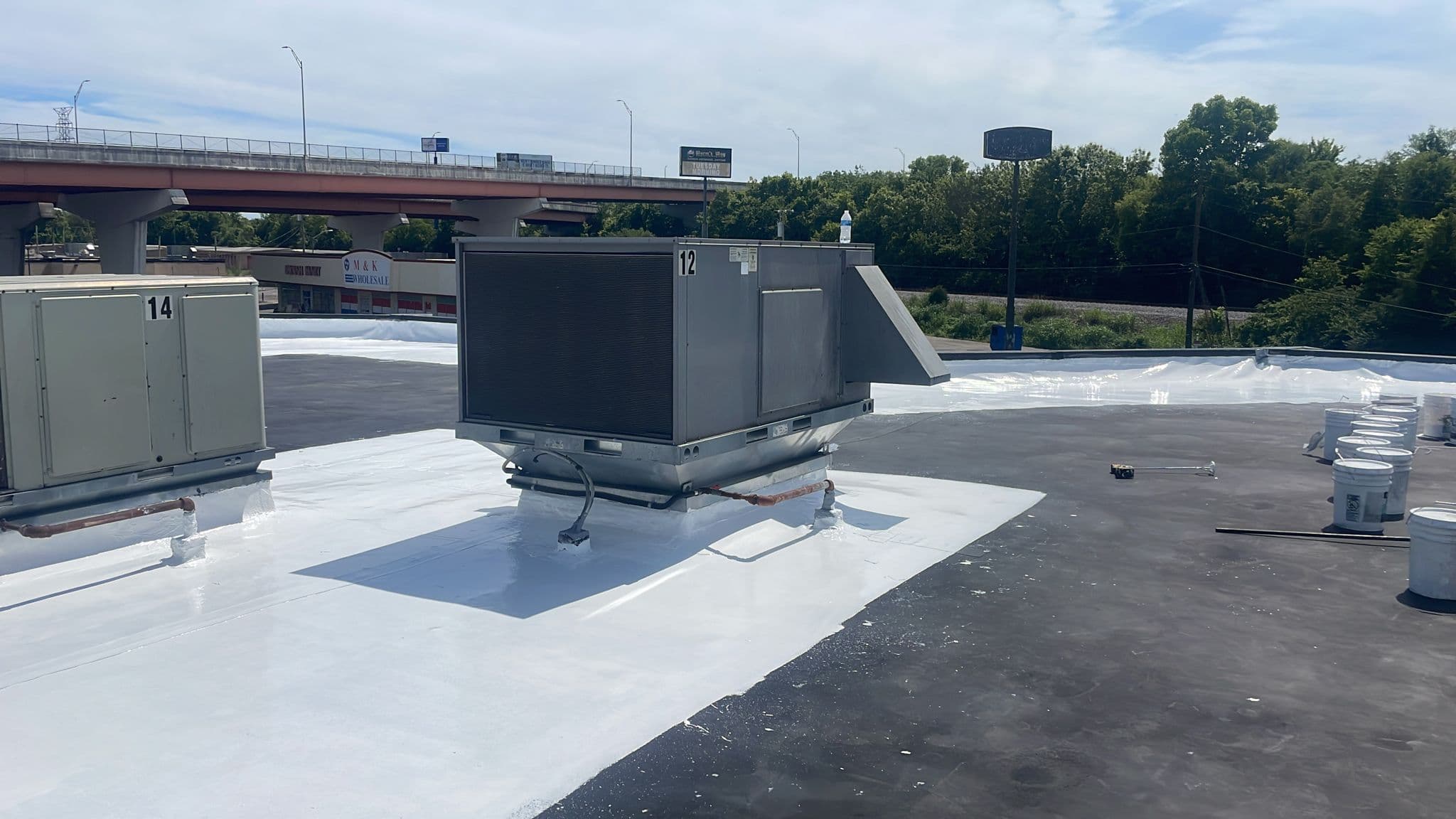
- HVAC units must be lifted or disconnected to raise or replace curbs, which can involve mechanical and electrical trades and a crane
- Abandoned equipment and curbs need to be removed and the deck infilled
- Solar arrays, satellite dishes, or lightning protection must be removed and reinstalled
When are drainage corrections part of the job?
Replacement is the practical time to fix drainage. Possible items include replacing or adding roof drains, adding overflow drains or scuppers where they are missing, resizing gutters and downspouts, and adding tapered insulation or crickets to remove ponding. Georgia's summer thunderstorms and tropical systems bring heavy rain, so working drainage matters.
How do access, height, and staging affect price?
Getting materials up and debris down is a real cost. It increases with building height, limited space for a crane, dumpsters, and material storage, tight urban sites, and long carrying distances across the roof. Fall protection and protection of landscaping, paving, and entrances are part of the price as well.
What do occupied-building constraints add?
Most commercial and multifamily roofs are replaced while the building is in use. That can require:
- Work phased in sections so each one is watertight at the end of every day
- Restricted hours to limit noise for tenants, patients, guests, or residents
- Protected walkways and entrances
- Interior protection over sensitive spaces
- Coordination with shipping, deliveries, and production schedules
These measures slow production and add labor.
How do warranty tier, permits, and season figure in?
- Warranty. A longer manufacturer warranty typically requires thicker membrane, specified details, and a manufacturer inspection, all of which add cost. Make sure every bid is priced to the same warranty.
- Permits and code items. Permit fees and inspections vary by jurisdiction. Code may also require upgrades at the time of replacement, such as edge metal that meets wind standards.
- Season and weather. Adhesives and sealants have temperature limits, rain stops work, and demand rises after major storms. Planning ahead usually gives more control over cost than replacing in a hurry.
Cost driver summary
| Cost driver | Tends to lower cost | Tends to raise cost |
|---|---|---|
| Size and layout | Large, simple, single level | Small, cut-up, multiple levels |
| Existing roof | Recover allowed, dry insulation | Tear-off, two roofs present, wet insulation |
| Membrane | Standard thickness, mechanically fastened | Thicker sheet, fully adhered, PVC |
| Insulation | Existing levels acceptable | Added R-value, tapered design |
| Deck | Sound | Rust, rot, or deterioration |
| Rooftop equipment | Few penetrations | Many units, curbs to raise, crane lifts |
| Drainage | Works as built | New drains, crickets, larger gutters |
| Access | Low building, open site | Tall building, tight site |
| Occupancy | Vacant or flexible | Restricted hours, phased work |
| Warranty | Standard term | Longer term with upgraded details |
When to call a roofer
Call when you need a number you can put in a budget, or when you have proposals in hand that differ and you cannot tell why. A firm price starts with a roof inspection that answers the open questions: how many layers, how much wet insulation, what the deck looks like, and whether a recover or a coating is possible instead of a full commercial roof replacement. If you are still deciding whether to replace at all, read repair versus replacement first.
Next step: request a no-obligation inspection and a written scope for your building. We reply within 1 business day.
Frequently Asked Questions
What is the biggest factor in commercial roof replacement cost?
Is a roof recover cheaper than a tear-off?
How many roof layers can a commercial building have?
Why did my roof quote include new insulation?
Can I get a commercial roof replacement price without an inspection?
Does a longer roof warranty cost more?
Related Guides
- ACV vs RCV Cheat Sheet for Commercial PoliciesPlain-language ACV vs RCV on commercial roof insurance - how carriers calculate depreciation, when R…
- Roof Certification vs Roof InspectionWhat insurance underwriters, lenders, and asset managers actually want from a roof certification - a…
- Commercial Roof Inspection ChecklistWhat a commercial roof inspection includes: the areas an inspector checks, moisture scans and core c…