What "Insurance Claim Support" Actually Means
Commercial roof insurance claim support, as we deliver it, is the contractor-side documentation and scope discipline that lets a carrier make a fair determination on evidence. It's not public adjusting - we don't represent the policyholder in carrier negotiations as a licensed public adjuster. It's not legal representation - claim disputes escalate to attorneys for a reason. What we do is the documentation and scope-development work that sits between the initial inspection and the final approved scope: photo-keyed evidence mapped to an overhead schematic, NOAA and NWS date-of-loss validation, priced scope against local labor and material norms, supplement filings for legitimate missed scope, and clean communication with the adjuster through the claim's lifecycle.
That distinction matters because commercial roof claims across Georgia and Alabama fail most commonly not on the damage itself but on documentation gaps and supplement-conversation breakdowns with the adjuster. Atlanta-area adjusters working an active spring severe-weather season are absorbing hundreds of commercial claim files; Birmingham and Huntsville adjusters post-2011 work under a raised documentation standard; Mobile and Gulf Coast adjusters work through named-storm deductible applications that didn't exist on commercial policies a decade ago. The contractor who shows up with clean, photo-keyed, code-referenced, date-of-loss-aligned documentation makes the adjuster's job easier. The contractor who shows up with speculative scope and weak evidence makes the adjuster's job harder - and the claim suffers.
The Georgia and Alabama Commercial Insurance Landscape
Commercial property insurance in Georgia is regulated by the Georgia Office of Insurance and Safety Fire Commissioner. The Georgia Unfair Claims Settlement Practices Act establishes statutory timelines for carriers to acknowledge, investigate, and reach liability determinations on commercial claims. Alabama commercial property insurance is regulated by the Alabama Department of Insurance. Both regulatory frameworks impose procedural requirements on carriers, and knowing those procedural floors is meaningful leverage for a property manager pursuing a timely claim resolution.
Percentage wind/hail deductibles have largely replaced flat-dollar deductibles on Georgia and Alabama commercial policies over the past decade. Typical percentages run 1 percent to 5 percent of insured value. A 2 percent wind/hail deductible on a $15 million commercial property is $300,000; a 3 percent deductible on a $5 million multifamily property is $150,000. Alabama Gulf Coast commercial policies (Mobile, Baldwin County) add a separately-applied named-storm deductible often running 2 percent to 5 percent of insured value on top of any wind/hail deductible. A 3 percent named-storm deductible on a $20 million Gulf Coast hospitality property is $600,000 - a dollar figure that property managers need to know before engaging a contractor on a named-storm claim.
Ordinance and Law coverage unlocks reimbursement for code-required upgrades a replacement scope triggers. Across Georgia and Alabama commercial properties, those upgrades typically include: continuous-insulation R-value increases to meet current ASHRAE 90.1 minimums (R-25 to R-30 on most commercial, higher in north Alabama); updated fastening patterns under current IBC and local amendments; perimeter edge-metal upgrades; fire-rated assembly requirements based on occupancy classification; and wind-uplift-rating upgrades on Gulf Coast commercial. Ordinance and Law reimbursement is often the single biggest line item adjusters miss on first-pass estimates - which is what the supplement process exists to capture.
Matching clauses under Georgia and Alabama case law and specific policy endorsements may require carriers to replace undamaged roof sections to maintain system integrity when damage is partial. Matching applies most commonly on shingle-system multifamily where discontinuing a damaged roof section with a visible patch would violate reasonable aesthetic and system-integrity expectations. Commercial single-ply claims on TPO, EPDM, and PVC involve matching conversations less often but still sometimes.
The Red Door Roofing Commercial Claim Documentation Package
Every commercial claim we support produces the same core documentation package. Adjusters across Georgia, Alabama, and our broader footprint have told us - directly and indirectly - that the package format matches what their carrier field teams request. The package contents:
Photo-Keyed Damage Mapping
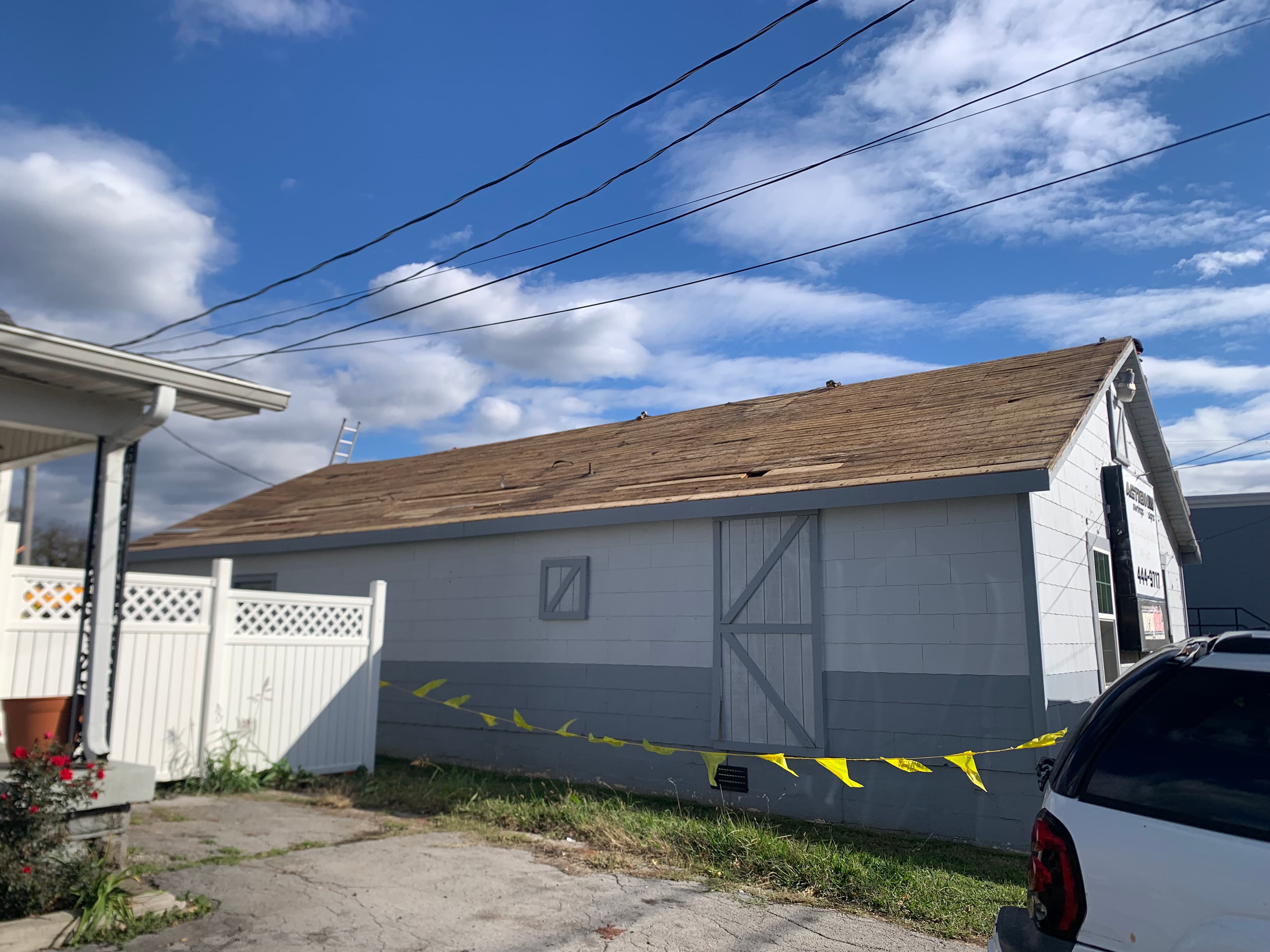
Every observed defect maps to a specific location on an overhead roof schematic. Close-up photography of the defect pairs with contextual photography that locates the defect relative to nearby roof features. For multi-building multifamily, each building gets its own mapping. Photo indexes are numbered and cross-referenced so the adjuster can verify every claimed defect against the visual evidence.
NOAA and NWS Date-of-Loss Alignment
We pull NOAA Storm Prediction Center hail reports and NWS Storm Events Database wind reports for the property's ZIP code and the approximate loss window. Alignment establishes that a specific weather event capable of producing the observed damage occurred at the right time in the right location. Carriers routinely cross-reference claims against these federal records; alignment at the claim filing stage removes a common documentation gap.
Roof-System Identification
The existing roof system gets identified - TPO, EPDM, PVC, modified bitumen, BUR, metal standing-seam, architectural asphalt shingle, or mixed portfolios - with membrane thickness, approximate age, and manufacturer where documentable. System identification feeds the remaining-useful-life analysis and the priced-scope development.
Priced Scope Against Local Labor and Material Norms
The scope gets priced using local labor and material norms, formatted to the carrier's estimating conventions (Xactimate on residential-style estimates, commercial estimating platforms on larger work). Pricing transparency is part of the documentation discipline - adjusters respond well to priced scopes they can verify against regional norms.
Code-Upgrade Documentation
Every code-triggered upgrade the replacement scope will require gets documented with a code citation. Continuous-insulation R-value under ASHRAE 90.1, perimeter metal under current IBC, fire-rated assembly under local occupancy rules, wind-uplift rating under Gulf Coast specific requirements where applicable. Code citations are the evidence Ordinance and Law coverage requires.
Repair-Versus-Replacement Recommendation
Our documentation includes an honest assessment of whether the observed damage warrants repair scope or replacement scope. We don't recommend replacement on properties with minor localized damage; we recommend replacement on properties with systemic damage that repair scope can't responsibly address. The recommendation gets justified against the observed evidence, not against sales volume.
The Supplement Process
Initial adjuster estimates on commercial roof claims almost always omit legitimate scope. The supplement process is the formal mechanism for requesting additional approved scope backed by photo evidence and code citations. Our supplement discipline follows strict rules:
- Every supplement line item ties to specific photo evidence in the original documentation package.
- Every code-upgrade line item ties to a specific code citation (ASHRAE 90.1 section, IBC section, local amendment reference).
- Every supplement gets filed promptly after the initial adjuster scope is received, not weeks later.
- We don't file speculative supplements. We don't push line items the evidence doesn't support. Adjusters remember contractors who try that - credibility is the currency of the claim process, and we protect it.
Reasonable, well-documented supplements are approved at a high rate in our Georgia and Alabama experience. The common supplement items across commercial and multifamily claims:
- Underlayment and cover-board replacement where inspection reveals condition requiring replacement
- Continuous-insulation R-value upgrades under Ordinance and Law
- Perimeter edge-metal upgrades to meet current wind-uplift standards
- Rotten deck replacement where inspection or tear-off reveals decayed substrate
- HVAC curb flashing detail where existing flashing is compromised
- Additional penetrations or drains identified during inspection
- Tapered insulation modifications to correct drainage where existing drainage is non-compliant
- Fire-rated assembly requirements where existing occupancy triggers code-upgrade
When Claims Go Sideways - Documentation as Leverage
Not every claim approves cleanly on first submission. Carriers occasionally deny outright. Initial scopes occasionally come back materially under the damage evidence. Supplement rounds occasionally produce disputes. The claim-support discipline that matters most in those scenarios is the same discipline that matters on clean claims: documented evidence formatted carrier-readily, date-of-loss alignment, code citations, and honest repair-versus-replacement positioning.
When an initial scope comes back short, we file supplements with the missed items backed by the photo evidence from the original inspection package. When a denial lands on evidence we believe the carrier didn't fully weight, we request a re-examination with additional documentation (infrared thermography supplement, second core sample, additional overhead coverage of the damage pattern). When a claim needs to escalate beyond contractor-side documentation - to a licensed public adjuster representing the policyholder, or to claim-representation counsel - we hand off the complete documentation package cleanly. Our scope is contractor-side documentation and scope discipline; attorneys and public adjusters work from that foundation when escalation is warranted.
We Never Guarantee Approval - And Here's Why That Matters
Commercial roof insurance claim outcomes depend on factors outside our control: the policy language, the carrier's adjuster assignment, the specific endorsements in force, the evidence quality at the time of loss, and the carrier's claim-handling posture. Any contractor who guarantees approval is either lying or misrepresenting what contractor-side claim support actually is.
What we commit to: thorough documentation, clear communication, honest assessment of whether observed damage warrants a claim filing, code-referenced supplement discipline, and a process that gives your carrier what they need to make the right determination on evidence rather than on gaps. Outcomes depend on the carrier. Documentation quality is what we control - and we control it rigorously.
For the adjacent service conversations, see our storm damage service, roof inspection service, commercial roof replacement service, and multifamily roofing service. For downloadable long-form reading on the commercial insurance process, see our commercial storm insurance guide, ACV vs RCV cheat sheet, and hail damage checklist. For market-specific insurance context, see our Georgia commercial roofing, Alabama commercial roofing, and Atlanta commercial roofing pages.
Commercial Insurance Claim Support Glossary
Insurance and roofing terms commonly encountered in commercial insurance claim support engagements. Definitions written for property owners and managers, not insurance underwriters.
- ACV (Actual Cash Value)
- Replacement cost minus depreciation calculated at the time of loss. Most commercial property policies pay an initial settlement at ACV - partial payment that reflects the depreciated value of the damaged roof.
- RCV (Replacement Cost Value)
- Full replacement cost paid out once work is completed and documented. The difference between ACV (initial payment) and RCV (final payment) is recoverable depreciation, released after the carrier verifies the work was completed.
- Recoverable Depreciation
- The depreciation amount initially withheld from an ACV payment that the carrier releases when the insured completes the repair or replacement and submits proof of completion.
- Named-Storm Deductible
- A separate, percentage-based deductible (typically 1%–5% of insured value) that applies only when a named tropical storm or hurricane causes the loss - applied independently of the policy's standard wind/hail deductible.
- Ordinance and Law Coverage
- An optional commercial-property endorsement that pays for code-required upgrades triggered by a covered loss - for example, requirements for additional insulation, fire-rated decking, or upgraded fasteners that the current building code mandates but the original roof did not have.
- Scope of Loss
- The itemized list of damaged components and the work required to restore them, agreed between the insured (and their contractor) and the carrier. The scope determines settlement amount.
- Supplement
- A formal request to the carrier to add scope items missed in the initial estimate - typically damage discovered during tear-off, code-required upgrades, or work the original adjuster did not include.
- Certificate of Clearance
- A signed letter Red Door Roofing issues when an inspection finds no qualifying storm damage on a commercial property. Suitable for lender, insurer, and asset-manager records to document inspection completion and current roof condition.
Our 5-Step Commercial Insurance Claim Support Process
Every commercial insurance claim support engagement follows the same five-step process. The process is built around photo-keyed documentation at each stage - documented work protects the owner through claim, production, and closeout, and gives carriers, lenders, and asset managers the evidence they need without follow-up requests.
Step 1
On-Site Assessment
Photo-keyed inspection across every slope, drain, flashing, and penetration - not a cursory walk-by.
Step 2
Damage Evaluation
Qualification determination, or Certificate of Clearance if no damage. No obligation either way.
Step 3
Claims Support
Carrier coordination, adjuster documentation delivery, and scope-supplement support where warranted.
Step 4
Project Management
Phased production schedule, tenant-notice distribution, material procurement, and daily operations.
Step 5
Installation & Restoration
On-roof production with daily photo documentation, punch-list completion, and closeout records.
What Commercial Insurance Claim Support Documentation Looks Like
Every commercial insurance claim support engagement produces a photo-keyed PDF report suitable for carrier, lender, and asset-manager review. The report identifies the roof system on your property (TPO, EPDM, PVC, modified bitumen, BUR, metal, architectural shingle, or a mixed portfolio), estimates remaining useful life, flags flashing and penetration condition, and documents any observed damage with date-of-loss alignment where applicable. We also call out situations where we recommend repair rather than replacement - our business is built on honest scoping, not upselling.
On multifamily buildings we document building-by-building, which matters because a 300-unit complex may show damage concentrated on two of eight roofs. Adjusters want that granularity, and the documentation protects owners from blanket-scope claims that get pared back in review. For portfolio owners with multiple commercial properties, we deliver portfolio-level summaries that asset-management teams can file without re-formatting.
Commercial Insurance Claim Support Across 16 States
Red Door Roofing delivers commercial insurance claim support across a 16-state footprint spanning the Southeast, South, Midwest, and Gulf. Most of our crews run out of Georgia, Tennessee, Alabama, and South Carolina, where we know the local storm history and code requirements firsthand, and our coverage extends across Georgia, North Carolina, South Carolina, Alabama, Kentucky, Tennessee, Texas, Oklahoma, Louisiana, Mississippi, Florida, Arkansas, Missouri, Kansas, Iowa, Indiana. Commercial and multifamily property owners in any served state can request an inspection through our contact form or by calling 1-855-GO4REDD.
Why Property Managers Choose Red Door Roofing for Commercial Insurance Claim Support
Commercial and multifamily property owners face a common problem: roof damage often hides in plain sight, claim windows close faster than tenant-reported symptoms, and storm-chaser crews flood markets promising everything and delivering inconsistently. Red Door Roofing is built on the opposite approach - inspect first, document with photo-keyed evidence, support the claim paperwork without guaranteeing outcomes, and manage installation with tenant-in-place phasing. Our commercial insurance claim supportwork draws on 30 years of Red Door family experience across the Southeast, including commercial projects for Best Western, Harbor Freight, Tractor Supply, Vanderbilt Medical Clinic, Food Land, Hope Church, Impact Church, and Milan Inn and Suites.
30+ years of Red Door family experience
Built on 30 years of commercial and multifamily work across the Southeast. Commercial clients include Best Western, Harbor Freight, Tractor Supply, and Vanderbilt Medical Clinic.
Carrier-ready documentation
Photo-keyed inspection reports formatted for adjuster and lender review. We match the documentation standards carriers actually request post-event.
Tenant-in-place multifamily phasing
Multifamily work phased by building block with tenant-notice templates, noise windows, and operations-team documentation. Tenants stay in place.
No-obligation inspection
If our inspection finds no qualifying damage, we issue a Certificate of Clearance at no cost or commitment.
Industry certifications
NRCA member, BOMA member, Licensed General Contractor in multiple states.
Honest scoping
We recommend repair over replacement when the building supports it. Our business is built on credibility with property managers - not upselling.
Frequently Asked Questions
Does Red Door Roofing negotiate insurance claims?
What is Ordinance and Law coverage?
How do supplements work on a commercial claim?
What do commercial claim deductibles look like in Georgia and Alabama?
What's the difference between RCV and ACV on commercial policies?
How long does a commercial claim take from filing to approval?
Can you document a claim for a storm event months ago?
Do you work with specific insurance carriers?
What if the carrier denies the claim or approves less than the full scope?
Does Red Door Roofing guarantee my claim will be approved?
What is an adjuster and why do they matter?
Do I pay you or does the insurance company pay you?
Can I file a claim without getting a roofer first?
What is a public adjuster and do I need one?
What if my landlord or tenant is the one with the insurance?
How do I know my policy covers a claim?
What does matching coverage or like kind and quality mean?
How long do I have to file a claim after a storm?
Will you meet the insurance adjuster at the property?
What do I do if my claim is denied?
Still have questions about commercial insurance claim support? Our inspections are no-obligation - if no damage is found, we issue a Certificate of Clearance at no cost.
Request InspectionRelated Services
Commercial Insurance Claim Support rarely exists in isolation - most commercial roof engagements touch two or three adjacent services (inspection → storm-damage → replacement, or inspection → certification, or replacement → insurance-claim-support). Here are the services most commonly paired with Commercial Insurance Claim Support.
Ready to start?
Call 1-855-GO4REDD or request a no-obligation inspection online. Most inspections are scheduled within days of the request.