Commercial Roofing in Atlanta, Georgia
Inspection, documentation, and insurance-supported roof replacement for commercial and multifamily properties across Atlanta.
Commercial & Multifamily Roofing Across the Atlanta-Sandy Springs-Roswell MSA
Atlanta is the Southeast's largest commercial and multifamily market, with roughly 5.9 million MSA residents spread across a corridor that stretches from Hartsfield-Jackson International Airport in the south to the Forsyth County line in the north. Our commercial roofing work in metro Atlanta spans office parks in the Perimeter, multifamily complexes along I-285, hospitality and mixed-use properties around Ponce City Market and Atlantic Station, and industrial stock across Fulton Industrial Boulevard and the I-675 corridor.
Red Door Roofing is headquartered in metro Atlanta and works directly with commercial and multifamily property owners across the city. From multifamily complexes along Buckhead and Midtown to office parks in the Perimeter and industrial roofs in South Atlanta, our team inspects, documents, and manages insurance-supported replacements so owners and asset managers can keep tenants in place, protect their assets, and hand clean documentation to their carriers. Atlanta sits in Georgia's spring (March–May) severe-weather window with a secondary late-summer peak corridor, with a recurring claim rhythm that rewards property owners who maintain a documented inspection cadence. Our Atlanta commercial roofing work tracks along the Peachtree Street (Midtown + Buckhead), I-285 Perimeter Beltway, I-75 North (Cumberland corridor) corridors, where commercial density, tenant complexity, and storm exposure concentrate. On the multifamily side we work across Midtown / Ansley Park, East Atlanta Village / Edgewood, Vinings / Cumberland, phasing by building block so tenants stay in place during production. Office and flex roofing work concentrates around Concourse Corporate Center (Sandy Springs), Technology Square (Midtown / Georgia Tech corridor), Perimeter Center (Dunwoody / Sandy Springs) and adjacent commercial inventory. Our typical Atlanta portfolio includes Multifamily complexes in Vinings, Brookhaven, and Sandy Springs; Office-park portfolios in Perimeter Center and Cumberland; Hospitality assets along Camp Creek Parkway and I-85 near the airport; Industrial stock along Fulton Industrial Boulevard. Every Atlanta commercial inspection produces a photo-keyed PDF report formatted for the way Georgia adjusters, lenders, and asset managers actually work - every slope, every drain, every penetration, every transition, documented to a building or unit reference. If our inspection finds no qualifying damage, we issue a Certificate of Clearance suitable for lender, insurer, or asset-manager files at no cost or obligation. We support the carrier scope conversation end-to-end on documented claims, and georgia commercial work operates under our red door family of companies' georgia general contractor licensure so the licensing and insurance side is handled correctly the first time. Owners benefit from annual inspections plus prompt post-event documentation on every Atlanta commercial portfolio.
Atlanta Business Parks & Office Districts We Serve
Our commercial roofing work in Atlanta concentrates around the metro's largest office parks and corporate districts. Each of these business parks contains multiple commercial and mixed-use tenants where tenant-in-place scheduling, after-hours production windows, and coordinated material staging matter as much as the roof scope itself. Commercial-grade flat roof systems and pitched multifamily assemblies are both well represented across these parks - our inspections walk every roof section, every transition, and every drain to build a complete condition document suitable for carrier, lender, and asset-manager review.
- Concourse Corporate Center (Sandy Springs)
- Technology Square (Midtown / Georgia Tech corridor)
- Perimeter Center (Dunwoody / Sandy Springs)
- Cumberland Galleria / The Battery Atlanta (Cobb)
- Ravinia Business Park (Dunwoody)
- Atlantic Station (West Midtown)
- Lake Pointe (Dunwoody)
- Fulton Industrial Boulevard corridor (West Atlanta)
- Piedmont Center (Buckhead)
- Lenox Park (Buckhead / North Atlanta)
Primary Atlanta Commercial Corridors
Atlanta's commercial and multifamily stock clusters along a handful of primary corridors. Our inspection and replacement work tracks along these corridors where commercial density, tenant complexity, and storm exposure concentrate. Routing and material staging around these corridors is part of every Atlanta project plan - peak commuter hours, event calendars, and fire-lane requirements all factor into how we schedule.
- Peachtree Street (Midtown + Buckhead)
- I-285 Perimeter Beltway
- I-75 North (Cumberland corridor)
- I-20 West (industrial belt)
- Camp Creek Parkway (airport-adjacent commercial / hotel cluster)
- Buford Highway (multifamily-heavy North Atlanta)
- Howell Mill Road (West Midtown)
Atlanta Multifamily Districts
Multifamily roof replacement demands phased scheduling so tenants stay in place. Our work across Atlanta's multifamily districts follows building-by-building production schedules with tenant-notice templates and noise-window coordination per property. Asset managers receive portfolio-level closeout documentation; property managers receive a phased Gantt-style schedule they can share with residents and operations teams; leasing teams receive advance notice for unit-turn and move-in coordination.
- Midtown / Ansley Park
- East Atlanta Village / Edgewood
- Vinings / Cumberland
- Sandy Springs multifamily belt
- Buford Highway corridor (DeKalb)
- West End / Atlantic Station
Atlanta Storm & Severe-Weather History
Atlanta sits in a recurring severe-weather corridor. NOAA SPC records show multiple reported hail and wind events each year, concentrated in March–May with a secondary late-summer peak. Metro Atlanta commercial property owners who schedule post-event inspections within weeks preserve clean carrier documentation; those who wait until interior water appears usually face compressed claim windows.
Atlanta sees recurring hail and high-wind events during spring severe-weather season and again in late summer. Damage on commercial flat roofs is often invisible from the ground - which is why we recommend post-storm inspections within a few weeks of any named event so supplemental claim windows aren't missed. Notable documented events on local record include 2008-03-14 (EF2 tornado - downtown atlanta tornado - cnn center, georgia dome damage, extensive commercial claims filed); 2011-04-27 (Severe-weather outbreak - super-outbreak affecting metro atlanta); 2017-09-11 (Tropical Storm Irma remnants - extended wind event through metro). Georgia commercial policies typically apply percentage wind/hail deductibles on insured value, and Georgia adjusters cross-reference NOAA SPC records for date-of-loss validation. Our Atlanta inspection reports align with the photo-keyed, slope-oriented format adjusters routinely request. Atlanta commercial property owners typically benefit from annual inspections plus prompt (two-to-four week) post-event documentation. Properties documented inside that window consistently move through carrier scope review faster than those waiting for interior water to appear.
Notable documented Atlanta-area events
2008-03-14 · EF2 tornado
Downtown Atlanta tornado - CNN Center, Georgia Dome damage, extensive commercial claims filed
2011-04-27 · Severe-weather outbreak
Super-outbreak affecting metro Atlanta; widespread hail and wind damage
2017-09-11 · Tropical Storm Irma remnants
Extended wind event through metro; commercial claims across roof systems and signage
2023-03-26 · Severe hail
2-inch hail reported across north Fulton and Cobb - documented commercial claims season
Insurance Process in Atlanta
Georgia commercial policies commonly use percentage wind/hail deductibles on insured value. Named-storm activity in Georgia is less frequent than Gulf Coast markets, but spring severe-weather events regularly trigger wind/hail deductible windows. Adjusters typically cross-reference NOAA SPC records for date-of-loss validation, which we align with our inspection documentation.
Atlanta commercial lenders (SunTrust/Truist, Atlantic Capital, and regional banks) routinely request Roof Condition Certifications at refinance and acquisition. Major carriers writing Atlanta commercial property (Chubb, Travelers, Liberty Mutual, and regional carriers) accept photo-keyed inspection reports as standard claim documentation.
Commercial Roof Systems Common in Atlanta
Atlanta metro commercial and multifamily stock leans heavily on TPO and EPDM for flat roofs on office parks and low-slope multifamily; architectural asphalt shingle is the dominant pitched-roof system. PVC appears on restaurant and food-service properties along the Peachtree and Buford corridors. Metal standing-seam is growing in newer suburban mixed-use and industrial builds along I-75 North and I-285.
Atlanta Landmarks & Properties We've Served Near
Our commercial and multifamily roofing work crosses paths with Atlanta's most recognizable properties and corridors. These landmarks anchor the commercial districts we work in daily - they're not just tourism references, they're the neighborhoods where property managers ask us to inspect multifamily, retail, hospitality, and office stock.
- Mercedes-Benz Stadium
- State Farm Arena
- Hartsfield-Jackson Atlanta International Airport
- Ponce City Market
- Atlantic Station
- Piedmont Park
- Georgia Aquarium
- Truist Park / The Battery (Cobb County)
- High Museum of Art
- World Congress Center
Property Types We Serve in Atlanta
- Multifamily complexes in Vinings, Brookhaven, and Sandy Springs
- Office-park portfolios in Perimeter Center and Cumberland
- Hospitality assets along Camp Creek Parkway and I-85 near the airport
- Industrial stock along Fulton Industrial Boulevard
What a Atlanta Commercial Roof Inspection Includes
Every Atlanta commercial inspection we perform produces a photo-keyed PDF report built for the way Georgia adjusters, lenders, and asset managers actually work. We walk the full roof system - every slope, every drain, every penetration, every transition - and document what we see with photos referenced to a building or unit location. No generic stock photos. No marketing filler. Just the evidence a carrier needs to make a scope determination on a real commercial property.
On multifamily buildings we document building-by-building, which matters because a 300-unit Atlanta complex may show damage concentrated on two of eight roofs. Adjusters want that level of granularity, and the documentation protects the owner from a blanket-scope claim that gets pared back in review.
The inspection report identifies your existing roof system (TPO, EPDM, PVC, modified bitumen, BUR, asphalt shingle, metal, or a mixed portfolio), estimates remaining useful life, flags flashing and penetration condition, and notes any observed damage with date-of-loss alignment where applicable. We also call out situations where we recommend repair rather than replacement - our business is not built on upselling.
Working With Atlanta Adjusters and Carriers
Most Atlanta commercial claims don't fail on the damage - they fail on documentation gaps or scope- supplement misunderstandings with the adjuster. Our inspection reports are formatted to match what Atlanta-area commercial adjusters routinely request: photo-keyed damage evidence, roof-system identification, a priced scope against local labor and material norms, and a repair-vs-replacement recommendation grounded in observed condition.
When an adjuster's initial scope misses legitimate work - underlayment, code-required upgrades, perimeter metal, additional penetrations - we submit a supplement with supporting documentation. Reasonable supplements with good evidence are typically approved. We don't submit questionable supplements, and we don't push scope that wasn't clearly warranted by what we photographed. Atlanta adjusters are experienced, and credibility is the currency we operate on.
Typical Atlanta Commercial Roof Project Timeline
A typical Atlanta commercial roof project runs 30–120 days from inspection to installation completion. Here's how that calendar breaks down on a mid-size property:
- Week 1: on-site inspection, photo-keyed report delivered to owner
- Weeks 2–3: claim filed, adjuster assigned, on-roof walk with adjuster + contractor
- Weeks 3–6: initial scope received, supplement filed for any missed work, approved scope returned
- Weeks 6–10: material procurement, tenant-notice distribution, phased production schedule built
- Weeks 10–16: on-roof production, daily photo documentation, weekly progress check-ins
- Weeks 16–17: final walk, punch-list completion, closeout documentation to lender and carrier
Multifamily properties in Atlanta with 100–300 units typically run on the longer end of that range; smaller commercial buildings close faster. Material lead times on TPO, EPDM, and PVC are the usual timeline variables. We share a phased Gantt schedule so operations, leasing, and asset-management teams can plan around the work.
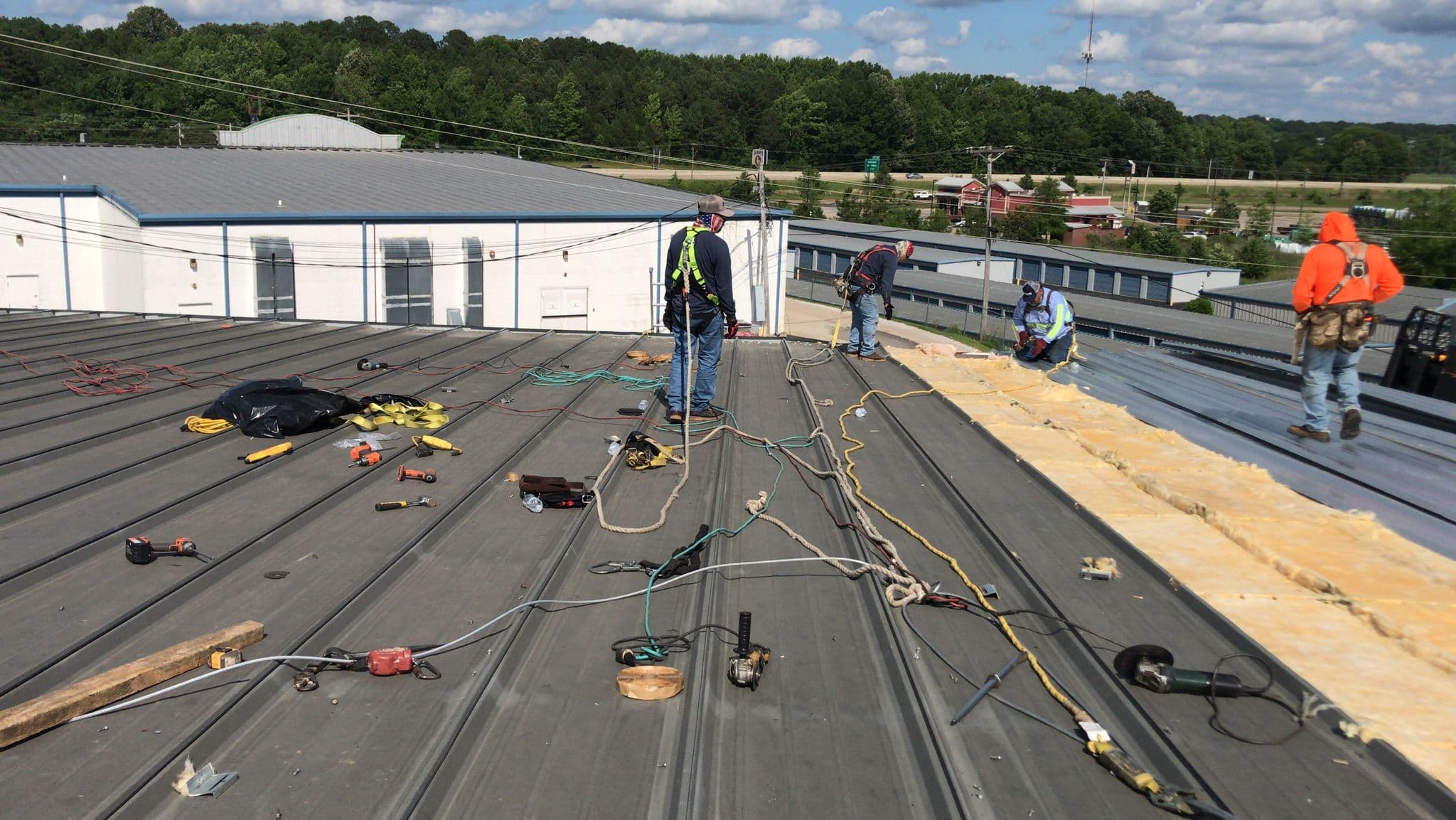
Why Atlanta's Commercial Roof Replacement Rhythm Is Unique
Atlanta sits in one of the Southeast's most active convective-storm corridors. NOAA Storm Prediction Center records show Fulton, DeKalb, Cobb, Gwinnett, and Clayton counties repeatedly logging 1-inch-plus hail during the March-through-May spring severe-weather window, with a secondary concentration in late summer. Commercial flat-roof systems - TPO, EPDM, PVC, modified bitumen, and metal standing-seam - all sustain documentable damage at those hail thresholds, but the damage is frequently invisible from the ground. That gap between event and observable interior failure is why metro Atlanta commercial property owners who build a documented post-storm inspection rhythm consistently protect their carrier supplement window, while owners who wait for tenant-reported water intrusion routinely face compressed timelines, scope disputes, and denied supplements.
Atlanta also sits on the ASHRAE Climate Zone 3A boundary - warm-humid with pronounced thermal differential between July daytime highs and clear overnight radiative cooling. That daily freeze-thaw substitute (plasticizer migration in PVC, expansion-contraction fatigue on metal, seam stress on single-ply) shortens commercial roof lifecycles on the lower end of manufacturer ranges. The commercial roofing replacement rhythm in Atlanta is therefore driven by three compounding inputs: spring and late-summer hail exposure, UV + thermal cycling, and the escalating percentage-deductible policy structures Georgia carriers have phased in over the past decade. Property managers, asset managers, and facilities directors who understand this rhythm plan CapEx replacement windows and inspection schedules around it.
- Spring severe-weather concentration: March through May - the window that triggers the majority of documented commercial hail and wind claims across the Atlanta metro.
- Secondary peak: late summer convection and tropical remnants tracking through Georgia (Irma 2017, Helene 2024 remnants).
- Climate zone 3A places Atlanta commercial properties under ASHRAE 90.1 commercial-roof insulation minimums (typical R-25 continuous insulation on replacement scope).
- Percentage wind/hail deductibles (1–5% of insured value) are standard on metro Atlanta commercial policies - which materially changes the math on whether to proceed with an insurance-supported replacement.
- Documented inspection windows of two to four weeks after any named severe-weather event materially change carrier-scope outcomes compared to delayed claim filings.
Atlanta Submarket Roofing Profile - Buckhead, Midtown, Perimeter, Cumberland, North Arc
The Atlanta commercial property footprint isn't uniform. Buckhead Class-A office and luxury retail tenants expect pristine aesthetic execution, which pushes toward white TPO or PVC with exacting parapet and perimeter-metal detail work. Midtown high-rise and mixed-use towers favor reinforced TPO with heavy-gauge membrane and elaborate flashing around the mechanical equipment density typical of 20+-story commercial stock. The Perimeter (Sandy Springs, Dunwoody, Brookhaven) hosts large corporate campuses - Concourse, Perimeter Center, Ravinia - where wide-roll TPO or EPDM over tapered polyiso insulation is the practical choice and logistics planning around surface parking, loading docks, and executive access is the real project constraint.
Cumberland-Galleria and the broader I-75 North corridor mix Class-A corporate campus with retail-adjacent hospitality (The Battery / Truist Park), where event-day operations dictate after-hours crane lifts and accelerated phased production. The North Arc - Alpharetta, Roswell, Johns Creek, Duluth, Suwanee - is the tech and flex-industrial concentration, with sprawling low-slope commercial roofs where reflective white TPO drives measurable summer HVAC savings and insurance carriers increasingly ask for documented impact-rated membrane on renewal. South Atlanta and Fulton Industrial carry the metro's heaviest industrial and distribution inventory, with older modified-bitumen and metal systems moving into replacement cycles as tenants demand LEED-aligned upgrades.
Retail-center and restaurant pad roofing along Buford Highway, Peachtree, and the I-85 corridor skews toward PVC because of the chemical and grease-exhaust tolerance those membranes offer near food-service tenants. Multifamily garden-style and mid-rise stock across Buford Highway, Vinings, Brookhaven, and Sandy Springs remains dominated by architectural asphalt shingle, with TPO or EPDM on common-area breezeways and flat-roof clubhouses. Every Atlanta submarket has a practical commercial roof-system default - and your replacement planning should start from that default rather than a one-size-fits-all conversion.
Georgia Insurance Rules of the Road for Atlanta Commercial Claims
Georgia commercial property claims operate under the Georgia Unfair Claims Settlement Practices Act, overseen by the Georgia Office of Insurance and Safety Fire Commissioner. The Act imposes statutory timelines on carriers for acknowledging, investigating, and reaching liability determinations, which matters because Atlanta's severe-weather seasons routinely overload adjuster rosters and slow down commercial-claim response - knowing the statutory timelines gives your claim a procedural floor to reference.
Commercial claims in Georgia lean heavily on photo-keyed evidence, date-of-loss meteorological alignment, and code-upgrade documentation under Ordinance and Law coverage. Metro Atlanta commercial buildings replaced under Georgia building code commonly trigger continuous-insulation upgrades (R-25 to R-30), improved fastening patterns, and code-required edge metal - legitimate scope items that adjusters frequently miss on first-pass estimates. Supplements with documented evidence are the mechanism for capturing those costs, and Georgia-area adjusters typically approve reasonable supplements when the evidence is clean. We don't file aggressive or speculative supplements; we submit photo-documented, code-referenced additions where the initial scope missed work the property legitimately needs.
Named-storm deductibles, RCV vs ACV payout structures, matching clauses, and business-interruption coverage all interact differently on Atlanta commercial policies than on residential accounts. Policy endorsement review is the foundation of any Atlanta commercial claim strategy - we walk property managers and asset managers through their declaration page in plain English so there are no surprise carve-outs during claim execution. Outcomes still depend on carrier decisions - we never guarantee approval - but a properly documented, code-referenced, photo-keyed Atlanta commercial claim gets a fair hearing.
- Georgia Unfair Claims Settlement Practices Act sets acknowledgment and investigation timelines - knowing them is procedural leverage.
- Percentage wind/hail deductibles on insured value, not flat dollar figures - a 2% deductible on a $15M property is $300,000.
- Ordinance and Law coverage unlocks legitimate code-upgrade reimbursement on Atlanta replacements.
- Commercial adjusters in Atlanta routinely cross-reference NOAA SPC hail reports and NWS storm reports for date-of-loss validation.
- Matching clauses and RCV/ACV structures vary by carrier and endorsement - reviewing the declaration page is step zero on every Atlanta commercial claim.
Atlanta Neighborhood-by-Neighborhood Commercial Roof Risk Profile
Not every Atlanta submarket experiences severe-weather exposure the same way. Our inspection and documentation rhythm shifts by neighborhood because the built environment, commercial density, and storm-track exposure all vary across the metro. Property managers with portfolios spanning multiple submarkets benefit from tracking the submarket-level risk profile when they plan annual inspection rosters and CapEx replacement budgets.
- Sandy Springs - high density of mid-rise corporate headquarters; microburst channeling through the urban canopy drives recurring wind-documented claims.
- Roswell - aging retail corridors plus affluent commercial; repeatedly in spring hail tracks along the GA-400 corridor.
- Johns Creek - office parks and healthcare campuses; complex rooftop HVAC curbs require exacting flashing detail during replacements.
- Alpharetta - tech-corridor footprint; reflective TPO drives measurable cooling-load savings on sprawling low-slope facilities.
- East Cobb - retail and institutional properties; heavy tree canopy increases drain-blockage and ponding risk.
- Tucker - high industrial and warehouse density; older metal and modified-bitumen systems moving into replacement cycles.
- Stone Mountain - aging commercial stock with intense UV and thermal-shock exposure accelerating asphalt-system failure.
- Decatur - dense historical downtown; strict municipal compliance and staging constraints on every replacement.
- Marietta - industrial mix near Dobbins ARB and retail; sits directly on historical northwest-to-southeast storm and hail tracks.
- Kennesaw - KSU-adjacent multifamily and retail; tenant-disruption management is the project constraint.
- Duluth - commercial density around Gwinnett Place; elevated straight-line-wind and hail exposure.
- Norcross - expansive industrial and distribution node; flat warehouse roofs require highly efficient tear-off sequencing.
- Buckhead - Class-A office and luxury retail; aesthetic execution and perimeter-metal precision are non-negotiable.
- Midtown - high-rise office and mixed-use; crane permitting and right-of-way coordination are the logistical constraint.
- West Midtown / Atlantic Station - creative-class office and retail over structured parking; load-calculation precision on tear-off and replacement.
The Atlanta Commercial Roof Inspection - What We Actually Deliver
Every Atlanta commercial and multifamily inspection we perform produces a photo-keyed PDF report structured for the way Georgia adjusters, lenders, and asset managers actually work. No generic stock images, no marketing filler. Every slope, every drain, every penetration, every transition is documented with photographs referenced to a building or unit location. For portfolios with multiple buildings - common across Atlanta multifamily and industrial stock - we document building-by-building so the evidence can travel with each roof through the carrier scope conversation.
Our inspection toolkit includes drone-assisted aerial documentation for rapid baseline mapping, infrared thermography at dusk to identify trapped moisture in the insulation layer, core-sample extraction to validate deck type and insulation stack, moisture-meter surveys to quantify the wet-insulation removal scope, and photo-keyed ground-level documentation tied to an overhead schematic. We also identify the existing roof system (TPO, EPDM, PVC, modified bitumen, BUR, metal standing-seam, or mixed portfolios) and estimate remaining useful life so property managers can plan CapEx replacement windows even when a replacement isn't immediately warranted.
The Atlanta commercial inspection report identifies observed damage with date-of-loss alignment where applicable, flags any code-upgrade scope that a replacement will trigger (continuous-insulation R-value, edge metal, ventilation, fire-rated assemblies where local code demands), and calls out situations where we recommend repair rather than replacement. Our business model is not built on upselling Atlanta property owners into replacements they don't need. When we find no qualifying damage, we issue a Certificate of Clearance formatted for lender, insurer, or asset-manager files - at no obligation and no cost.
Working With Atlanta Adjusters - Documentation and Supplement Discipline
Most Atlanta commercial claims don't fail because the damage isn't there - they fail because the documentation has gaps or because the supplement conversation with the adjuster goes sideways. Our inspection reports are formatted to match what Atlanta-area commercial adjusters routinely request: photo-keyed damage evidence, roof-system identification, a priced scope against local labor and material norms, and a clear repair-vs-replacement recommendation grounded in observed condition.
When an adjuster's initial scope misses legitimate work - underlayment, code-required R-value upgrades, perimeter metal, additional penetrations, rotten deck replacement, ordinance-and-law items - we submit a supplement backed by photo evidence and code citations. Reasonable, well-documented supplements get approved at a high rate in metro Atlanta because the adjuster field is experienced and evidence-responsive. We don't submit questionable scope, and we don't push line items that weren't clearly warranted by what we photographed. Atlanta adjusters remember contractors who try that - credibility is the currency our entire business operates on.
Because Atlanta sees concentrated claim volume after severe-weather events, adjuster response timelines lengthen after major storms. We plan around that: inspection and documentation within the first two-to-four weeks after a named event, claim filing with complete evidence package, polite but persistent follow-up against statutory timelines, and a coordinated on-roof walk with the adjuster once assignment is made. Property managers who follow that rhythm on Atlanta commercial properties consistently move through claim review faster than those who wait for interior water to appear before filing.
Atlanta Commercial Roof Project Logistics - Crane, Parking, Tenants
Atlanta commercial roof replacements live or die on logistics as much as on roof craft. Buckhead and Midtown staging requires direct coordination with Atlanta Department of Transportation (ATLDOT) for temporary lane closures, parking meter bagging, and right-of-way permits. Weekend or pre-dawn crane lifts are routinely the only path to staging materials on tight footprints without sideswiping office-hour traffic. Perimeter corporate campuses allow more flexibility on laydown areas but require careful scheduling around executive-access loops and loading-dock traffic.
Retail and hospitality properties in Cumberland, Atlantic Station, and the airport-adjacent I-85 hotel cluster need after-hours high-decibel work - decking and tear-off run during the shoulder hours; quieter finish work moves into business hours. Multifamily properties in Buford Highway, Vinings, and Brookhaven run on phased per-building schedules with tenant-notice templates distributed to operations and leasing teams a minimum of seven days before each building's turn. We publish a Gantt-style schedule at project kickoff so asset managers, property managers, leasing, and operations all work from the same timeline - and we revise it in real time when weather windows move.
Safety on Atlanta commercial sites follows OSHA-compliant fall-protection, debris-containment, and ground-level-pedestrian protocols. Every active Atlanta project has a documented site safety plan, a daily crew check-in, and a published point-of-contact escalation path for tenant or manager-reported issues. Atlanta property managers frequently tell us this is the single biggest differentiator from the storm-chaser contractor experience - a professional project-management layer that treats the asset, the tenant, and the manager with the same care as the roof itself.
Why Atlanta Property Owners Choose Red Door Roofing
30+ years, Red Door family
Built on 30 years of commercial experience across the Southeast. Notable clients include Best Western, Harbor Freight, Tractor Supply, and Vanderbilt Medical Clinic.
Carrier-ready documentation
Photo-keyed inspection reports formatted for Atlanta-area adjuster and lender workflows. No guarantees on claim outcomes - the carrier calls that.
Tenant-in-place phasing
Multifamily work phased by building block with tenant-notice templates, noise windows, and operations- team documentation. Tenants stay in place.
No-obligation inspection
If our Atlanta inspection finds no qualifying damage, we issue a Certificate of Clearance - suitable for lender, insurer, and asset-manager files. No further commitment.
Atlanta Commercial Roofing FAQs
Does Atlanta commercial roof storm damage qualify for insurance replacement?
Which metro Atlanta corridors do you serve most often?
How long does a commercial roof replacement take on an Atlanta multifamily property?
What commercial roof systems are most common in Atlanta?
Can Red Door Roofing work around Atlanta traffic and event schedules?
Does Red Door Roofing have experience with Atlanta insurance carriers and adjusters?
Does commercial roof storm damage qualify for insurance replacement in Atlanta?
What commercial roof systems do you see most often in Atlanta?
How long does a commercial roof replacement take in the Atlanta area?
Which Atlanta-area landmarks and corridors has Red Door worked near?
Nearby Georgia Cities We Also Serve
Our commercial roofing coverage extends across Georgia. These three Atlanta-adjacent cities are part of our routine service footprint.
Need a Atlanta inspection?
Call us directly at 1-855-GO4REDD or request a no-obligation inspection online. Most Atlanta-area inspections are scheduled within days of the request.
Request InspectionSchedule a Atlanta Roof Inspection
No obligation. Documented findings you can use for insurance, lender, or asset-manager records.
30+ Years of Red Door Family Experience · 16 States
Free · No obligation · No follow-up sales calls