Frequently Asked Questions
159+ questions from carriers, adjusters, property managers, and asset managers - aggregated across all commercial and multifamily roofing services.
Commercial Roof Coatings & Restoration
What is a commercial roof coating?
A commercial roof coating is a fluid-applied elastomeric membrane - typically silicone, acrylic, or polyurethane - that bonds to an existing commercial roof to restore waterproofing, extend useful life by 10 to 20 years, and add solar-reflectance properties. Coatings are sprayed, rolled, or squeegeed in liquid form and cure into a monolithic seamless membrane covering the entire existing roof surface, including seams and flashings that are the highest-failure-risk elements on aging commercial roofs.
How much does a commercial roof coating cost per square foot?
Installed commercial roof coating pricing across the Southeast typically runs $2 to $6 per square foot depending on coating chemistry, mil thickness, surface preparation requirements, and roof condition. Silicone systems run higher than acrylic; polyurethane higher again. Coatings cost roughly 30 to 50 percent of a comparable tear-off-and-replace scope, which is the core economic argument for restoration when the existing roof is structurally sound but the membrane is aging.
How long does a commercial roof coating last?
Manufacturer warranties on commercial coatings commonly run 10, 15, or 20 years depending on system, mil thickness, and inspection cadence. Real-world service life on properly-prepped, manufacturer-specified silicone and polyurethane systems regularly reaches the upper end of the warranty range. Acrylic systems trend toward the lower end. Recoat at the warranty interval extends the asset life indefinitely - a coated roof can effectively be maintained as a coated roof for decades.
When is a roof coating the right answer versus full replacement?
Coating is the right answer when the existing membrane is structurally sound but aging, when capital budget defers full replacement, when storm damage falls below the insurance deductible, or when the roof is approaching the end of its current warranty and you want to extend useful life before triggering replacement. Replacement is the right answer when the membrane has systemic failure, when wet insulation is widespread, when the deck is compromised, or when the roof has reached the end of useful life regardless of cosmetic condition. Honest scoping during inspection determines which path applies.
Can you coat a roof with active leaks?
No - leaks must be repaired before coating. The repair-first sequence is non-negotiable: any seam separations, flashing failures, fastener back-out, or penetration leaks get repaired and verified watertight before the coating system goes on. Coating over an active leak traps moisture in the insulation, accelerates substrate failure, and voids the coating warranty. Our coating proposals include the upfront repair scope as a separate line item.
What is the difference between silicone, acrylic, and polyurethane roof coatings?
Silicone coatings excel on flat roofs with ponding-water exposure - silicone tolerates standing water indefinitely without degradation. Acrylic coatings are the lowest-cost option with strong UV resistance, suitable for dry climates and roofs without ponding. Polyurethane coatings deliver the highest abrasion and impact resistance, used on high-traffic commercial roofs with frequent HVAC service or rooftop equipment. The right chemistry depends on your roof's specific condition and exposure profile.
Will a roof coating extend my manufacturer warranty?
It can, when the coating system is approved by the original membrane manufacturer and installed by a credentialed contractor. Many TPO, EPDM, and PVC manufacturers have approved coating systems that integrate with their warranty programs. The integration creates a documented continuation of coverage rather than a coating warranty separate from the underlying membrane warranty. We confirm manufacturer compatibility before specifying the coating system.
Does a roof coating reduce energy costs?
Yes, on white reflective coatings. White silicone, white acrylic, and white polyurethane carry Solar Reflectance Index values of 80 to 95+, comparable to white TPO. On a 50,000-square-foot commercial roof in metro Atlanta, the reflective-coating cooling-load reduction translates to documentable annual operating-expense savings - measurable on utility bills within the first cooling season after application.
Can roof coatings qualify for insurance coverage after storm damage?
Sometimes. If hail or wind damage is documented and the carrier scope includes restoration as a remediation path, a coating system can be the appropriate scope - particularly when the underlying membrane is salvageable but cosmetic and waterproofing performance is compromised. Most storm-damage carrier scopes default to full replacement, but coating can be the right path on borderline-deductible claims or when the property owner wants to defer full replacement. Our inspection documents condition for the carrier conversation.
Do you coat metal roofs?
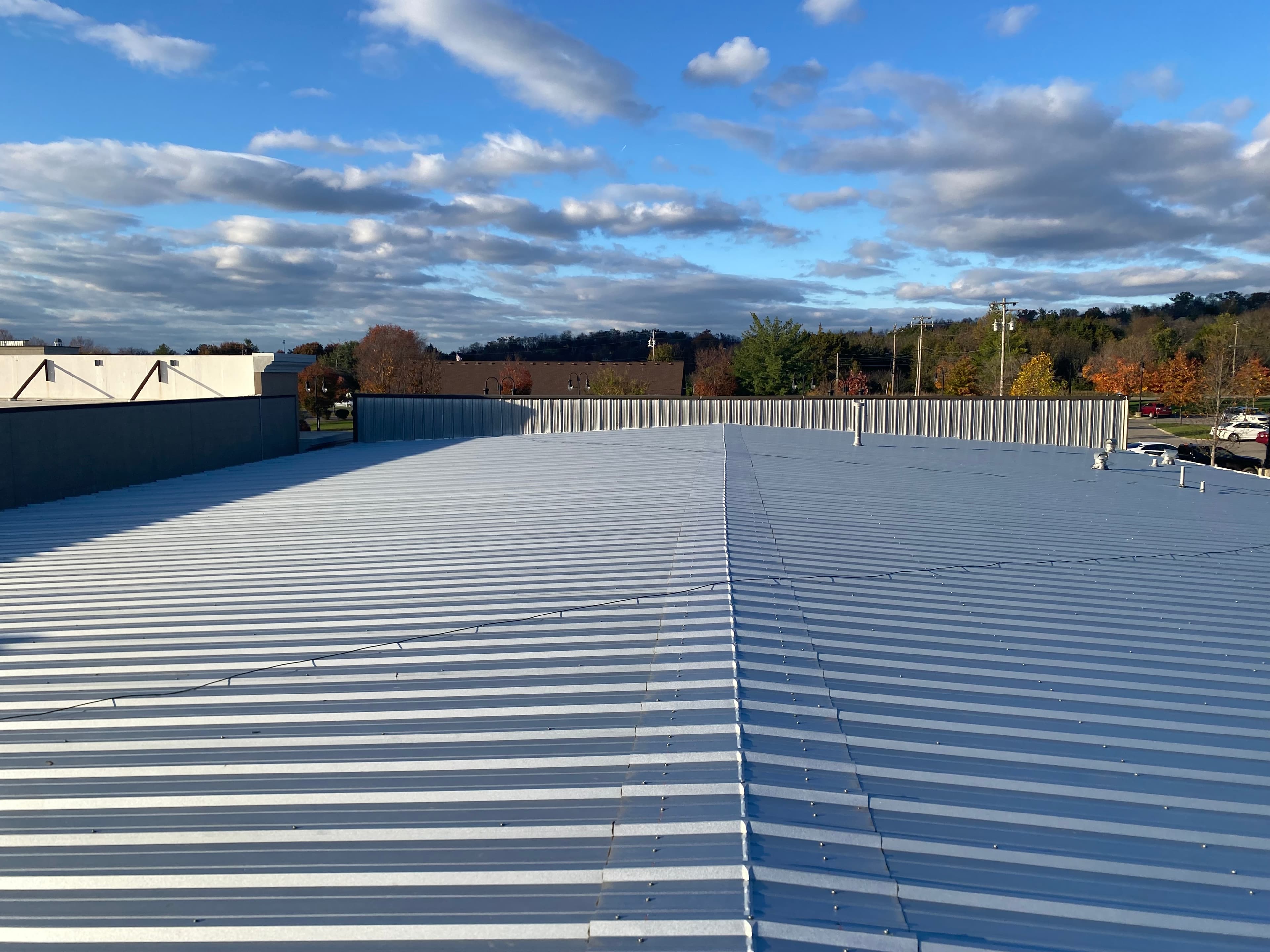
Yes. Metal roof coating extends service life on standing-seam, exposed-fastener, and corrugated metal commercial roofs. The coating addresses oxidation, UV-induced color fade, fastener-gasket deterioration, and seam-sealant failure on aging metal. White reflective coatings on metal roofs deliver substantial cooling-load reduction on industrial and warehouse stock with large metal-roof footprints. Metal-coating systems use specialized acrylic or silicone formulations designed for metal substrates with appropriate primer and rust-converter pre-treatment.
How long does the coating application take?
Typical application timeline runs 3 to 7 days for a 25,000- to 50,000-square-foot commercial roof - surface preparation 1 to 2 days, primer if required 1 day, first coat 1 day, dry/cure window 1 day, second coat 1 day. Larger commercial work scales accordingly. Weather windows matter - rain within the manufacturer-specified cure window can compromise the system, so scheduling around forecast precipitation is part of the project planning.
Do you offer commercial roof coating across the Southeast?
Yes. Our commercial coating capability covers Georgia (Atlanta metro and statewide), Alabama (Birmingham, Huntsville, Mobile and statewide), South Carolina (Charleston, Columbia, Greenville and statewide), and Tennessee (Nashville, Memphis, Knoxville, Chattanooga and statewide). Coating work is engaged across our 16-state footprint by request. Project sizing - most coating engagements run from 10,000 square feet up through 250,000+ square feet on large industrial and distribution stock.
Commercial Roof Leak Repair
How fast can you respond to an active commercial roof leak?
Emergency leak response in metro Atlanta, Birmingham, Huntsville, Mobile, Savannah, Charleston, Columbia, and Nashville typically schedules within 24 to 48 hours for active water intrusion. Same-day response is common during business hours when the property is in our primary metro footprint. Post-severe-weather volume can push timelines - we triage active water-intrusion situations first, then structural exposure, then cosmetic damage.
Why is commercial roof leak diagnosis harder than residential?
Commercial flat-roof systems separate the membrane (waterproofing layer) from the deck (structural layer) by an insulation stack - water that breaches the membrane can travel laterally for dozens of feet between the membrane and deck before finding a path through the deck and into interior space. The interior wet spot is often nowhere near the actual membrane breach. On pitched single-family roofs the path is more direct. Diagnosing a commercial leak requires understanding the assembly stack, deck slope, and substrate condition - not just patching the obvious water spot.
How much does a commercial roof leak repair cost?
Varies significantly by system, scope, and access. A targeted seam repair or flashing-detail repair on TPO or EPDM typically runs hundreds to low thousands of dollars. Repairs requiring wet-insulation removal or deck remediation run into the thousands or tens of thousands. Emergency-response premiums apply for after-hours or weekend dispatch. We provide fixed-fee proposals for all repair scopes after diagnosis - no surprise scope expansions during execution.
What are the most common sources of commercial roof leaks?
In rough order of frequency: failed seams on aging single-ply membranes (TPO, EPDM, PVC); flashing failures around HVAC curbs, pitch pans, parapet caps, and pipe penetrations; backed-out fasteners on mechanically-attached systems creating tenting and puncture risk; clogged drains and scuppers causing standing water that finds compromised seams; tree-fall and wind-driven debris punctures; and failed perimeter terminations at roof-to-wall transitions. Each source has a distinct repair scope and a distinct prevention strategy.
Can you repair a leaking roof while it is actively raining?
Limited scope only. Water-active conditions prevent durable membrane bonding and welding - TPO and PVC require dry seams to weld properly, EPDM requires dry surfaces for adhesive cure, and modified bitumen torch and self-adhered systems require dry substrate. Active-rain response is typically temporary tarp-and-cover work to prevent further interior damage, with permanent repair scheduled at the next dry weather window. Tarp-and-cover scope buys time for proper diagnosis and durable repair.
Do leak repairs void manufacturer warranties on commercial roofs?
Not when the repair follows manufacturer-approved methodology and credentialed installation. We use manufacturer-specified materials and procedures on warrantied roofs - TPO and PVC seam repairs using manufacturer-specified welding, EPDM patches using manufacturer adhesives, modified bitumen patches matching the original cap sheet - and the repair documentation gets filed with the warranty to preserve continuity. Improper repair (off-spec materials, untrained installers) can void warranty coverage; that is why credentialed installation matters.
What if the leak source cannot be found from on-roof inspection alone?
Diagnostic escalation. Infrared thermography identifies trapped moisture under the membrane that is invisible to visual inspection. Moisture meter survey quantifies wet zones across the roof field. Water-test verification - controlled flooding of suspect zones with interior observation - confirms the path on ambiguous cases. Core sampling evaluates insulation condition and validates whether the leak is a localized event or evidence of broader system failure. The diagnostic toolkit scales with the difficulty of the case.
Is a leak repair the right answer or do I need full replacement?
Repair is the right answer when the leak is an isolated event on a structurally sound membrane and the repair scope is bounded. Replacement becomes the right answer when leaks are recurring across multiple zones, when wet insulation is widespread, when the membrane is at end of useful life, or when repair scope approaches an unreasonable percentage of replacement cost. Our diagnosis includes an honest assessment of the repair-vs-replacement decision - see our [commercial roof repair service](/services/roof-repair) for the broader decision matrix.
Do you handle leak repairs on industrial and warehouse properties?
Yes. Industrial and warehouse leak repair is a core specialty. Distribution-center, manufacturing, and flex-space leak response includes operational-continuity coordination - production and shipping cannot stop during repair on most industrial sites. We schedule around shift changes, dock-door access, and material-handling equipment paths. Wide-roll TPO and EPDM patching on industrial scope often happens overhead while operations continue below with appropriate containment.
Do you handle multifamily leak repairs on occupied buildings?
Yes. Multifamily leak repair on occupied buildings is a core multifamily specialty. Coordination respects tenant operations: noise-window scheduling, access-route protection, walkway safety, and tenant-notice templates for any visible work. Active interior water intrusion in a multifamily unit typically gets priority scheduling - we coordinate directly with property management on tenant access and any interior remediation handoff.
What documentation do you provide after a commercial roof leak repair?
A written PDF report including: photo-keyed before-and-after documentation of the repair area; root-cause analysis identifying the leak source; repair methodology with materials and manufacturer references; warranty terms on the repair work (typically 1 to 5 years on workmanship depending on scope); manufacturer warranty continuation notes for systems under active coverage; and any monitoring recommendations. The report format suits asset-management workflow entry - direct upload into AppFolio, Yardi, RealPage, Entrata, or custom asset-management systems is straightforward.
Can a commercial roof leak qualify for insurance coverage?
Sometimes. If the underlying cause is a covered peril - wind-uplift damage, hail puncture, tree-fall puncture, named-storm intrusion - and the cumulative repair scope exceeds the policy deductible, the insurance pathway may apply. Routine wear-and-tear leaks (aged seams, oxidized flashings, fastener back-out) are typically not covered as they are excluded under most commercial property policy language. Our diagnosis identifies the cause and helps determine whether the [insurance claim support](/services/insurance-claim-support) pathway is appropriate.
Do you offer emergency commercial roof leak repair across the Southeast?
Yes. Emergency leak response operates across our Georgia, Alabama, South Carolina, and Tennessee focus markets - metro Atlanta, Birmingham, Huntsville, Mobile, Savannah, Charleston, Columbia, Greenville, Nashville, Memphis, Knoxville, and Chattanooga as primary markets, plus secondary cities across the four states. Emergency response to our broader 16-state footprint is engaged on a market-by-market basis with travel-time considerations factored into the dispatch.
Commercial Roof Maintenance Programs
What is a commercial roof maintenance program?
A commercial roof maintenance program is a documented service agreement that combines recurring inspection (typically annual or semi-annual), drainage and detail-work cleaning, minor repair labor, and written condition reporting on a commercial or multifamily property. The program extends roof useful life, preserves manufacturer warranty coverage, prevents reactive emergency-repair spending, and produces the documentation asset managers and lenders expect to see in property records.
How much does a commercial roof maintenance program cost?
Annual maintenance pricing typically runs $0.05 to $0.15 per square foot depending on roof system, complexity, and visit frequency - roughly $1,000 to $5,000 annually on a 50,000-square-foot commercial property. Semi-annual programs run higher. Cost variables include roof complexity (number of penetrations, flashings, drains), access and site logistics, manufacturer warranty inspection requirements, and the maintenance allotment included for minor repair work performed during visits.
Why do commercial roof manufacturers require annual inspections to keep warranties in force?
Manufacturer warranties on TPO, EPDM, PVC, and most commercial single-ply systems are conditional on documented annual inspections by a credentialed contractor. Lapsed inspection documentation gives the manufacturer grounds to deny warranty claims regardless of the membrane's actual condition. The annual-inspection requirement is the primary reason maintenance programs pay for themselves multiple times over on properties under active manufacturer warranty - a single denied warranty claim costs more than a decade of maintenance fees.
What does a commercial roof maintenance visit include?
Each visit includes drainage clearing (drains, scuppers, gutters, downspouts), seam and flashing examination on every slope, fastener and penetration checks (HVAC curbs, pipe boots, skylights, vents), debris removal, photo documentation by slope orientation, minor repair labor within the program's allotment (sealant renewal, drain-screen reinstallation, small patches), and a written PDF condition report formatted for asset-management workflow.
How often should a commercial roof be inspected and maintained?
Annual visits suit most commercial properties with standard exposure - office, retail, multifamily, light industrial. Semi-annual visits (typically spring after severe-weather season and fall before winter) suit Gulf Coast properties with named-storm exposure, north Alabama and metro Atlanta properties in the spring hail corridor, properties with rooftop solar or dense mechanical traffic, and high-value commercial where early-detection economics justify the extra visit. Quarterly inspection cadence is reserved for institutional commercial with operational-continuity requirements.
What is the difference between roof maintenance and roof repair?
Maintenance is scheduled, recurring, preventative - the cost is predictable and the work happens before problems develop into failures. Repair is reactive - the cost is unpredictable and the work happens after a problem has manifested as a leak, water intrusion, or visible damage. A property under an active maintenance program experiences fewer reactive repairs because issues get caught early; the maintenance allotment absorbs minor work that would otherwise become billable repair scopes.
Can I add a maintenance program to a roof we did not install?
Yes. We maintain commercial and multifamily roofs regardless of original installer or manufacturer. Many of our maintenance accounts are properties with manufacturer warranties from prior installers - we deliver the credentialed annual inspections and condition reporting that keep those warranties in force, even though we did not perform the original installation.
Does a maintenance program cover storm damage repair?
Storm damage that exceeds the maintenance allotment falls outside the program scope and gets handled as a separate engagement - typically through our [storm damage service](/services/storm-damage) and, where applicable, [insurance claim support service](/services/insurance-claim-support). Maintenance programs do help with storm-damage scenarios because the documented prior condition (from maintenance reports) speeds the carrier scope conversation when storm damage occurs - adjusters credit pre-storm condition documentation.
What roof systems do you maintain?
All commercial single-ply membranes (TPO, EPDM, PVC, KEE, and specialty systems), modified bitumen and built-up asphalt, standing-seam and exposed-fastener metal, asphalt shingle on commercial pitched roofs, tile on specialty commercial, and coated systems where the underlying membrane is one of the above. Each system has a distinct maintenance cadence and inspection focus reflected in the program scope.
Do you offer maintenance programs for multifamily properties?
Yes. Multifamily maintenance programs are a core specialty. Coordination respects tenant operations: noise-window scheduling during business hours, parking-area protection, walkway safety during work, and tenant-notice templates for any visible activity. Multifamily-specific inspection focus includes balcony and walkway transitions, breezeway flashings, common-area roofs, and any tenant-occupied unit with documented historical leak activity.
How does a maintenance program save money over time?
Three mechanisms: (1) early failure detection - catching seam separations or flashing failures at maintenance visits prevents the interior-damage cascade that makes reactive repairs 5 to 10 times more expensive; (2) extended useful life - well-maintained commercial roofs routinely exceed manufacturer warranty terms by years, deferring the next capital replacement event; (3) preserved warranty coverage - documented annual inspections keep the manufacturer warranty in force, protecting against denied claims that can cost tens of thousands. The program economics typically pay back within the first 3 to 5 years on commercial properties of any meaningful size.
What documentation do you provide with each maintenance visit?
A PDF condition report for every visit including photo-keyed findings by slope orientation, action recommendations categorized as immediate, near-term, or monitor, an updated remaining-useful-life estimate, before-and-after documentation of any minor repair work performed, and warranty-continuation notes for systems under manufacturer coverage. The report format is built for asset-management workflow - direct entry into AppFolio, Yardi, RealPage, Entrata, or custom asset-management systems is straightforward.
Do you offer commercial roof maintenance across the Southeast?
Yes. Maintenance programs operate across our Georgia, Alabama, South Carolina, and Tennessee focus markets - metro Atlanta, Birmingham, Huntsville, Mobile, Savannah, Charleston, Columbia, Greenville, Nashville, Memphis, Knoxville, and Chattanooga as the primary markets, plus secondary cities across the four states. Maintenance work extends to our broader 16-state footprint by request on properties where regular travel is operationally feasible.
Commercial Roof Replacement
Does commercial roof storm damage qualify for insurance replacement?
It depends on the carrier, the policy wording (named peril vs open peril), and documented damage. During inspection we identify hail indentations, wind-uplift signs, and membrane failures and document them for your carrier to evaluate.
How long does a commercial roof replacement take?
Most mid-size commercial projects take 5–15 working days on-roof. Multifamily buildings phased by unit block can take longer. Weather windows and material lead times matter most; we sequence delivery so tenants see minimal disruption.
What is the typical deductible on a commercial roof claim?
Commercial deductibles vary widely. Policies commonly use a named-storm or wind/hail percentage deductible applied to the insured value (often 1–5%). We help you read the declaration page so there are no surprises.
What is the difference between ACV and RCV?
ACV (Actual Cash Value) pays replacement cost minus depreciation at the time of loss. RCV (Replacement Cost Value) pays full replacement cost once work is completed and documented. Most commercial policies pay initial funds at ACV and release recoverable depreciation at RCV after completion.
Can tenants remain in the building during replacement?
In multifamily and occupied commercial buildings, yes. We coordinate noise windows, debris containment, and safe walking paths. Morning installs and phased sections minimize tenant impact.
What roof systems do you install on commercial properties?
TPO, EPDM, PVC, and modified bitumen on flat and low-slope roofs; architectural and commercial asphalt shingle on pitched multifamily; metal standing-seam and exposed-fastener where the building and budget warrant. Our inspection identifies the existing system and recommends fit by climate zone, traffic, and chemical exposure.
How is a commercial roof replacement different from single-family work?
Scope is larger, systems are different (single-ply membranes, tapered insulation, code-required fire assemblies), documentation is more rigorous, insurance is more complex (percentage deductibles, ordinance and law coverage, business interruption), and tenant coordination usually matters. Our team specializes in commercial, industrial, and multifamily - not retrofitted single-family crews. For single-family work we refer to our sister company Red Door Contracting.
What does a commercial roof inspection include?
Drone-assisted aerial mapping, photo-keyed ground-level documentation, infrared thermography for trapped moisture, core-sample extraction to validate the insulation stack and deck type, moisture-meter survey, and a photo-keyed PDF report formatted for carrier, lender, and asset-manager review.
Do you handle multifamily properties with tenants in place?
Yes. Multifamily replacement is a core specialty. We phase by building block, distribute tenant-notice templates seven-plus days ahead of each building's turn, coordinate noise windows and walking-path safety, and publish a Gantt-style production schedule property managers can share with residents and operations teams.
Which states does Red Door Roofing serve?
We operate across 16 states in the Southeast, South, and lower Midwest: Georgia, North Carolina, South Carolina, Alabama, Kentucky, Tennessee, Texas, Oklahoma, Louisiana, Mississippi, Florida, Arkansas, Missouri, Kansas, Iowa, and Indiana. Georgia is home base, and most of our crews run out of Georgia, Tennessee, Alabama, and South Carolina - so response is fastest in those markets.
How much does a new commercial roof cost?
The price depends on the size, the kind of roof, and the damage. A small roof may cost $60,000. A large roof on a big building can cost more than $500,000. We give you a clear quote after we look at the roof. The quote shows every part of the job so there are no surprises.
What warranty comes with a new commercial roof?
Most new roofs come with two warranties. One is from the factory that made the roof material. It often lasts 15 to 30 years. The other is from us, and it covers the work we did. Ours runs about 2 to 10 years. We give you both papers in a folder when the job is done.
How do I know when my commercial roof needs to be replaced?
Look for these signs: water stains on the ceiling inside, soft spots or bubbles on the roof top, cracks around vents or drains, or a roof that is more than 20 years old. If you see any of these, call us for an inspection. We take photos and tell you the truth about what we find.
Will you work with my insurance company for me?
Yes. We take photos of every part of the damage. We write a report that your insurance company can use. We talk with the insurance worker (the adjuster) when they visit. We send the paperwork the insurance company asks for. We help you understand what your policy covers so you can make a good choice.
What is a photo-keyed PDF report?
It is a picture book of your roof. Every photo has a number. The number points to a spot on a roof map. That way your insurance company knows exactly where each crack, dent, or leak is. It makes claims much easier and faster to approve.
Do you offer roof inspections?
Yes. A full commercial roof inspection costs you nothing. If we find damage, we write a report you can share with your insurance. If we do not find damage, we give you a Certificate of Clearance. That paper is yours to keep and show to lenders, insurers, or owners. No cost, no pressure.
How long will my new commercial roof last?
A TPO or EPDM flat roof often lasts 20 to 30 years. A metal standing-seam roof can last 40 to 60 years. Asphalt shingles last 20 to 30 years. How long your roof lasts also depends on the weather where you are and how well you take care of it. We tell you what to expect before we start.
What roof systems work best in Georgia and Alabama heat?
White TPO is a popular choice because it reflects the sun and keeps buildings cooler. That can cut your air conditioning bill in the summer. EPDM (a black rubber roof) also works well and lasts a long time. Metal roofs with a light color coating are great for industrial buildings. We help you pick what fits your building and budget.
Can I put a new roof on top of my old roof?
Sometimes yes, sometimes no. Local building rules say you can usually have at most two layers of roof. If your roof already has one layer, we may be able to add a second. If it has two, we have to take them off first. We check the rules for your city and tell you what is allowed.
What happens if it rains during my roof replacement?
We watch the weather every day. If rain is coming, we cover the roof with strong tarps before we stop work. Our crews only take off roof sections they can finish in one day. Your building stays dry through the whole project. We have never lost a building to rain during a job.
What should I do before the roof crew arrives?
Move cars and trucks out of the work area. Cover items in the attic or top floor to protect from dust. Tell your tenants when work will happen and how long it will take. Take down any wall art or shelves right under the roof deck. We send a checklist to help you get ready. Our job manager walks the site with you before we start.
Commercial Insurance Claim Support
Does Red Door Roofing negotiate insurance claims?
We support the documentation side of the claim - photo-keyed evidence, NOAA/NWS date-of-loss alignment, priced scope against local labor and material norms, and supplement filings for legitimate missed scope. The carrier's adjuster makes the final determination. We do not act as a licensed public adjuster; we provide contractor-side documentation and scope discipline.
What is Ordinance and Law coverage?
Ordinance and Law coverage unlocks reimbursement for code-required upgrades that a commercial roof replacement triggers - continuous-insulation R-value increases to ASHRAE 90.1 minimums (typically R-25 to R-30 on Georgia and Alabama commercial), updated fastening patterns, perimeter edge-metal upgrades, and fire-rated assembly requirements under local code.
How do supplements work on a commercial claim?
A supplement is a formal request to add documented scope items the initial adjuster estimate missed. We file supplements backed by photo evidence and code citations. Reasonable, well-documented supplements are approved at a high rate in our Georgia and Alabama experience because the adjuster field is experienced and evidence-responsive.
What do commercial claim deductibles look like in Georgia and Alabama?
Commercial policies have largely moved to percentage wind/hail deductibles - commonly 1 percent to 5 percent of insured value. Gulf Coast commercial policies in Alabama (Mobile, Baldwin) add named-storm deductibles applied separately. A 2 percent wind/hail deductible on a $10 million property is $200,000. Knowing the actual deductible dollar figure is step zero on any commercial claim conversation.
What's the difference between RCV and ACV on commercial policies?
Replacement Cost Value (RCV) policies cover new-roof cost at current market prices. Actual Cash Value (ACV) policies deduct depreciation based on the roof's current age and condition. Most commercial policies pay initial funds at ACV and release recoverable depreciation at RCV after work is completed and documented.
How long does a commercial claim take from filing to approval?
Varies by carrier and severity-season volume. Standard commercial claims in non-catastrophic conditions typically move through initial scope review in 2-6 weeks. Post-major-event commercial claims in Georgia and Alabama during active severe-weather seasons can take 60-120 days as adjuster rosters absorb volume.
Can you document a claim for a storm event months ago?
We can inspect and document current condition, cross-reference to historical NOAA/NWS records for the ZIP code, and identify damage patterns consistent with a specific storm. Older damage is harder to attribute definitively than fresh damage, but documented condition still matters for open claim windows.
Do you work with specific insurance carriers?
We work with whatever carrier the owner's policy is written with - Chubb, Travelers, Liberty Mutual, AIG, Zurich, regional carriers, and captive programs are all routine. Adjuster field preferences vary by metro; we adapt documentation formatting to whatever the assigned adjuster requests.
What if the carrier denies the claim or approves less than the full scope?
Documented evidence is the mechanism for scope disputes. Reasonable supplements with photo and code citations are the standard next step. If the evidence is clean and the denial or under-scope is unreasonable, a public adjuster or claim-representation attorney may be the appropriate next step - that's outside our service scope but we hand off documentation cleanly.
Does Red Door Roofing guarantee my claim will be approved?
No. Nobody legitimately can. Outcomes depend on policy language, carrier adjustment, documented evidence, and specific endorsements. What we commit to is thorough documentation, clear communication, honest assessment of whether damage warrants filing, and a process that lets your carrier make the right call on evidence.
What is an adjuster and why do they matter?
An adjuster is the person your insurance company sends to check the damage. They walk the roof, take notes, and decide how much the claim is worth. A good adjuster visit can make or break your claim. We walk the roof with them. We show every mark. We make sure they see what we see.
Do I pay you or does the insurance company pay you?
The insurance company pays for the roof work. You pay only your deductible. That is the small piece you agreed to pay when you signed up for the policy. For a storm-damage replacement, that might be a few thousand dollars or a small percent of the building value. You never pay for our inspection or our claim help.
Can I file a claim without getting a roofer first?
You can, but it is better to have a roofer check the damage first. If you file without a report, the insurance company sends their own inspector. Their inspector works for them, not for you. Getting our inspection first means you have your own proof of what is wrong.
What is a public adjuster and do I need one?
A public adjuster is a person you can hire to fight for your claim. They cost 10% to 15% of the total. We are not public adjusters - we are a roofing company. We give the damage report and work with the insurance adjuster directly. Many cases settle without needing a public adjuster. If your claim goes sideways, we can refer you to one.
What if my landlord or tenant is the one with the insurance?
The lease says who pays for what. Commercial leases often put the roof on the landlord. But tenants sometimes pay for damage to inside items like product or equipment. We work with whoever holds the policy. If both parties have claims, we can write separate reports for each.
How do I know my policy covers a claim?
Pull out your policy folder and look for the Declarations Page. It shows what is covered and what is not. Key words to find: named peril, open peril, wind, hail, tropical storm, and wear and tear. We can look at your declarations with you and point to the parts that matter. We do not give legal advice - just help you read the paper.
What does matching coverage or like kind and quality mean?
It means if only part of your roof is damaged, the insurance company has to replace the damaged part with roof material that matches the rest. If the old color or style is no longer made, this often means replacing the whole section. Not every policy has this. Georgia, Alabama, and South Carolina rules differ. We help you read your rules and explain your options.
How long do I have to file a claim after a storm?
Most commercial policies give you 1 to 2 years to file. Some storms reset this clock. Some policies are shorter. The exact time is in your policy papers. We always say: file as soon as you know you have damage. Waiting can hurt your case. Fresh damage is easier to prove than old damage.
Will you meet the insurance adjuster at the property?
Yes. We call this a joint inspection. It is the most important step in many claims. We meet the adjuster at the building. We walk the roof together. We point out every mark. We show photos. Most claims move faster and smoother after a joint inspection. We do it at no cost to you.
What do I do if my claim is denied?
Don't give up on the first answer. Ask the insurance company for a written reason. Many denials are based on missing details. Our team can write an extra report called a supplement. Sometimes we bring in a public adjuster or a roof-damage expert called an engineer. Many denied claims get approved after a stronger review. We walk you through each step.
Multifamily Roofing
Will tenants need to relocate during a multifamily roof replacement?
Almost never. We phase work by building or unit block, coordinate noise windows during daytime hours, and use containment to keep walkways and entrances clear. Owners who need written tenant communications receive a phased schedule and notice letter template.
How long does a multifamily project take?
Most 100–300 unit properties complete in 3–8 weeks depending on building count, weather, and material lead times. We share a phased Gantt chart so operations and leasing teams can plan.
Do you work with property management software?
Yes. We deliver progress updates in whatever format your PM team prefers - PDF reports, photo packs, or direct entry into maintenance systems like AppFolio, Yardi, or RealPage work orders.
What flat-roof system is best on multifamily buildings?
It depends on pitch, drainage, climate, and tenant-mix. TPO dominates low-slope multifamily across the Southeast for UV resistance and seam weldability; EPDM remains common on older stock; architectural asphalt shingle is standard on pitched garden-style. We recommend a system based on inspection findings and submarket.
What happens if damage is not found on inspection?
If no qualifying damage is present, we issue a Certificate of Clearance - a documented statement suitable for lender, insurer, or asset-manager records. There is no obligation.
Can Red Door Roofing handle properties with 500+ units?
Yes. Multi-building multifamily portfolios are a core specialty. We have sequenced 500-plus-unit replacements across metro Atlanta, Birmingham, Huntsville, and Nashville with phased production schedules, multi-building tenant-notice distribution, and portfolio-level closeout binders.
How does multifamily roofing documentation differ from single-building commercial?
Documentation is granular per building. A 300-unit property may show damage concentrated on two of eight roofs, and adjusters want that per-building granularity. Our photo-keyed reports map damage to specific building numbers and unit blocks - the format adjusters actually work in.
Do you handle student-housing multifamily near UA, UAB, or UGA?
Yes. Student-housing multifamily near the University of Alabama, UAB, the University of Georgia, and other regional colleges requires production scheduling coordinated with academic calendars - move-in weekends, finals, spring break. We work those calendars into the phased Gantt schedule.
What's different about multifamily storm-claim documentation?
Per-building damage assessment is non-negotiable. A single-building commercial claim has one roof; a multifamily claim has N roofs across N buildings with different exposure. We document building-by-building with separate evidence packages so the carrier can evaluate each roof on its merits.
Which states does Red Door Roofing serve for multifamily work?
Across our 16-state footprint, with our deepest multifamily experience in Georgia (HQ), Alabama, Tennessee, and South Carolina. Multifamily is a core portfolio specialty - metro Atlanta, Birmingham, Huntsville, Nashville, Charleston, and Greenville portfolios are all regular engagements.
What time of day do you work on apartment roofs?
We usually start around 7 or 8 in the morning. We finish by 5 or 6 in the evening. We do not make loud noise before 7am or after 7pm. Sundays and big holidays are off. This lets your renters sleep and enjoy home time. Every project has a daily schedule you can share with tenants.
How much notice do tenants get before work starts on their building?
We send a notice at least 7 days before work starts on each building. The notice tells them the dates, work hours, where to park, and who to call with questions. We have a letter ready for you to print or email. Good notice keeps tenants calm and keeps complaints low.
Will my renters lose power or water during roof work?
Almost never. Roof work does not touch your water lines or power lines. In rare cases, we may need to turn off a unit's AC for a few hours when working near the condenser. We tell you first, pick a time that works, and get it back on as fast as we can.
What about pets living in the apartment during roof work?
Pets are safe. Roof noise can scare dogs and cats, though. We suggest owners keep pets inside with a fan or TV for background sound. Some tenants take dogs to daycare for the loudest days. We can give you a list of pet-friendly day spots near the property. No pets should be on balconies during work hours.
How do you protect cars, pools, and playgrounds during the job?
We set up cones and caution tape around the work zone. We block parking spots under the work area. We cover pools with tarps and close them during the work day. Playgrounds stay closed while crews are above them. We clean all debris at the end of every day so kids and families can use the space again.
Do you do apartment roofs during winter months?
Yes, as long as the temperature is right for the roof material. TPO and EPDM can go down when it's above 40°F. Shingles need above 50°F to stick right. In Georgia and Alabama, most weeks in winter are fine. We plan around weather and tell you if we need to push a start date.
What if there's a leak in only one building of my property?
We start with that one building first. Many times a repair or partial replacement solves the problem. If all the buildings are the same age, they may all be near end of life. We can inspect the whole property at no cost and plan replacement in phases across one or two years.
How do you keep tenants happy during a big roof project?
Clear and early notice. Daily clean-up. A single point of contact they can call. Quiet hours they can count on. Updates each week by email to the leasing office. Listening when they have questions. These small steps keep most tenants happy. Your leasing team should notice fewer complaints once the project is in motion.
Can you handle HUD or LIHTC apartment properties?
Yes. We know HUD, LIHTC, and Section 8 property rules. We write reports that match what HUD, your lender, and your state housing agency ask for. We work with property managers who run these programs all the time. Our paperwork stands up to a funding review.
What happens to the old roof when you tear it off?
We load it into dumpsters as we go. The dumpsters get hauled off to a landfill or a recycling center. Many of the roof parts can be recycled - metal goes to a metal yard, shingles can sometimes be ground up for road paving. We leave the site cleaner than we found it.
Commercial Roof Certifications
What is a Roof Condition Certification?
A Roof Condition Certification is a formal, signed statement of a commercial or multifamily roof's documented condition at a specific point in time, packaged for lender, insurer, and asset-manager use. It includes roof-system identification, condition assessment, remaining-useful-life estimate, repair or replacement recommendations where applicable, and photo-keyed documentation supporting each finding.
When do commercial lenders require a Roof Condition Certification?
Commercial lenders increasingly require certifications at refinance, acquisition, and renewal. The specific trigger varies by lender - some require on every commercial real-estate refinance, some only when the building is past a certain age, some only on specific property types. Atlanta-area commercial lenders including Truist, Atlantic Capital, and regional banks routinely request the certification on commercial refinance files.
What's the difference between a Certification and a Certificate of Clearance?
A Certification is the broader document that states current roof condition - may include identified repairs, remaining-useful-life estimates, and recommended actions. A Certificate of Clearance is a narrower subset issued when the inspection finds no qualifying storm damage or end-of-life condition - specifically suited to insurance renewal and storm-claim-window documentation.
Are certifications accepted by all carriers and lenders?
Most major commercial carriers and lenders accept third-party Roof Condition Certifications as valid documentation. Specific format requirements vary; we adapt the certification to the requesting party's format where reasonable. Some lenders require specific certifying authorities (NRCA member, licensed GC, etc.) - we carry those credentials.
How long is a Roof Condition Certification valid?
Validity varies by recipient. Commercial lenders commonly accept certifications within 6-12 months of issuance; insurance carriers may accept within 12-24 months at renewal. A certification issued before a major severe-weather event may be superseded by post-event inspection findings.
Can you certify a roof under manufacturer warranty?
Yes. Warranty-cycle certifications verify that installation and maintenance comply with the manufacturer's warranty terms - penetration count, foot-traffic protection, drain maintenance, seam-integrity inspection. The certification supports warranty registration and future manufacturer-warranty claims.
Do you certify roofs you didn't install?
Yes. Most certifications we issue are on roofs installed by other contractors - our role is inspection and documentation, not validation that the original installer's work is warranty-compliant. We document current condition honestly regardless of the original installer.
What's included in a Roof Condition Certification deliverable?
Executive summary, property identification, inspector credentials, inspection date, overhead schematic, roof-system identification per section, current condition assessment, flashing and penetration condition, drain and parapet condition, remaining-useful-life estimate, any observed defects or concerns, repair or replacement recommendations with priority, photo-keyed supporting documentation, and signed certification statement.
Do you certify commercial roofs in Atlanta, Birmingham, Huntsville, Mobile, Savannah?
Yes. Roof Condition Certifications across metro Atlanta, Birmingham-Hoover, Huntsville-Madison, Mobile/Baldwin County, and Savannah MSA are standard deliverables. We also certify commercial and multifamily roofs across our broader 16-state footprint including Tennessee, South Carolina, and the Southeast/South/lower-Midwest states.
What does a commercial roof certification cost?
Certification fees depend on property size, building count, and complexity. Single-building commercial certifications are typically fixed-fee; multi-building multifamily and campus certifications run on a per-building basis. Fees are quoted in advance. If the certification is part of an insurance-claim inspection, the certification itself is usually rolled into the inspection deliverable.
Commercial Roof Inspection
How much does a commercial roof inspection cost?
Initial no-obligation commercial and multifamily inspections are provided at no cost. If we find no qualifying damage, we issue a Certificate of Clearance. For capital-planning inspections without a pending claim, we provide a fixed fee in advance based on building count and complexity.
How long does a commercial roof inspection take?
A single-building commercial inspection typically takes 2-4 hours on-site plus additional time for report preparation. Multi-building multifamily and campus inspections run 1-3 days on-site. Drone mapping adds 30-60 minutes per building.
What equipment do you use for commercial roof inspections?
Drone-assisted aerial mapping, infrared thermography for trapped-moisture detection, moisture meters (pin-type and impedance), core-sample extraction tools, and photo-documentation equipment. The toolkit is designed around carrier-ready evidence production.
Do you offer no-obligation inspections in Atlanta, Birmingham, and Huntsville?
Yes. Commercial and multifamily inspections across metro Atlanta, Birmingham-Hoover, and Huntsville-Madison are always no-obligation on first engagement. We schedule within days of the request - faster after named severe-weather events.
What does the final inspection report include?
Executive summary, overhead roof schematic, photo-keyed defect mapping, existing roof-system identification (TPO, EPDM, PVC, modified bitumen, BUR, metal, or mixed), remaining-useful-life estimate per section, flashing and penetration condition, any observed damage with date-of-loss alignment, repair-versus-replacement recommendations, and code-upgrade flagging.
When should I schedule a commercial roof inspection?
Post-winter baseline inspection (February through April), post-event inspection within 2-4 weeks of any documented severe-weather activity, annual portfolio inspection for multifamily and commercial capital planning, refinance or acquisition due-diligence inspection, and pre-warranty-expiration inspection on manufactured-warranty roofs.
Do you inspect multifamily portfolios per-building?
Yes. Per-building documentation is standard on multifamily inspections. A 300-unit property gets separate evidence for each building, which is the granularity adjusters and asset managers actually work with.
What is a Certificate of Clearance?
A documented statement that the property's roof was inspected and found to have no qualifying damage. The certificate is formatted for lender, insurer, and asset-manager records and satisfies most refinance and insurance renewal documentation requests. We issue it at no cost when our inspection finds no qualifying damage.
Can you inspect roofs under manufacturer warranty?
Yes. Warranty-cycle inspections are a standard service - we document current condition, verify warranty compliance (penetration count, foot-traffic protection, drain maintenance), and provide evidence suitable for warranty registration or claim filings with the manufacturer.
What about infrared moisture surveys - when are they warranted?
Infrared thermography is warranted when hidden moisture is suspected - unexplained tenant-reported leaks, aging membrane with unclear damage attribution, post-event inspection where damage patterns suggest interior-layer moisture, or pre-acquisition due diligence. We deploy IR at dusk when temperature differentials make trapped moisture visible.
Is a roof inspection really free?
Yes. A commercial roof inspection costs you nothing. We show up, look at your roof, take photos, and write a report. If you have damage, we help you file a claim. If you don't have damage, you get a free Certificate of Clearance. There is no bill either way.
Do I have to be there when you inspect my roof?
No, you don't have to be there. But it helps if someone with a key can let us in. We just need safe roof access. We walk the roof, take pictures, and send you the report the same day or the next day. You can call us with questions any time.
How soon can you come out to inspect my roof after a storm?
We try to be there within 3 to 5 days after a storm. Busy storm weeks may push that to 7 to 10 days. Fast booking matters because insurance claims have time limits. Call us as soon as you see damage or hear other buildings nearby had damage.
What kind of damage can you find on a roof that I cannot see from the ground?
A lot. Hail can dent metal flashings and crack membranes. Wind can lift seams you can't see. Water can sit under the surface for years. Old caulk can split. Drains can clog. Vent pipes can come loose. From the ground, roofs often look fine when they are not. That's why a close-up look matters.
Can you check my roof before I buy the building?
Yes. This is called a pre-purchase inspection. We give you a full report so you know what you are getting. We can tell you how old the roof is, how long it might last, and if the roof is tied to a factory warranty. Many lenders ask for this report before they approve the loan.
How often should I get my commercial roof looked at?
Two times a year is a good plan - once in spring and once in fall. Also check after any big storm with hail, high wind, or heavy rain. Catching small problems early saves a lot of money. A $200 fix today can stop a $20,000 fix next year.
What if you find damage but my insurance says no?
Do not give up on the first answer. We can write an extra report called a supplement. It shows more details and may change the insurance company's mind. Sometimes we find damage the first adjuster missed. We walk through the steps with you. We never promise a different answer, but we give the claim the best chance.
Are your inspectors trained and insured?
Yes. All of our roof inspectors have special safety training. They wear harnesses and follow OSHA rules. Our company carries full general liability and workers' compensation insurance. You can ask for proof of insurance before we start. We are happy to share it.
Will walking on my roof cause any damage?
No. Our team is trained to walk on roofs the right way. We use soft-soled shoes and spread our weight. We stay away from skylights and weak spots. We walk on flat paths and avoid new seams. If a roof is too fragile for foot traffic, we use a drone instead.
Can you inspect a roof that is very steep or very tall?
Yes. For steep or tall roofs, we use drones and cameras on long poles. We can also set up safety ropes and harnesses. No roof is too steep or too tall for our team. We have looked at roofs on five-story apartment buildings, hotels with pitched metal roofs, and tall industrial plants.
Commercial Roof Repair
When is roof repair the right answer versus roof replacement?
Repair is the right answer when the observed failure is localized and the surrounding membrane, deck, and insulation are in acceptable condition - seam separations on otherwise-sound TPO, flashing compromise around a specific HVAC curb, fastener back-out in a specific section, drain or parapet detail issues. Replacement becomes the right answer when damage is systemic, the membrane is at end of useful life, or repair scope approaches a significant percentage of replacement cost.
How fast can Red Door Roofing respond to a commercial roof repair request?
Emergency leak response in metro Atlanta, Birmingham, Huntsville, Mobile, Savannah, and adjacent markets typically schedules within 24-48 hours for active water intrusion. Non-emergency commercial repair requests schedule within days. Post-severe-weather volume can push timelines - we prioritize active water-intrusion situations first.
What does commercial roof repair cost?
Varies significantly by scope, system, access, and scale. Minor TPO seam repair or flashing detail work may run hundreds of dollars; extensive multi-area repairs on larger commercial properties run thousands to tens of thousands. Fixed-fee proposals in advance for all repair scopes so there are no surprises.
Do you warranty commercial roof repairs?
Yes. Our commercial repair work carries a workmanship warranty - typically 1-5 years depending on repair scope. The existing-system manufacturer warranty remains intact where the repair is compatible with the manufacturer's approved repair methodology.
Can you repair a commercial roof under manufacturer warranty without voiding the warranty?
Yes. We follow manufacturer-approved repair methodology on warrantied roofs - TPO and PVC seam repairs using manufacturer-specified welding procedures, EPDM patches using manufacturer adhesives, modified-bitumen patches matching the original cap sheet. Documentation of the repair gets filed with the warranty to preserve continuity.
What types of commercial roof repairs do you handle?
Seam separations on TPO/EPDM/PVC/modified bitumen; flashing repairs (parapet caps, HVAC curbs, pitch pans, expansion joints, skylights); fastener back-out remediation; puncture repairs; drain replacement and flashing; parapet detail work; granule-loss mitigation on modified bitumen; and targeted decking or insulation replacement where localized moisture damage doesn't warrant full replacement.
Do you handle commercial roof leaks in Atlanta, Birmingham, and Huntsville?
Yes. Active leak response across metro Atlanta (Fulton, DeKalb, Cobb, Gwinnett, Clayton counties), Birmingham (Jefferson, Shelby), Huntsville (Madison), Mobile (Mobile, Baldwin), and our broader Georgia/Alabama footprint. Water intrusion gets priority scheduling.
Can repairs qualify for insurance coverage?
Sometimes. If the underlying damage is storm-related (hail, wind, tropical) and the repair is under the policy's deductible, the repair is typically out-of-pocket. If repair scope crosses the deductible threshold, the insurance-claim pathway may apply. Our inspection determines the right approach.
Do you handle multifamily roof repairs on occupied buildings?
Yes. Multifamily repair work is a core specialty. We coordinate noise windows, debris containment, walkway safety, and tenant-notification protocols on occupied buildings - the same discipline we bring to multifamily replacement work, scaled to the narrower repair scope.
Will a repair delay a future replacement?
Not materially. A properly-scoped repair extends useful life by 2-7+ years depending on the original roof condition and the repair scope. When the roof reaches natural end-of-life or sustains replacement-triggering storm damage, the repair history gets documented and transferred to the replacement project planning.
Storm Damage Roofing
How can I tell if my roof has storm damage?
Most storm damage on commercial flat and pitched roofs isn't visible from the ground. Signs include granule loss in gutters, dented flashings, hail-indented membranes, wind-lifted panels, and unexplained interior leaks after a storm. A professional on-roof inspection is the only reliable way to confirm damage.
Does storm damage always qualify for an insurance claim?
No. Qualifying requires documented damage, policy coverage, adherence to named-storm deductibles where applicable, and date-of-loss validation against NOAA/NWS records. Our inspection report gives your carrier what they need to make the determination.
How long after a storm can I file a claim?
Claim windows vary by carrier and state, typically 1–2 years after the loss. Earlier documentation is always better because damage patterns weather and become harder to attribute to a specific event as time passes.
What if the inspection finds no damage?
We issue a Certificate of Clearance - documented roof condition suitable for lender, insurer, and asset-manager files. There's no obligation and no cost for the inspection in this case.
How fast do you respond after a storm in Atlanta or Birmingham?
Post-event inspection requests in Atlanta, Birmingham, Huntsville, Mobile, Montgomery, and across our Georgia/Alabama focus markets are scheduled within days, not weeks. Commercial and multifamily inspection priority ramps after named severe-weather events in the footprint.
Do you document hail damage on commercial TPO, EPDM, and PVC membranes?
Yes. Commercial single-ply membranes can sustain hail damage that's invisible from the ground - micro-fractures in the matting, compromised seam integrity, and circular depressions that require tactile inspection to detect. Our commercial hail documentation is core specialty work.
What about post-hurricane commercial roof inspections on the Gulf Coast?
Mobile, Baldwin County, and the Alabama Gulf Coast face elevated named-storm exposure. Our post-hurricane commercial inspection protocol pairs drone-assisted aerial documentation with ground-level wind-uplift-rating evaluation and perimeter-metal detail assessment - the three factors that typically determine named-storm claim outcomes on Gulf Coast commercial.
Do you handle storm-damage documentation for multifamily portfolios?
Yes. Multifamily portfolios require per-building damage documentation - a 300-unit property may show damage concentrated on two of eight buildings, and adjusters want per-building granularity. Our photo-keyed documentation maps damage to building numbers, which is the format adjusters actually use.
What evidence do carriers require for a commercial storm claim?
Photo-keyed documentation mapped to an overhead schematic, date-of-loss alignment with NOAA/NWS records, roof-system identification, and a priced scope against local labor and material norms. Ordinance and Law coverage typically requires code-referenced upgrade documentation. We provide all of that as standard in our commercial inspection reports.
Can you document damage from storm events several months ago?
We can inspect and document current roof condition, cross-reference to historical NOAA/NWS records for the ZIP code, and identify damage patterns consistent with a specific storm. Older damage is harder to attribute definitively than fresh damage, but documented condition still matters for open claim windows.
What should I do right after a storm hits my building?
Safety first. Keep everyone away from any fallen roof pieces or broken glass. Take photos of anything you can see from the ground. Call your insurance company to start a claim. Then call us for a roof inspection. Try to get us out within a week so your claim starts strong.
What does hail damage look like on a flat commercial roof?
Hail leaves round dents in soft spots and small cracks in hard spots. On a TPO or EPDM rubber roof, hail makes small round marks that break the top layer. On metal flashing, hail leaves dings you can see in the sun. On skylights, hail can crack the glass or dome. We mark and photo every hit so the insurance company has proof.
How big does hail have to be to damage my roof?
Hail the size of a quarter (1 inch) can hurt soft roof parts. Hail the size of a golf ball (1.75 inch) or bigger usually damages most roof systems. But wind can drive small hail sideways and still cause damage. We measure and map every hit, no matter the size. The insurance company uses NOAA storm reports to check the hail size in your area.
Will a storm claim raise my insurance rates?
Every carrier handles this differently. Weather-related claims often affect rates less than fault-based claims. Your policy papers show the rules. We don't give insurance advice, but we do give you clear roof facts so you can make a smart choice with your agent. Not filing a real claim can cost more than filing one.
What if my roof was old when the storm hit?
An old roof can still be covered if a storm pushed it past its useful life. Insurance companies call this an accelerated loss. We show the age and prior condition with photos. If a storm made a weak roof fail, your claim may still go through. We are honest about the odds - the carrier decides, not us.
Can wind damage happen without visible broken parts?
Yes. Wind can lift roof seams without tearing them. This is called uplift. It breaks the glue and leaves the seam weak. Next rain, the seam leaks. On metal roofs, wind can loosen fasteners you can't see from above. We look for these hidden problems on every storm inspection.
How long do I have to use my insurance money once the claim is paid?
Most insurance policies give you one year from the claim date to finish the repair. Some give longer. Check your policy page for the exact rule. If you wait too long, the insurance company may take back part of the money. We help you plan a timeline that fits inside the window.
What if my adjuster disagrees with your inspection?
This happens sometimes. We set up a joint roof inspection. Our team and your adjuster walk the roof together. We show photos, point to each mark, and explain what we see. Most disagreements get settled on the roof. If not, we can write an extra report called a supplement.
Do you inspect for storm damage on roofs that look fine?
Yes. Many storm-damaged roofs look fine from the ground. That is the whole point of a close-up look. We find cracks and dents that the human eye misses. After a hail or wind storm in your area, call for an inspection even if your roof looks okay. Better to know than to find out from a ceiling leak six months later.
Is it worth filing a small storm claim?
Maybe. If the repair cost is less than your deductible, filing does not help. If the cost is more than your deductible, filing may make sense. We give you repair cost numbers so you can make the math work. We never tell you to file a false claim - only to know your options when real damage is found.
Ready for an inspection?
No-obligation. If no damage is found, we issue a Certificate of Clearance at no cost - suitable for lender, insurer, or asset-manager files.
Request Inspection →Have a Specific Question?
Contact us - we'll answer directly.
30+ Years of Red Door Family Experience · 16 States
Free · No obligation · No follow-up sales calls