Why Commercial Roof Replacement Is a Capital Decision, Not a Repair
Commercial roof replacement is a capital expenditure that directly affects Net Operating Income, tenant retention, and asset valuation. Prolonging a failing roof doesn't save money - it shifts cost from CapEx into OpEx through escalating reactive repairs, interior-damage claims, HVAC inefficiency, and tenant concessions. Asset managers and facilities directors across Georgia, Alabama, and the broader Southeast know this in the abstract. The question we get asked is the execution question: when is replacement the right call, how does insurance-supported replacement change the math, and what does a professional commercial roofing contractor actually deliver end-to-end.
The short answer: replacement becomes the right call when the existing roof system's remaining useful life, the compounding cost of reactive repair, the interior and tenant-impact risk, and the insurance-claim opportunity (post-storm) all converge. That convergence moment is what we help property owners identify - through a photo-keyed inspection, honest remaining-useful-life estimate, and a clear-eyed conversation about whether a qualifying storm event may support a carrier-funded replacement. Our business is not built on pushing replacements. It's built on earning the right to be the contractor when replacement is the right answer.
Commercial Roof Systems 101 - What We Install and Why
Commercial roofing in Georgia and Alabama concentrates on five system families, each with a distinct lifecycle, failure pattern, and replacement rhythm. Understanding the system you own is the foundation of any replacement conversation.
TPO (Thermoplastic Polyolefin)
TPO is the most common single-ply membrane on new and replacement commercial roofs across the metro Atlanta, Birmingham, and Huntsville markets. Typical lifespans run 15 to 30 years depending on membrane thickness, installation quality, and UV exposure, per the National Roofing Contractors Association. Strengths: heat-welded seams create monolithic waterproofing, high solar reflectance reduces HVAC cooling load on office-park and multifamily roofs, and reinforced-thickness TPO carries strong hail and wind-uplift performance. Failure modes: long-term UV degradation and embrittlement, puncture vulnerability near rooftop mechanical traffic, and seam integrity loss when installation quality is poor. Modern reinforced TPO with factory-laminated fleece-back offers improved puncture and wind-uplift performance at a modest cost premium.
EPDM (Ethylene Propylene Diene Terpolymer)
EPDM is the synthetic-rubber membrane that dominated commercial roofing from the 1980s through the early 2000s and remains common on replacement scopes where owners value proven longevity. Strengths: exceptional elasticity under thermal cycling, strong hail performance due to the rubber's impact-absorption characteristics, and long field-verified service life across diverse climates. Failure modes: adhesive degradation at seams (particularly on older ballasted and mechanically-fastened systems), membrane shrinkage that pulls away from parapets and drains over decades, and reduced solar reflectance compared to white TPO. EPDM remains an excellent choice for properties with heavy hail exposure.
PVC (Polyvinyl Chloride)
PVC membranes are the default for properties with chemical, grease, or animal-fat exposure - restaurant outparcels, food-service facilities, industrial plants with chemical vent discharge, and rooftops with heavy HVAC-service foot traffic. Strengths: exceptional chemical and fire resistance, strong seam welding comparable to TPO, and long field performance near greasy exhausts that would prematurely age TPO or EPDM. Failure modes: plasticizer migration over multiple decades leading to membrane embrittlement, cracking, or shattering in extreme cases, and a higher material cost than TPO on equivalent specifications. For Atlanta retail centers along Buford Highway and Peachtree, PVC's chemical tolerance consistently outperforms TPO.
Modified Bitumen and Built-Up Roofing
Multi-ply asphalt-based systems remain widely specified on properties with heavy rooftop foot traffic, punishing mechanical-service schedules, or historical structure considerations. Strengths: excellent puncture resistance, heavy-load tolerance, and a proven track record on institutional and industrial properties. Failure modes: blistering when moisture gets trapped under the membrane, ridging along seams, and UV- induced granule loss on the cap sheet. Atlanta and Birmingham industrial stock along I-285, I-20, and the I-59 corridor still carries significant modified-bitumen and BUR inventory approaching end of useful life.
Metal Standing-Seam and Exposed-Fastener Metal
Metal roofing ranges from entry-level exposed-fastener panels on agricultural and light-industrial buildings to premium standing-seam systems on Class-A commercial and upscale multifamily. Lifespans on properly installed standing-seam can exceed 40 years with periodic maintenance, and UL 580 Class 90 wind-uplift ratings are common on quality installations. Failure modes: thermal-expansion fatigue at penetrations, fastener back-out on exposed-fastener systems, and oxidation at cut edges. For new suburban mixed-use and industrial construction across metro Atlanta and along I-65 in Alabama, metal is growing in specification share.
How We Evaluate Whether a Commercial Roof Needs Replacement
Not every roof that looks tired needs to be replaced. We start with a photo-keyed inspection that catalogues the condition of every slope, every drain, every penetration, and every transition - referenced to an overhead schematic of the building. That schematic becomes the backbone of every subsequent conversation: the initial owner debrief, the carrier-scope discussion if a claim is warranted, and the production plan when replacement is approved. Our inspection toolkit includes:
- Drone-assisted aerial mapping for rapid baseline documentation of roof footprint, HVAC unit layout, drain locations, and gross-defect identification - without walking damage into the existing membrane.
- Infrared (IR) thermography at dusk or dawn to identify moisture trapped within the insulation layer. Wet insulation is invisible from the surface but shows up dramatically on IR because of its different thermal emissivity than dry insulation.
- Core-sample extraction to validate the existing roof assembly - number of membrane layers, insulation type and thickness, deck type (wood, gypsum, steel), and presence of vapor retarders. Core samples are non-negotiable on any replacement scope because local building codes generally cap total roof-system layers at two.
- Moisture-meter surveys (pin-type or impedance scanning) to quantify the wet-insulation removal scope. Saturated insulation must be removed during a replacement - it kills the thermal performance and invalidates manufacturer warranties.
- Photo-keyed ground-level documentation mapping every observed defect to the overhead schematic. The final report gives adjusters, lenders, and asset managers exactly what they need in one document.
From that inspection we produce a condition report that includes remaining-useful-life estimates per roof section, a prioritized repair- or-replace recommendation, and - if storm damage is present - a date-of-loss assessment cross-referenced to NOAA Storm Prediction Center records. When our inspection finds no qualifying damage, we issue a Certificate of Clearance suitable for lender, insurer, or asset-manager files at no cost and no obligation. That's the inspection-as-commodity promise that sets a professional commercial roofing contractor apart from storm-chaser crews.
The 10 Pre-Inspection Signals That Warrant an On-Roof Visit
Property managers and asset managers frequently call us for an inspection because they spotted one of the following signals from the ground or during routine maintenance. Any single signal warrants an on-roof walk; two or more signals generally mean a formal inspection is overdue. The signals, in rough order of urgency:
- Granule loss. Excessive granule accumulation in gutters, drains, or downspouts - particularly after a hail event - indicates UV protective layer degradation on modified bitumen or shingle systems. Granule loss accelerates membrane failure because the asphalt layer underneath is no longer UV-shielded.
- Blistering. Raised, bubble-like areas on the membrane indicate trapped moisture or air expanding under the roofing layer. Blisters are high-vulnerability points for puncture and hail impact, and they signal an underlying moisture or installation problem.
- Seam separation. Visible gaps, lifting, or "fish-mouth" openings in TPO, EPDM, or modified bitumen seam overlaps are the primary entry point for slow, systemic water intrusion. Seams are the weakest link in any membrane system.
- Fastener back-out. Screws or fastening plates visibly pushing up under the membrane (tenting) compromise wind-uplift resistance and create puncture risk. Fastener back-out is a maintenance issue when caught early and a replacement trigger when widespread.
- Hail bruising. Circular depressions or micro-fractures in the membrane matting - often requiring tactile inspection to feel the softness - indicate impact damage that compromises the waterproofing layer even when the surface appears intact.
- Flashing oxidation. Rust or corrosion on metal parapet caps, pitch pans, HVAC curbs, or expansion joints allows water to enter behind the primary roofing system. Flashing failures are the root cause of many "mysterious" leaks.
- Drain compromise. Clogged, rusted, sunken, or undersized commercial drains cause ponding water and critical roof loading issues. Drain maintenance is the single highest-ROI roof task on commercial properties.
- Ponding water. Standing water persisting 48-plus hours after rainfall - the NRCA threshold - accelerates membrane degradation, promotes biological growth, and voids many manufacturer warranties.
- Parapet cracking. Masonry or coping-joint deterioration on the parapet allows moisture to bypass the roof system entirely and enter the building envelope through the wall.
- Deck delamination. Spongy, uneven, or soft areas underfoot during a roof walk indicate long-term moisture trapping and substrate rot - wood decay, gypsum saturation, or rusting steel. Deck replacement is a major replacement-scope trigger.
The Red Door Roofing 5-Step Replacement Process
Every commercial roof replacement follows the same five-step process, regardless of property type or system. The process is designed to document at every stage, protect the owner through claim and production, and give carriers and asset managers the evidence they need without follow-up requests.
Step 1 - On-Site Assessment
A commercial-roofing specialist deploys to the property with the full inspection toolkit: drone, IR thermography equipment, core-sample tools, moisture meter, and photo-documentation protocol. The output is a baseline condition report detailing the existing roof system's remaining life, flashing and penetration condition, deck integrity, drain and parapet condition, and any observed damage. Customer role: provide site access, historical leak records if available, and drawings if the as-built roof schematic exists.
Step 2 - Damage Evaluation and Qualification
Findings cross-reference with NOAA/NWS storm records for the property's ZIP code and assess whether observed damage aligns with a peril-driven loss (wind, hail, tropical remnants) or represents wear-and-tear at the end of the roof's useful life. The output is a clear determination of whether the property may qualify for insurance-supported replacement. If no qualifying damage is found, we issue a Certificate of Clearance formatted for lender or insurer use and walk away with no follow-on commitment.
Step 3 - Claims-Process Support
When peril damage is identified, we compile the forensic data into carrier-compliant documentation: exacting photo-keyed reports mapped to an overhead schematic, Xactimate or commercial-estimating scopes priced against local labor and material norms, and code-upgrade documentation under Ordinance and Law coverage. Customer role: initiate the claim with the carrier; we coordinate technical data directly with the adjuster and attend the on-roof walk.
Step 4 - Project Management and Logistics
Once scope is approved (often after one or more rounds of supplement negotiation), we execute material procurement, staging coordination, tenant-notification planning, and site-safety planning. Output: a phased Gantt-style schedule, a documented safety plan, a staging schematic, and a weekly communication cadence with property management. Customer role: approve laydown areas, distribute tenant-notice templates, confirm production-window preferences.
Step 5 - Installation, Restoration, and Closeout
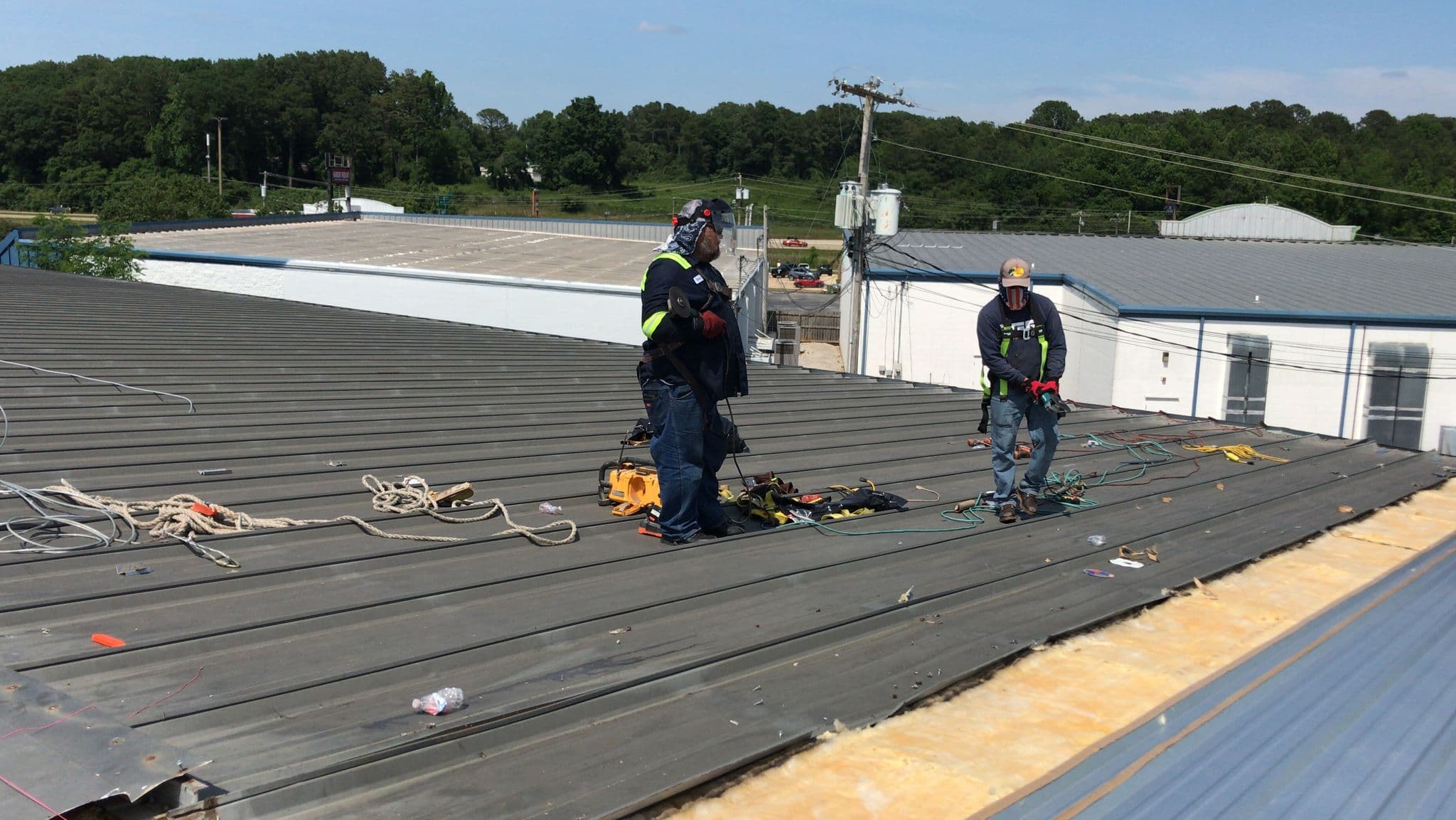
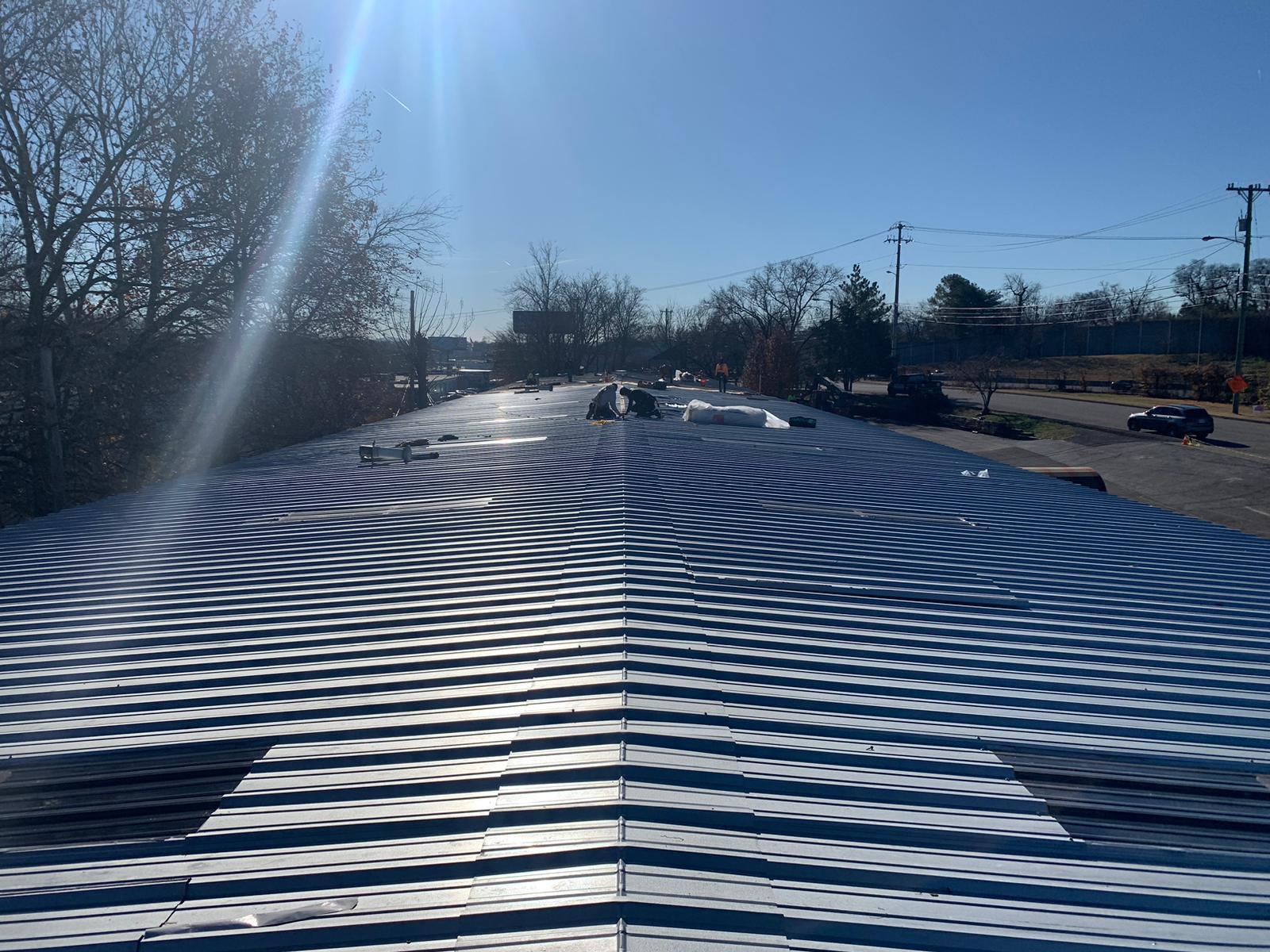
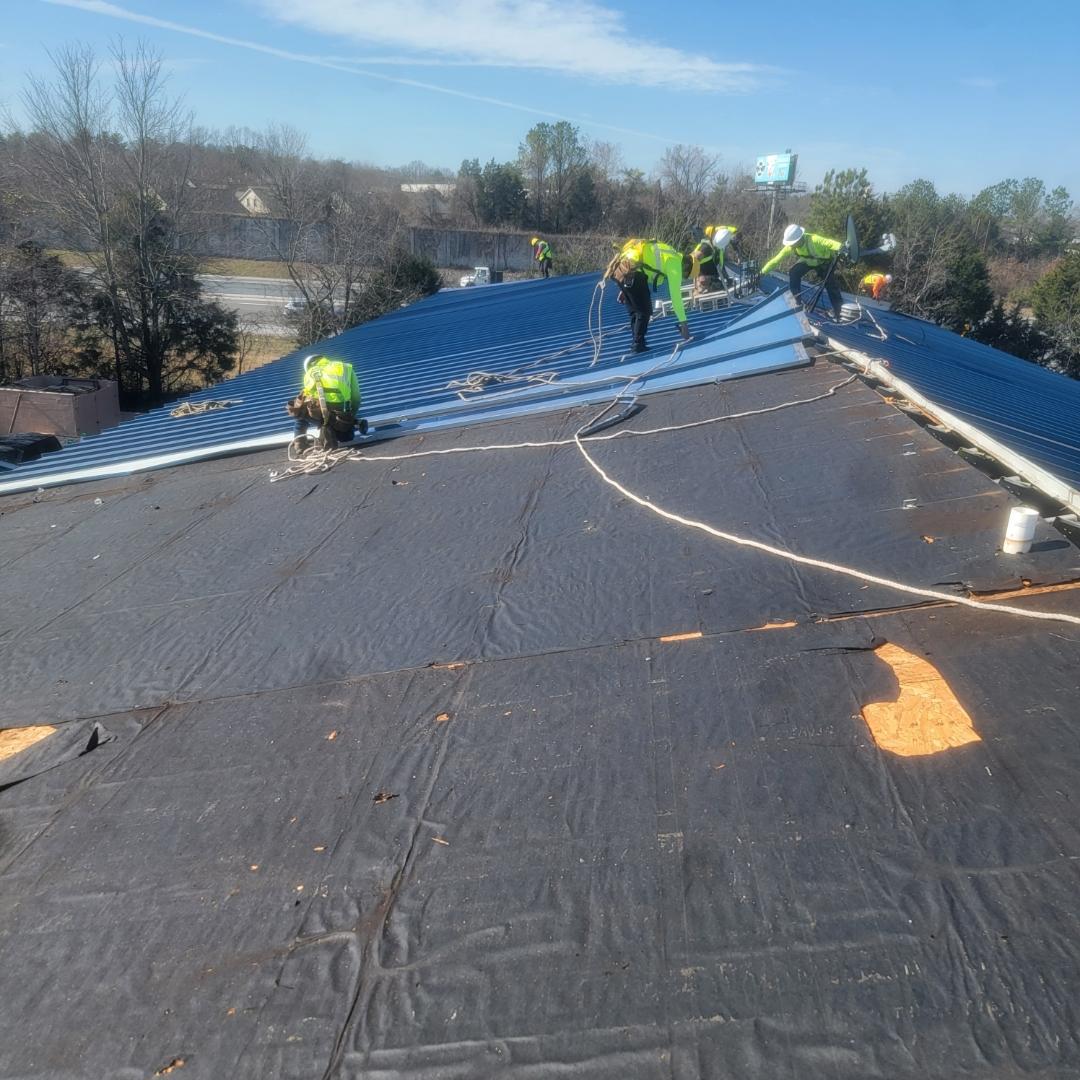
Tear-off and replacement execute to manufacturer specification with daily progress photography. Phased dry-in protocols protect the building from any weather event during the production window. Final deliverables include a close-out packet (material specs, warranty registration, as-built roof schematic, photo records), the workmanship warranty document alongside the manufacturer's No Dollar Limit (NDL) system warranty, and a Roof Condition Certification suitable for lender or insurer records. Customer role: final walk-through approval and sign-off.
How Insurance-Supported Commercial Roof Replacement Actually Works
Commercial property insurance in Georgia and Alabama has evolved significantly over the past decade. Percentage-based named-storm or wind/hail deductibles - typically 1 percent to 5 percent of the property's insured value - have largely replaced flat-dollar deductibles on commercial accounts. That structural change is what makes commercial and industrial roof claims materially different from single-family residential claims. Here's what matters:
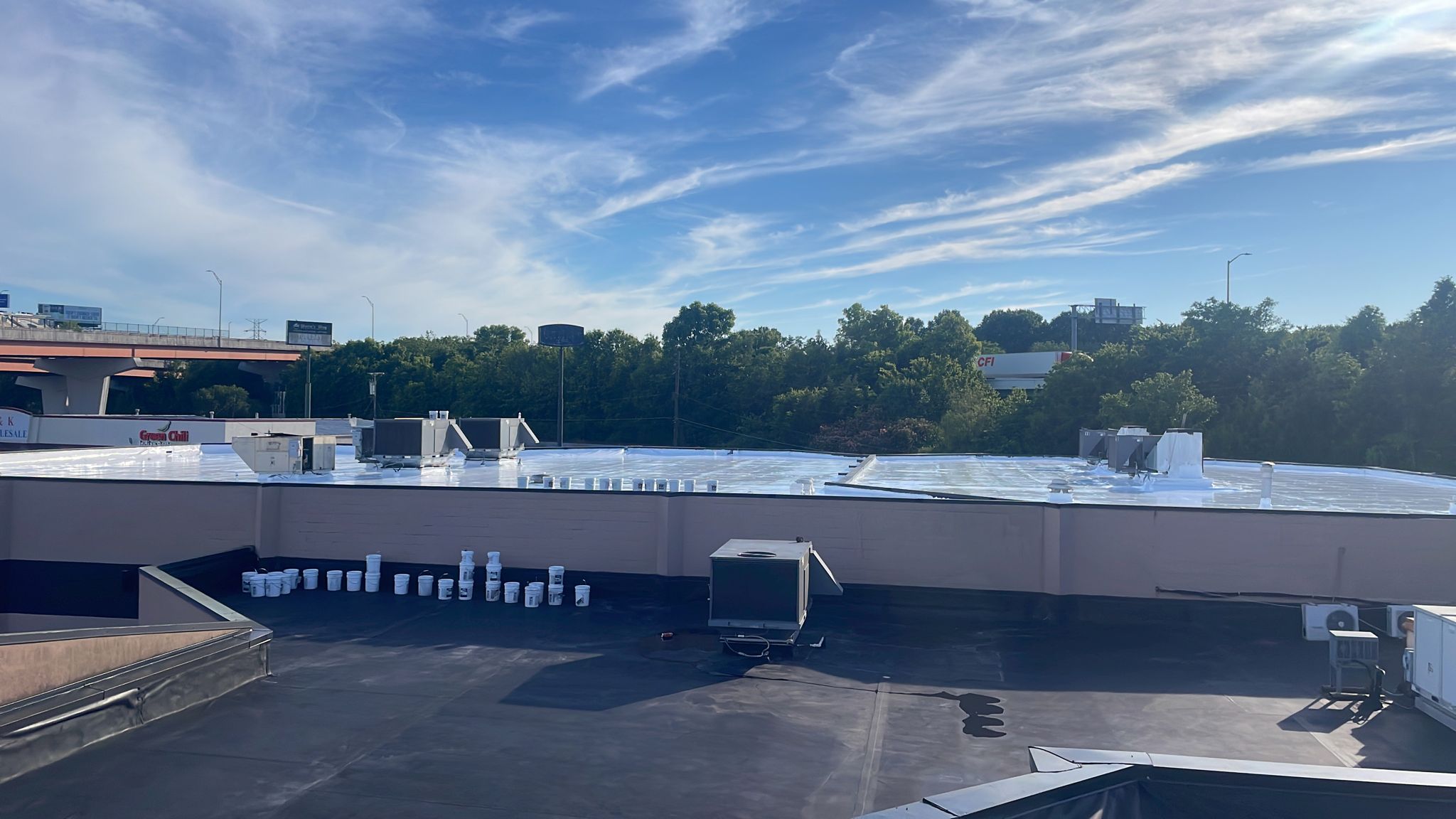
Percentage Deductibles Change the Math
A 2 percent wind/hail deductible on a $15 million commercial property is $300,000. That's the floor the owner pays out of pocket before any carrier reimbursement kicks in. On a $3 million multifamily building, a 3 percent deductible is $90,000. Understanding the actual deductible dollar figure is the first question any Atlanta, Birmingham, or Huntsville property manager should answer before engaging a roofing contractor on a storm claim. We walk the declaration page with you in plain English so there are no surprise carve-outs when the claim hits review.
RCV vs ACV - What the Payout Actually Looks Like
Replacement Cost Value (RCV) policies cover the cost of a new roof at current market prices. Actual Cash Value (ACV) policies deduct depreciation based on the roof's current age and condition, covering only the roof's depreciated value at time of loss. Most commercial policies pay initial funds at ACV (the depreciated value) and release recoverable depreciation at RCV after the work is completed, inspected, and documented. That two-step payout structure is why documentation-at-completion matters as much as documentation-at-claim: without the completion evidence, the recoverable depreciation never releases.
Matching Clauses and Ordinance-and-Law Coverage
Depending on state law and specific policy endorsements, carriers may be required to replace undamaged roof sections to maintain a uniform appearance and system integrity ("matching"), even when damage is partial. Ordinance-and-Law coverage unlocks reimbursement for code- required upgrades that the replacement scope triggers - typical examples across Georgia and Alabama include continuous-insulation R-value increases to ASHRAE 90.1 minimums (R-25 to R-30 on commercial replacements), updated fastening patterns, perimeter edge-metal upgrades, and fire-rated assembly requirements where local code mandates. Those line items are legitimate, code-referenced, and frequently missed on first-pass adjuster estimates - which is what the supplement process exists to capture.
The Supplement Process - What Legitimate Looks Like
Initial adjuster estimates on commercial roofs almost always omit legitimate scope. The supplement is the formal mechanism for documenting missed work with photo evidence and code citations and requesting it be added to the approved scope. We submit supplements for real missed items - underlayment, code-upgrade R-value, perimeter metal, rotten-deck replacement, HVAC curb flashing detail, additional penetrations - and we back every line with a photograph and a code or manufacturer-spec reference. We do not file speculative supplements. In our experience, Atlanta, Birmingham, and Huntsville adjusters approve reasonable, well-documented supplements at a high rate because the adjuster field is experienced and evidence-responsive.
What Outcomes Depend On (and What We Never Promise)
Commercial claim outcomes depend on the policy language, the carrier's adjuster assignment, the documented evidence quality, the date-of-loss validation against NOAA/NWS records, and the specific endorsements (matching, ordinance and law, business interruption) that apply. We never guarantee approval - nobody legitimately can. What we do commit to is thorough documentation, clear communication, and a process that lets the carrier make the right call on evidence rather than on gaps. When a claim is denied or partially approved, we explain why in plain language and help the owner decide next steps.
Material Selection by Building Type and Climate Zone
Not every building calls for the same roof system. Our material recommendations align with building type, rooftop traffic, chemical exposure, and the ASHRAE climate zone (mostly 3A across Georgia and Alabama; 2A along the Gulf Coast; 4A in north Alabama's higher elevations).
- Multifamily garden-style properties - architectural asphalt shingle dominates, with ridge ventilation and soffit detail work driving long-term performance. Roof replacements on multifamily often trigger ventilation-upgrade code requirements.
- Mid-rise and high-rise multifamily and office - single-ply membranes (reinforced TPO, EPDM) over tapered polyiso insulation deliver the wind-uplift performance and thermal efficiency that premium properties demand.
- Office parks and corporate campuses - white reinforced TPO is the near-default because of its Solar Reflectance Index (SRI), which delivers measurable summer HVAC savings on sprawling low-slope roofs.
- Retail centers and restaurant pads - PVC membrane is the standard for chemical and grease tolerance near food-service exhaust. TPO is acceptable on retail pads without food-service tenants but PVC is the safer specification where tenant mix is uncertain.
- Industrial, warehouse, and self-storage - wide-roll TPO or metal standing-seam goes down fast across massive square footages. Insulation R-value and fastening patterns dominate the scope decision.
- Hospitality - TPO or PVC with high-performance perimeter detailing; event-adjacent retail often drives PVC specification because of nearby food-service exhaust.
Tenant and Operations Coordination - Why It Matters
Commercial roof replacements on occupied properties live or die on tenant and operations coordination as much as on roof craft. The practical reality across Atlanta, Birmingham, Huntsville, Mobile, Montgomery, and the rest of our Georgia/Alabama footprint:
- Parking and crane logistics. Staging materials and setting crane positions on tight commercial footprints takes weeks of advance coordination with property management, tenants, and in some cases municipal right-of-way permitting (City of Atlanta, City of Birmingham, Montgomery downtown).
- Leak-risk mitigation. Tear-offs execute in phased sections with documented dry-in protocols so the building is never exposed to a weather event overnight. Every active section has its phased waterproofing plan before the first fastener backs out.
- Noise windows and debris containment. High-decibel activities (deck drilling, heavy tear-off) get scheduled around tenant operational hours where possible. OSHA-compliant debris chutes, ground-level fencing, and pedestrian-safety protocols apply on every active site.
- Phased Gantt communication. Property managers receive detailed timelines that let them notify specific tenants (a top-floor law firm, a medical tenant with noise sensitivity, a retail anchor with weekend events) precisely which days work will occur above their suite. Real coordination, real documentation.
Post-Install Deliverables and Closeout Documentation
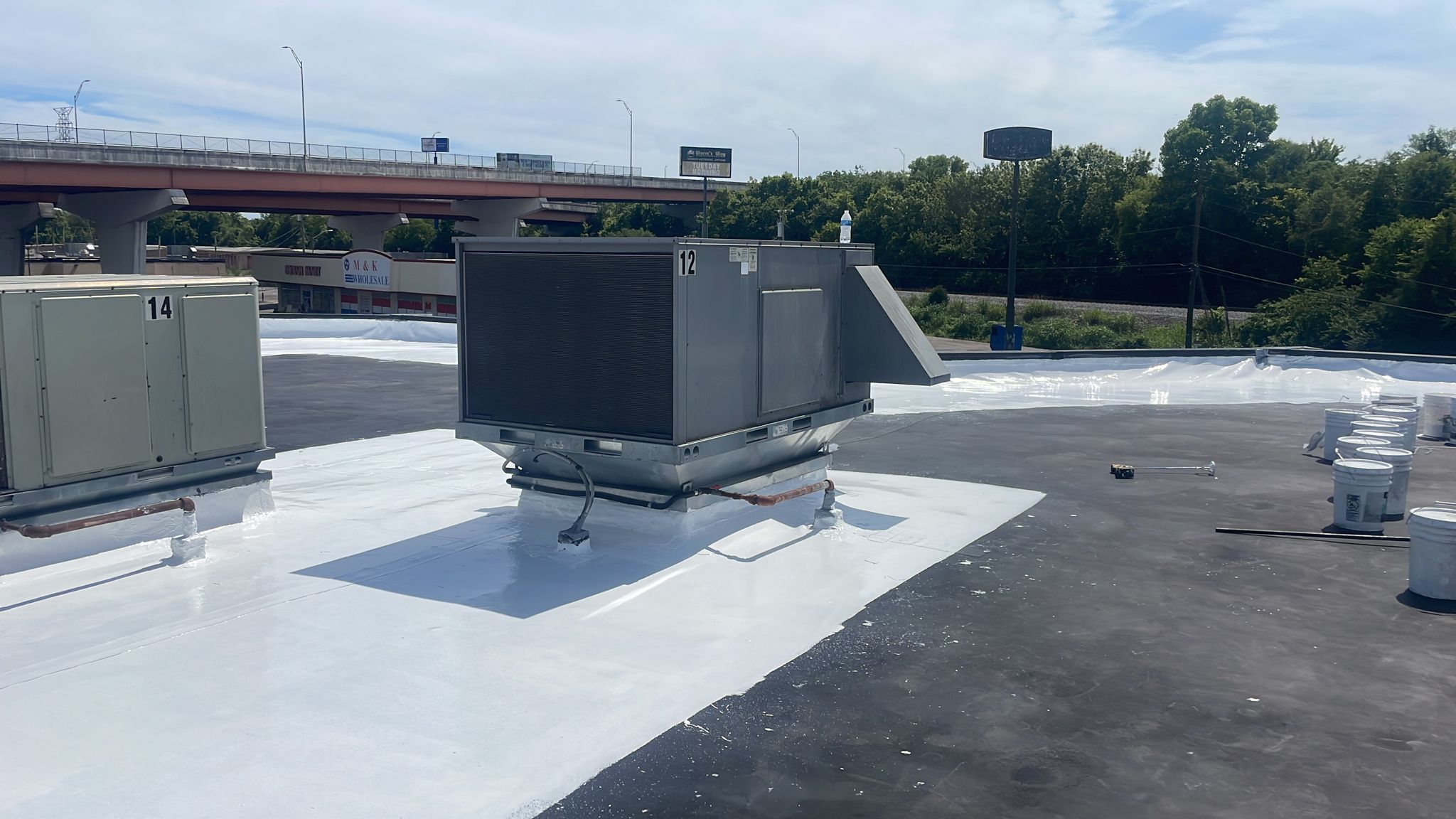
Every commercial roof replacement closes with a comprehensive deliverable package formatted for the way property owners, lenders, and carriers actually work:
- Close-out packet - digital and physical binder with all material specifications, safety data sheets (SDS), permits, and inspection sign-offs.
- As-built documentation - updated roof schematics detailing new drainage paths, tapered insulation layouts, and HVAC curb modifications. As-built drawings matter for future maintenance and the next replacement cycle.
- Warranty registration - workmanship warranty alongside the manufacturer's No Dollar Limit (NDL) system warranty, registered and transmitted to the property owner.
- Asset-manager photo records - before, during, and after high-resolution photography serving as a baseline for future asset valuation or storm claims.
- Roof Condition Certification - formal documentation that the roof meets current codes and manufacturer specifications, crucial for lender compliance on refinance or acquisition.
Georgia, Alabama, and the Broader Southeast - Regional Context
The commercial roof replacement rhythm across Georgia and Alabama is driven by three compounding inputs: the NOAA Storm Prediction Center's recurring severe-weather corridor that stretches from Mobile through Montgomery and Birmingham to metro Atlanta and up through Chattanooga; the UV and thermal-shock load that ASHRAE climate zone 3A delivers across the Piedmont and Coastal Plain; and the percentage wind/hail deductible structures Georgia and Alabama carriers have phased in across commercial accounts over the past decade. Metro Atlanta, Birmingham, and Huntsville all sit firmly in spring hail alley, with secondary late-summer convection exposure. Mobile and Savannah face elevated wind-uplift code requirements from Gulf tropical exposure, which drives material specification toward reinforced TPO or standing-seam metal.
Related reading on our site: our multifamily roofing service explores how we phase replacements on occupied apartment and condominium properties; our storm damage service covers the inspection-to-documentation workflow for post-event claims; our insurance claim support service goes deeper on adjuster coordination and supplement discipline; and our commercial storm insurance guide is a downloadable long-form walkthrough for property managers building out their storm-readiness playbook.
Our 5-Step Commercial Roof Replacement Process
Every commercial roof replacement engagement follows the same five-step process. The process is built around photo-keyed documentation at each stage - documented work protects the owner through claim, production, and closeout, and gives carriers, lenders, and asset managers the evidence they need without follow-up requests.
Step 1
On-Site Assessment
Photo-keyed inspection across every slope, drain, flashing, and penetration - not a cursory walk-by.
Step 2
Damage Evaluation
Qualification determination, or Certificate of Clearance if no damage. No obligation either way.
Step 3
Claims Support
Carrier coordination, adjuster documentation delivery, and scope-supplement support where warranted.
Step 4
Project Management
Phased production schedule, tenant-notice distribution, material procurement, and daily operations.
Step 5
Installation & Restoration
On-roof production with daily photo documentation, punch-list completion, and closeout records.
What Commercial Roof Replacement Documentation Looks Like
Every commercial roof replacement engagement produces a photo-keyed PDF report suitable for carrier, lender, and asset-manager review. The report identifies the roof system on your property (TPO, EPDM, PVC, modified bitumen, BUR, metal, architectural shingle, or a mixed portfolio), estimates remaining useful life, flags flashing and penetration condition, and documents any observed damage with date-of-loss alignment where applicable. We also call out situations where we recommend repair rather than replacement - our business is built on honest scoping, not upselling.
On multifamily buildings we document building-by-building, which matters because a 300-unit complex may show damage concentrated on two of eight roofs. Adjusters want that granularity, and the documentation protects owners from blanket-scope claims that get pared back in review. For portfolio owners with multiple commercial properties, we deliver portfolio-level summaries that asset-management teams can file without re-formatting.
Commercial Roof Replacement Across 16 States
Red Door Roofing delivers commercial roof replacement across a 16-state footprint spanning the Southeast, South, Midwest, and Gulf. Most of our crews run out of Georgia, Tennessee, Alabama, and South Carolina, where we know the local storm history and code requirements firsthand, and our coverage extends across Georgia, North Carolina, South Carolina, Alabama, Kentucky, Tennessee, Texas, Oklahoma, Louisiana, Mississippi, Florida, Arkansas, Missouri, Kansas, Iowa, Indiana. Commercial and multifamily property owners in any served state can request an inspection through our contact form or by calling 1-855-GO4REDD.
Why Property Managers Choose Red Door Roofing for Commercial Roof Replacement
Commercial and multifamily property owners face a common problem: roof damage often hides in plain sight, claim windows close faster than tenant-reported symptoms, and storm-chaser crews flood markets promising everything and delivering inconsistently. Red Door Roofing is built on the opposite approach - inspect first, document with photo-keyed evidence, support the claim paperwork without guaranteeing outcomes, and manage installation with tenant-in-place phasing. Our commercial roof replacementwork draws on 30 years of Red Door family experience across the Southeast, including commercial projects for Best Western, Harbor Freight, Tractor Supply, Vanderbilt Medical Clinic, Food Land, Hope Church, Impact Church, and Milan Inn and Suites.
30+ years of Red Door family experience
Built on 30 years of commercial and multifamily work across the Southeast. Commercial clients include Best Western, Harbor Freight, Tractor Supply, and Vanderbilt Medical Clinic.
Carrier-ready documentation
Photo-keyed inspection reports formatted for adjuster and lender review. We match the documentation standards carriers actually request post-event.
Tenant-in-place multifamily phasing
Multifamily work phased by building block with tenant-notice templates, noise windows, and operations-team documentation. Tenants stay in place.
No-obligation inspection
If our inspection finds no qualifying damage, we issue a Certificate of Clearance at no cost or commitment.
Industry certifications
NRCA member, BOMA member, Licensed General Contractor in multiple states.
Honest scoping
We recommend repair over replacement when the building supports it. Our business is built on credibility with property managers - not upselling.
Frequently Asked Questions
Does commercial roof storm damage qualify for insurance replacement?
How long does a commercial roof replacement take?
What is the typical deductible on a commercial roof claim?
What is the difference between ACV and RCV?
Can tenants remain in the building during replacement?
What roof systems do you install on commercial properties?
How is a commercial roof replacement different from single-family work?
What does a commercial roof inspection include?
Do you handle multifamily properties with tenants in place?
Which states does Red Door Roofing serve?
How much does a new commercial roof cost?
What warranty comes with a new commercial roof?
How do I know when my commercial roof needs to be replaced?
Will you work with my insurance company for me?
What is a photo-keyed PDF report?
Do you offer roof inspections?
How long will my new commercial roof last?
What roof systems work best in Georgia and Alabama heat?
Can I put a new roof on top of my old roof?
What happens if it rains during my roof replacement?
What should I do before the roof crew arrives?
Still have questions about commercial roof replacement? Our inspections are no-obligation - if no damage is found, we issue a Certificate of Clearance at no cost.
Request InspectionRelated Services
Commercial Roof Replacement rarely exists in isolation - most commercial roof engagements touch two or three adjacent services (inspection → storm-damage → replacement, or inspection → certification, or replacement → insurance-claim-support). Here are the services most commonly paired with Commercial Roof Replacement.
Ready to start?
Call 1-855-GO4REDD or request a no-obligation inspection online. Most inspections are scheduled within days of the request.