Short answer: Commercial roof leak repair is the targeted-scope service of locating the actual source of an active or recurring water-intrusion event on a commercial, industrial, or multifamily roof - then remediating that source with manufacturer-approved methodology - distinct from full roof replacement and from generic preventative repair.
When You Have an Active Commercial Roof Leak
An active commercial roof leak is an emergency. Water inside the building means tenant complaints, interior damage, business-interruption exposure, mold-growth risk, and a documentation timeline that starts now whether you act or not. The right response is fast triage, accurate diagnosis, and a repair that addresses the actual source - not a patch on the obvious wet spot that buys six weeks before the same leak comes back.
Three things to know in the first hour of an active commercial leak:
- The leak source is rarely directly above the interior damage. Water travels along the underside of the membrane, along deck slope, or along structural members before manifesting at a tenant-visible location. The wet ceiling tile is usually nowhere near the actual membrane breach. Pulling the ceiling tile and looking up will tell you the deck condition above the wet spot, not the membrane breach.
- Patching the obvious symptom is the wrong move. A patch over the interior wet spot - without finding and addressing the actual source - almost always fails within weeks because water continues to enter at the actual breach and finds a new path to interior space.
- The first 24 to 48 hours matter for documentation. If the leak is from a covered peril (wind, hail, tropical storm, tree-fall), the insurance claim window starts when the loss occurs. Photo documentation, dated, with weather correlation, is what supports the carrier conversation. Even if you do not pursue a claim, the documentation protects future warranty conversations.
What Gets Done Inside the First 48 Hours
Our emergency leak response sequence on a commercial property:
Hour 0 - Phone Triage and Dispatch
Phone intake captures: property address, building type and approximate square footage, observed interior damage location and severity, weather context (recent storm event, ongoing rain, no precipitation), tenant impact, any prior repair history, and existing manufacturer warranty status. Triage classifies the call as immediate-response (active intrusion into occupied space), priority-response (intrusion contained but ongoing), or scheduled-response (recurring or chronic leak without acute intrusion). Dispatch follows the triage outcome.
Hour 1 to 24 - On-Site Diagnosis
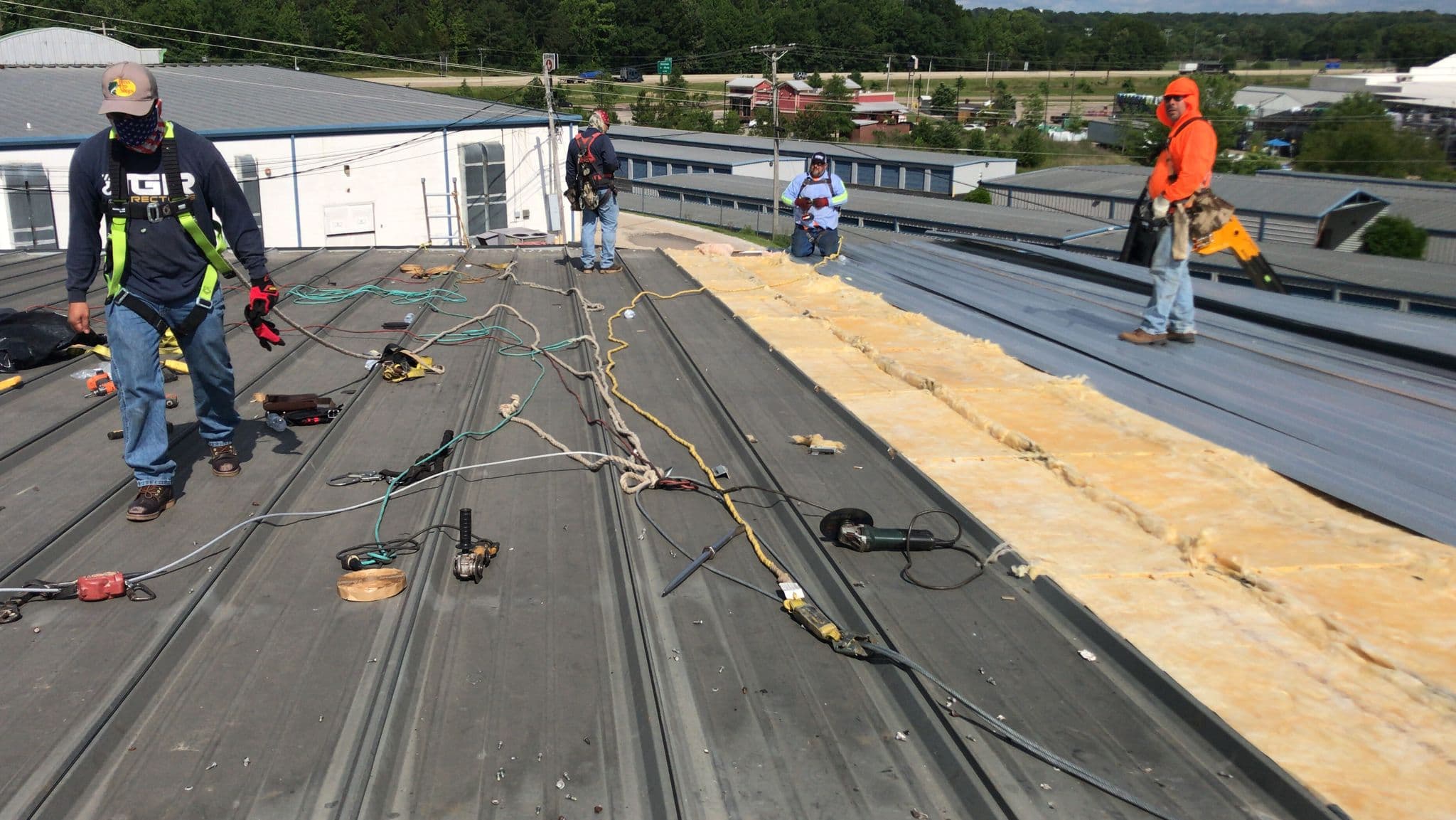
On-site arrival begins with interior damage assessment, then transitions to on-roof inspection. On-roof diagnosis combines visual examination by slope orientation, tactile inspection of suspect seams and flashings, moisture meter survey across the field, infrared thermography on the area above the interior damage, and where the path remains ambiguous, water-test verification with controlled flooding of suspect zones. Diagnosis ends with a documented root-cause finding, not a guess.
Hour 24 to 48 - Temporary Stabilization
Permanent repair often requires a dry weather window for membrane bonding and welding. Temporary stabilization in the meantime - tarp-and-cover, emergency sealant on accessible breaches, drain clearing where standing water contributes - buys the time needed to schedule durable repair. Temporary work is documented as temporary; the permanent repair scope and timeline get communicated to the property manager or asset manager at the same visit.
Day 2 to 14 - Permanent Repair Execution
Permanent repair scheduling depends on weather window, materials availability, and crew availability. The repair scope is fixed-fee with no surprise expansions; if diagnosis revealed adjacent issues that warrant attention beyond the leak source, those get scoped separately rather than added during execution. Repair execution uses manufacturer-approved methodology and materials. Closeout includes water-test verification on the repair area, before-and-after photo documentation, and the written report that gets filed with the property records.
Common Commercial Roof Leak Sources by System
TPO Roof Leaks
The dominant TPO leak sources, in rough order of frequency:
- Heat-welded seam separation - improperly welded seams from amateur installation, or aged seams approaching end-of-life. Visual scan typically identifies the failed seam; tactile validation with a probe confirms the gap.
- Penetration flashing failure - pipe boots and HVAC-curb flashings are high-failure-risk areas. Sealant degradation, gasket failure, and fastener back-out at penetrations all create direct leak paths.
- Puncture damage from rooftop traffic - HVAC-service work, telecommunications maintenance, solar-array installation, and window-cleaning anchors can puncture thinner-mil TPO. Walking pads at high-traffic zones mitigate.
- Perimeter termination failure - roof-to-wall transitions, parapet flashings, and edge-metal terminations at perimeter are stress zones that fail before the field membrane.
For TPO substrate context, see our TPO Roofing material guide.
EPDM Roof Leaks
The dominant EPDM leak sources:
- Adhesive seam failure - older mechanically-fastened and adhered EPDM systems develop seam-adhesive degradation that opens leak paths along the roll edges.
- Membrane shrinkage at perimeter - decades-old EPDM can shrink and pull away from parapets, drains, and penetrations, opening gaps at perimeter terminations.
- Puncture damage - lower puncture resistance than reinforced TPO; high-traffic zones develop punctures from foot traffic and dropped equipment.
- Ballast displacement on ballasted EPDM systems - wind events can shift stone ballast, exposing the membrane to UV and creating uplift vulnerability that progresses to leak paths.
PVC Roof Leaks
The dominant PVC leak sources:
- Heat-welded seam failure - similar pattern to TPO; welding quality determines long-term integrity.
- Plasticizer migration on aged PVC - decades-old PVC can lose plasticizer flexibility and develop cracking or shattering, especially at stress zones around penetrations.
- Penetration flashing in chemical/grease zones - PVC's chemical resistance is the reason it gets specified, but flashings around chemical-exhaust HVAC equipment still fail at the gasket and sealant level.
Modified Bitumen and Built-Up Asphalt Leaks
The dominant mod-bit leak sources:
- Cap-sheet granule loss - UV-induced granule loss accelerates degradation of the underlying asphalt; eventually the membrane reaches the end of useful life and develops leak paths in the field.
- Lap and seam failure - multi-ply assemblies have multiple seam interfaces, each a potential leak path as the asphalt ages.
- Blistering and ridging - trapped moisture under the membrane can create blisters that progress to ruptures and active leak paths.
- Flashing failure - same penetration and perimeter failure modes as single-ply systems.
Metal Roof Leaks
The dominant metal leak sources:
- Fastener-gasket failure on exposed-fastener metal - gaskets degrade over time, creating leak paths at every fastener penetration. Common on aging exposed-fastener systems.
- Seam-sealant failure on standing-seam - sealant at field-seamed joints degrades over time, allowing water entry at the seam.
- Penetration flashings - chimney, vent, and skylight flashings on metal roofs follow the same failure pattern as on other systems.
- Snow-guard and gutter failures in north Tennessee and north Georgia - improper snow management can drive water under shingled or metal courses during ice events.
For metal substrate context, see our Metal Roofing guide.
Repair Verification - Why It Matters
A commercial roof leak repair that has not been verified watertight is not done. We close out every leak repair with verification appropriate to the diagnosis: water-test on the suspect zone after the patch cures, observation period during subsequent rain events with the property manager, and where the leak path was complex, infrared thermography on the area to confirm no remaining moisture in the substrate.
The verification step matters because the alternative - closing out a "completed" repair without verification - produces the worst customer-experience outcome in commercial roofing: the same leak comes back six weeks later, the original repair invoice is contested, and the relationship with the property owner suffers. Doing the verification right the first time is cheaper and faster than the back-and-forth that follows a missed verification.
Commercial Roof Leak Repair Across the Southeast
Emergency leak response operates across our Georgia, Alabama, South Carolina, and Tennessee focus markets. Metro Atlanta emergency leak response covers the full I-285 perimeter and inside-the-perimeter commercial including Buckhead, Midtown, Sandy Springs, Vinings, Roswell, Alpharetta, Decatur, Marietta, and the broader Atlanta MSA. Birmingham emergency leak response covers Hoover, Vestavia Hills, Homewood, Mountain Brook, Trussville, and the U.S. 280 corridor. Huntsville emergency leak response covers Cummings Research Park, Madison, and the Redstone-adjacent commercial footprint. Mobile and Baldwin County emergency leak response includes Gulf Coast hospitality, port-adjacent industrial, and named-storm-event response. Charleston, Columbia, and Greenville emergency leak response covers the South Carolina commercial footprint. Nashville, Memphis, Knoxville, and Chattanooga emergency leak response covers the Tennessee commercial corridor.
For the adjacent service conversations, see our commercial roof repair service (the broader repair-vs-replace decision framework), storm damage service (insurance-supported response to storm-event leaks), commercial roof inspection service (the diagnostic foundation), commercial roof maintenance programs (the recurring discipline that prevents most leaks before they happen), commercial roof coatings & restoration service (the life-extension scope on aging systems), commercial roof replacement service (when leak frequency justifies replacement), and insurance claim support service (when the leak source qualifies for carrier coverage). For material-specific context, see our TPO Roofing guide, Flat Roof Systems comparison, and Metal Roofing guide. For market-specific context, see our Atlanta commercial roofing, Birmingham commercial roofing, Huntsville commercial roofing, Charleston commercial roofing, and Nashville commercial roofing pages.
Our 5-Step Commercial Roof Leak Repair Process
Every commercial roof leak repair engagement follows the same five-step process. The process is built around photo-keyed documentation at each stage - documented work protects the owner through claim, production, and closeout, and gives carriers, lenders, and asset managers the evidence they need without follow-up requests.
Step 1
On-Site Assessment
Photo-keyed inspection across every slope, drain, flashing, and penetration - not a cursory walk-by.
Step 2
Damage Evaluation
Qualification determination, or Certificate of Clearance if no damage. No obligation either way.
Step 3
Claims Support
Carrier coordination, adjuster documentation delivery, and scope-supplement support where warranted.
Step 4
Project Management
Phased production schedule, tenant-notice distribution, material procurement, and daily operations.
Step 5
Installation & Restoration
On-roof production with daily photo documentation, punch-list completion, and closeout records.
What Commercial Roof Leak Repair Documentation Looks Like
Every commercial roof leak repair engagement produces a photo-keyed PDF report suitable for carrier, lender, and asset-manager review. The report identifies the roof system on your property (TPO, EPDM, PVC, modified bitumen, BUR, metal, architectural shingle, or a mixed portfolio), estimates remaining useful life, flags flashing and penetration condition, and documents any observed damage with date-of-loss alignment where applicable. We also call out situations where we recommend repair rather than replacement - our business is built on honest scoping, not upselling.
On multifamily buildings we document building-by-building, which matters because a 300-unit complex may show damage concentrated on two of eight roofs. Adjusters want that granularity, and the documentation protects owners from blanket-scope claims that get pared back in review. For portfolio owners with multiple commercial properties, we deliver portfolio-level summaries that asset-management teams can file without re-formatting.
Commercial Roof Leak Repair Across 16 States
Red Door Roofing delivers commercial roof leak repair across a 16-state footprint spanning the Southeast, South, Midwest, and Gulf. Most of our crews run out of Georgia, Tennessee, Alabama, and South Carolina, where we know the local storm history and code requirements firsthand, and our coverage extends across Georgia, North Carolina, South Carolina, Alabama, Kentucky, Tennessee, Texas, Oklahoma, Louisiana, Mississippi, Florida, Arkansas, Missouri, Kansas, Iowa, Indiana. Commercial and multifamily property owners in any served state can request an inspection through our contact form or by calling 1-855-GO4REDD.
Why Property Managers Choose Red Door Roofing for Commercial Roof Leak Repair
Commercial and multifamily property owners face a common problem: roof damage often hides in plain sight, claim windows close faster than tenant-reported symptoms, and storm-chaser crews flood markets promising everything and delivering inconsistently. Red Door Roofing is built on the opposite approach - inspect first, document with photo-keyed evidence, support the claim paperwork without guaranteeing outcomes, and manage installation with tenant-in-place phasing. Our commercial roof leak repairwork draws on 30 years of Red Door family experience across the Southeast, including commercial projects for Best Western, Harbor Freight, Tractor Supply, Vanderbilt Medical Clinic, Food Land, Hope Church, Impact Church, and Milan Inn and Suites.
30+ years of Red Door family experience
Built on 30 years of commercial and multifamily work across the Southeast. Commercial clients include Best Western, Harbor Freight, Tractor Supply, and Vanderbilt Medical Clinic.
Carrier-ready documentation
Photo-keyed inspection reports formatted for adjuster and lender review. We match the documentation standards carriers actually request post-event.
Tenant-in-place multifamily phasing
Multifamily work phased by building block with tenant-notice templates, noise windows, and operations-team documentation. Tenants stay in place.
No-obligation inspection
If our inspection finds no qualifying damage, we issue a Certificate of Clearance at no cost or commitment.
Industry certifications
NRCA member, BOMA member, Licensed General Contractor in multiple states.
Honest scoping
We recommend repair over replacement when the building supports it. Our business is built on credibility with property managers - not upselling.
Frequently Asked Questions
How fast can you respond to an active commercial roof leak?
Why is commercial roof leak diagnosis harder than residential?
How much does a commercial roof leak repair cost?
What are the most common sources of commercial roof leaks?
Can you repair a leaking roof while it is actively raining?
Do leak repairs void manufacturer warranties on commercial roofs?
What if the leak source cannot be found from on-roof inspection alone?
Is a leak repair the right answer or do I need full replacement?
Do you handle leak repairs on industrial and warehouse properties?
Do you handle multifamily leak repairs on occupied buildings?
What documentation do you provide after a commercial roof leak repair?
Can a commercial roof leak qualify for insurance coverage?
Do you offer emergency commercial roof leak repair across the Southeast?
Still have questions about commercial roof leak repair? Our inspections are no-obligation - if no damage is found, we issue a Certificate of Clearance at no cost.
Request InspectionRelated Services
Commercial Roof Leak Repair rarely exists in isolation - most commercial roof engagements touch two or three adjacent services (inspection → storm-damage → replacement, or inspection → certification, or replacement → insurance-claim-support). Here are the services most commonly paired with Commercial Roof Leak Repair.
Ready to start?
Call 1-855-GO4REDD or request a no-obligation inspection online. Most inspections are scheduled within days of the request.