
The 48-Hour Rule — and Why Memphis Makes It Hard to Ignore
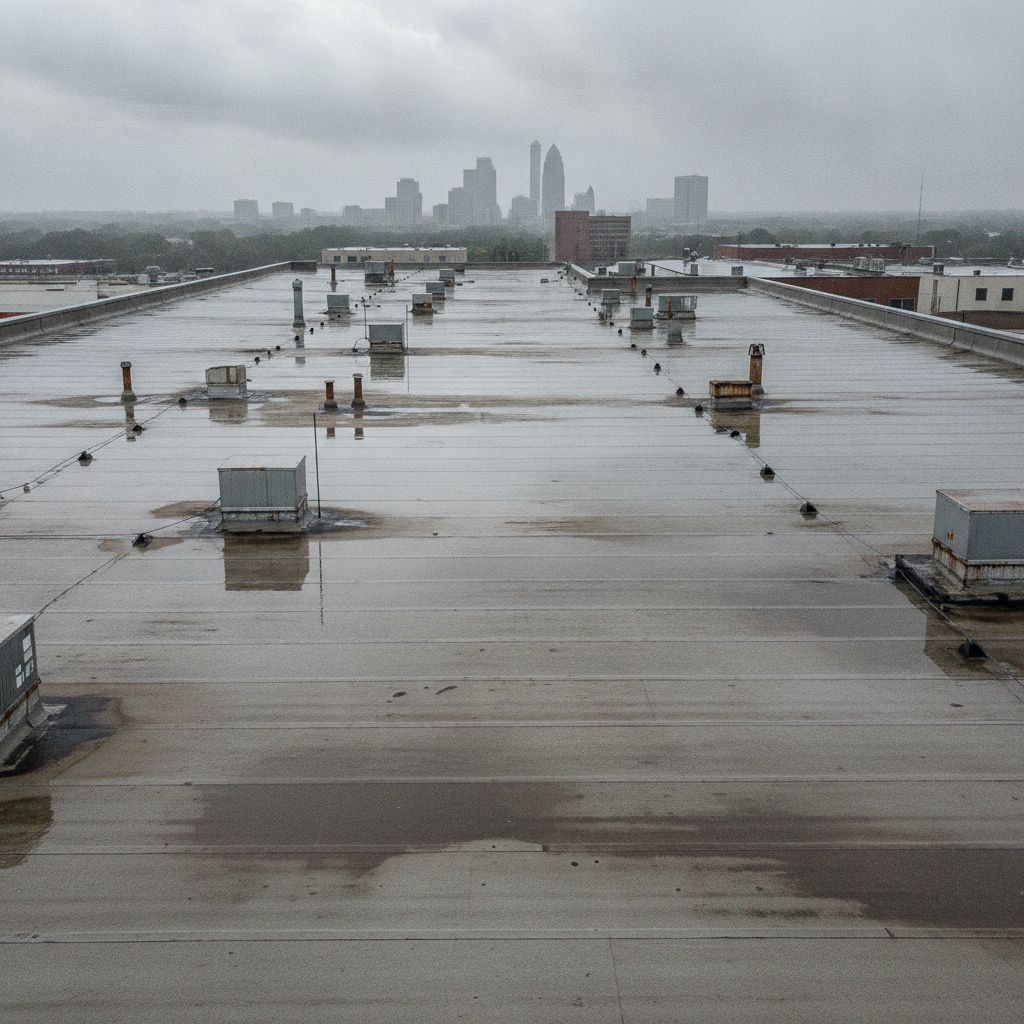
Ponding water on a flat roof isn't a cosmetic issue. The NRCA's standard is clear: water that's still sitting on a low-slope roof 48 hours after a rain event is a problem that warrants action. In Memphis, that threshold gets tested constantly.
The metro averages around 53 inches of rainfall a year — well above the national average — and it doesn't come in gentle, spread-out showers. We get heavy convective storms off the Mississippi corridor, fast-moving squall lines, and multi-day soaking events that drop several inches before your drains have time to recover. If your drainage system is even marginally underperforming, you're going to see ponding after most of those events.
The older commercial stock along Airways Boulevard, the industrial corridors near the port, and the warehouse clusters off Shelby Drive and Lamar Avenue — a lot of that was built between the late 1970s and mid-1990s. Those buildings have decades of thermal cycling, structural settlement, and insulation compression working against them. Drainage problems that didn't exist when the building was new are common now.
So let's talk about what's actually causing the water to sit, what it's doing to your roof while it does, and what your realistic fix options are.
What Causes Flat Roof Ponding Water
There's rarely just one cause. In our experience, ponding on older Memphis commercial properties usually involves a combination of these:
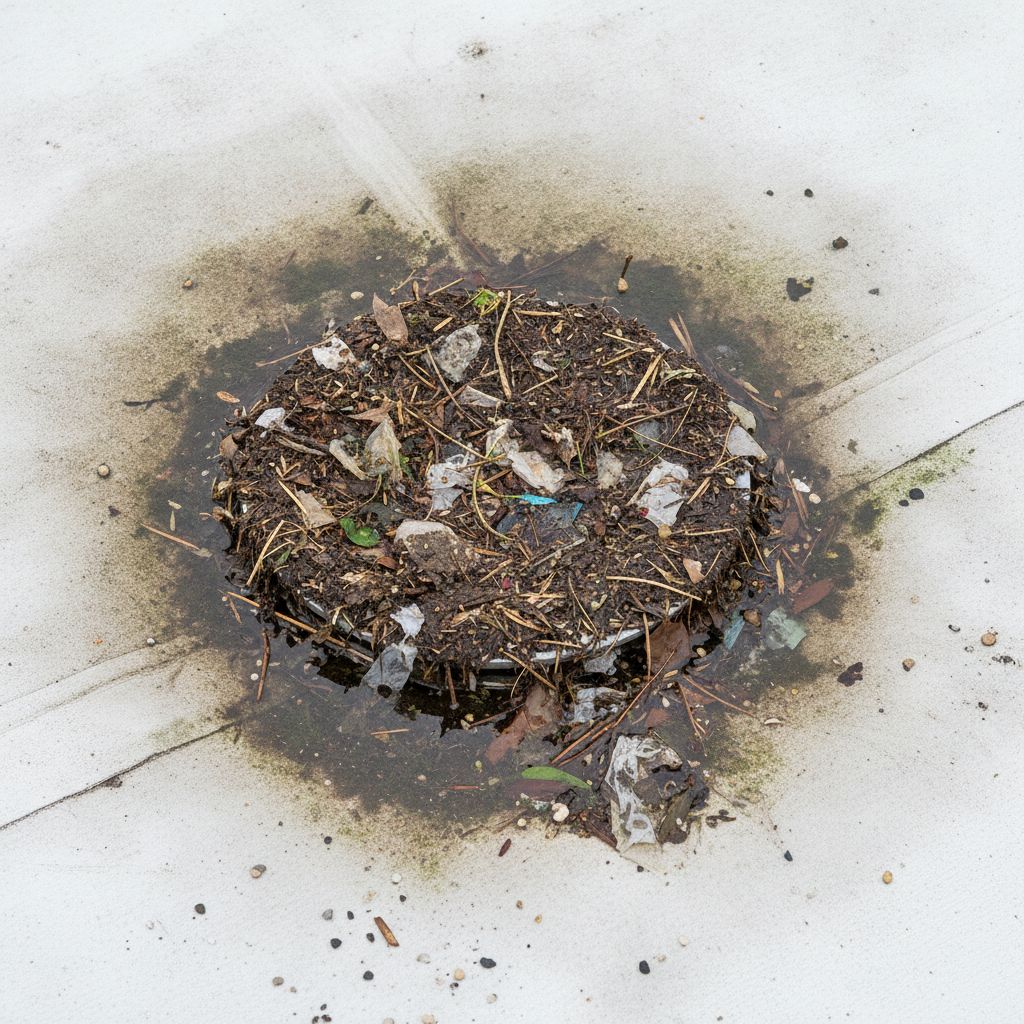
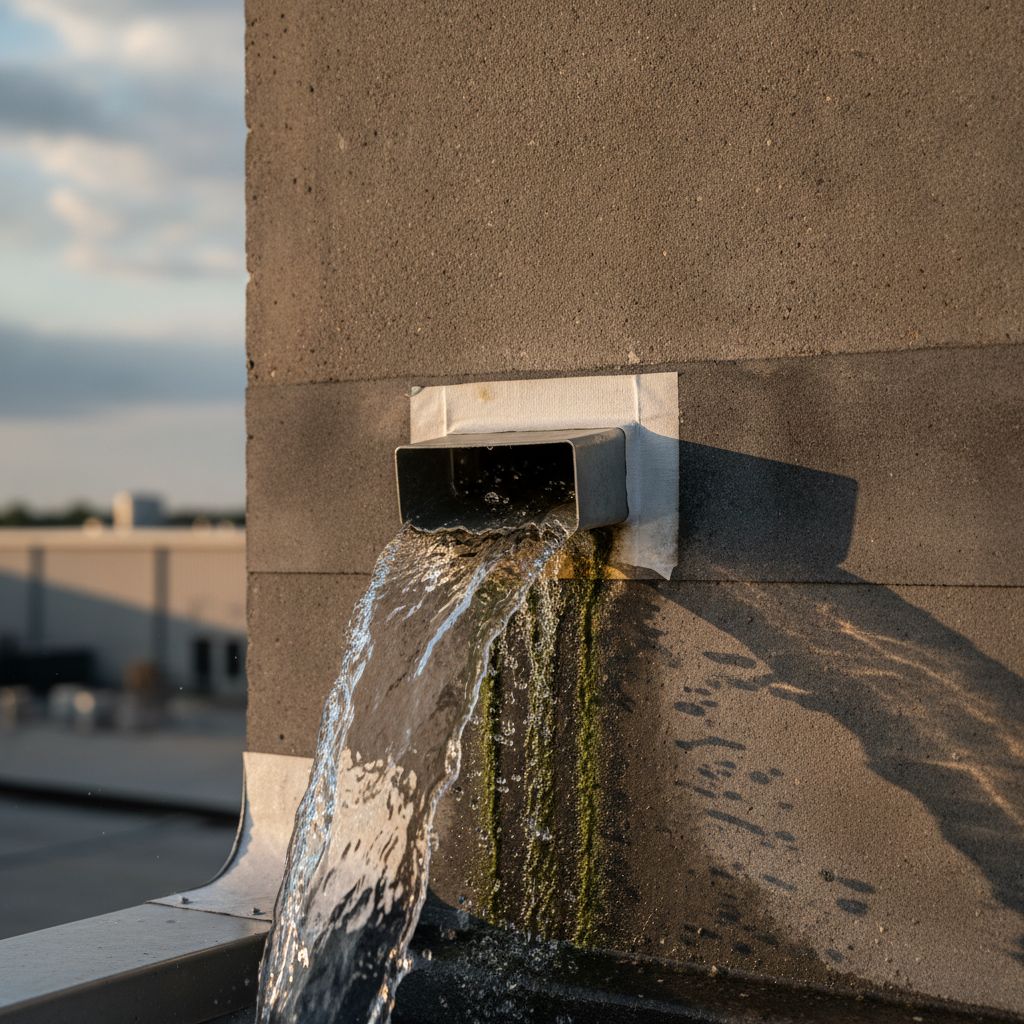
Clogged or undersized drains and scuppers. This is the most common starting point. Roof drains accumulate debris — gravel, leaves, HVAC condensate scale, biological growth. Scuppers at parapet walls get blocked by the same. A drain that's 90% obstructed doesn't look obviously clogged from a distance, but it can't move water fast enough during a heavy rain event. Memphis summer storms regularly drop an inch or more per hour. Even a correctly sized drain can't keep up if it's partially blocked.
Structural deck deflection. Steel and concrete decks settle over time. On buildings 25-plus years old, it's common to find low spots that weren't designed into the original drainage slope — the structure has moved. Those depressions collect water regardless of whether the drains are clear.
Insulation compression. Polyiso and other rigid insulation boards compress over decades, especially in areas with repeated foot traffic around HVAC units. A two-inch insulation board that's lost a quarter-inch of thickness in a 20-by-20-foot area around a rooftop unit creates a low spot. Multiply that across a 50,000-square-foot roof and you've got multiple collection points.
Inadequate original slope. Memphis building codes today require a minimum ¼-inch-per-foot slope on low-slope roofs, but plenty of older buildings were built to looser standards — or had roofing contractors in past decades spec flat assemblies without tapered insulation. The roof was never going to drain well.
Membrane displacement or settlement at drains. The area immediately around an interior drain can sink slightly as the drain body settles, creating a moat effect that actually slows drainage near the point where it should be fastest.
What Ponding Water Is Doing to Your Roof Right Now
If you've got known low spots that hold water for days after every storm, here's what's happening to your membrane and your building:
Dead load accumulation. Water weighs about 5.2 pounds per square foot per inch of depth. Two inches of standing water across a 5,000-square-foot low spot is roughly 52,000 pounds of unplanned load. That number matters if your structural calculations weren't designed around it — and on an older Memphis warehouse or retail box, they probably weren't. This isn't a theoretical concern; it's a structural one.
Accelerated membrane degradation. UV exposure is more intense at water surfaces. Biological growth — algae, mold, root intrusion from wind-deposited seeds — establishes fastest in areas that stay wet. On TPO and EPDM membranes, prolonged ponding softens and breaks down the membrane surface over time. Modified bitumen is susceptible to the same degradation. The areas that pond first are usually the areas that fail first.
Seam and flashing stress. The weight of standing water puts lateral stress on membrane seams at the edges of low spots. Over time, seams that were sound can begin to open. Flash points around HVAC curbs sitting in chronic ponding areas see accelerated sealant failure.
Warranty exposure. Most single-ply membrane manufacturers — Firestone, GAF, Carlisle, among others — include language in their warranties that voids coverage in areas of documented ponding. If you've got a roof under a manufacturer warranty and you've got chronic ponding, that's a gap in your coverage you should know about.
Freeze events. Memphis doesn't get brutal winters, but we do get enough below-freezing nights — typically in January and February — that standing water freezes. Ice expansion at seams and around drain bodies can open penetrations that were marginal all summer. A drainage problem that seemed manageable in August becomes an emergency in January.
How to Actually Fix It
The right fix depends on what's causing the ponding. This is where a proper roof assessment matters, because throwing money at a drain cleaning when the real problem is deck deflection won't solve anything.
Start with drain and scupper cleaning. This should happen at minimum twice a year on any Memphis commercial property — spring and fall. It's not glamorous, but it's the highest-return maintenance task on a flat roof. Clear the strainer baskets, rod out the drain bodies, verify flow. If you can't remember the last time it was done, get someone up there this week.
Crickets and saddles at HVAC curbs. Rooftop units sitting in low spots benefit from properly built crickets — triangular sheet-metal or membrane-formed ridges that direct water around the curb and toward drains rather than letting it pool. This is a repair-scope item, not a replacement trigger.
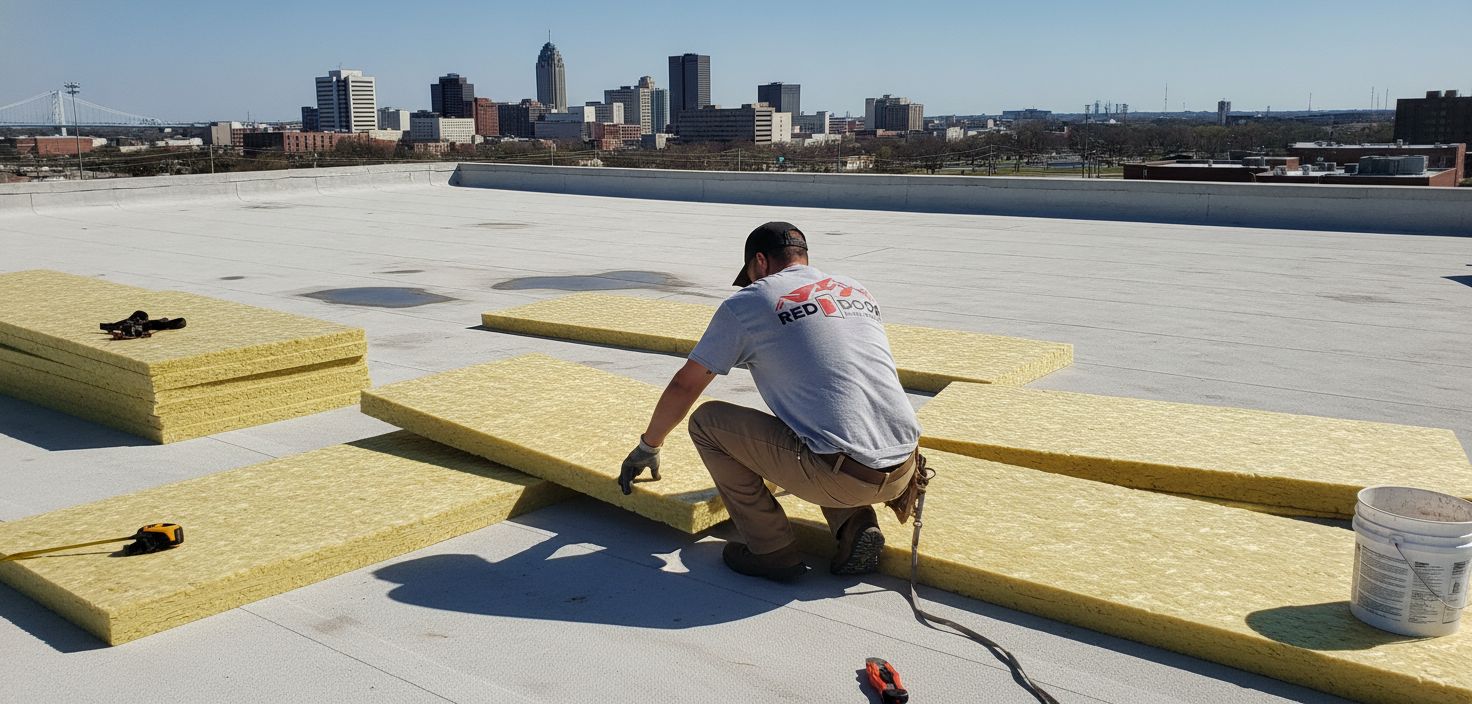
Tapered insulation systems. This is the standard fix for chronic low spots caused by inadequate original slope or insulation compression. Tapered polyiso boards are installed over the existing assembly in a layout designed to create positive drainage toward drains or scuppers. On a replacement, we'd typically spec this into the full scope. On an existing roof with remaining useful life, we can often add tapered fill boards as a targeted repair. This is the most durable long-term solution for drainage problems that aren't drain-maintenance related.
Additional drains or scuppers. Some buildings genuinely don't have enough drainage capacity for their roof area, or drains are positioned poorly relative to where the low spots actually are. Adding interior drains or cutting additional scuppers through parapets is a legitimate fix — but it requires coordination with your structural engineer on drain sizing and waterproofing the new penetration correctly.
Drain extension rings. If a drain body has settled below the membrane surface, a drain extension ring can raise the drain edge to meet current membrane height. Simple fix, often overlooked.
How to Know What You're Actually Dealing With
Before you spend money on any of these fixes, get a proper assessment. Specifically:
- A roof walk after a significant rain event (24-48 hours out) is the most revealing thing you can do. Bring someone who knows what to look for. The low spots will show themselves.
- An infrared moisture survey identifies where water has migrated into the insulation layer below the membrane — areas that feel dry on top but have trapped moisture underneath. This matters because wet insulation has to come out regardless of what the membrane looks like above it.
- Core samples at suspected low spots confirm whether the insulation is compressed or wet, and tell you how many roof layers you're working with (relevant if recovery versus tear-off is on the table).

On Memphis properties specifically, I'd also ask your roofer to check the parapet scuppers for proper positioning relative to the current membrane height. We've found buildings where previous re-roofing added insulation thickness and the scuppers are now effectively higher than the low spots they were supposed to drain — they're useless until that geometry gets corrected.
Questions We Get
How much water does it take to be a structural concern? Any standing water adds load that wasn't accounted for in the original structural design. Two inches across a large area is significant — we've referenced the math above. If you're seeing more than an inch of depth or the ponding covers a large portion of your roof, get a structural engineer involved alongside the roofing assessment. We can make the roof drain better; a structural engineer tells you whether the deck is handling the existing load safely.
Can I just coat over the low spots to fix ponding? No. Fluid-applied coatings — silicone, acrylic, urethane — don't change the geometry of the roof. They may extend membrane life in areas that drain, but they don't make water flow uphill. Coating over a chronic ponding area without correcting the drainage just gives you a coated pond.
Will my insurance cover the cost of fixing drainage? Drainage correction from original inadequate slope is typically a maintenance or improvement item, not a covered loss. However, if the ponding resulted from storm damage — a drain body that was damaged in a hail event, a parapet scupper that was displaced — there may be a covered component. Don't assume either way; document the condition and ask your adjuster specifically about the drainage-related scope.
How often should drains be cleaned on a Memphis commercial property? At minimum twice a year — before storm season ramps up in spring and again heading into fall. If you're surrounded by trees or have significant HVAC scale buildup, quarterly is worth the cost. Drain cleaning is cheap. Emergency water intrusion from a backed-up drain is not.
What's the difference between a drain problem and a slope problem? A drain problem means water isn't leaving fast enough — the path exists but it's obstructed or undersized. A slope problem means the water isn't moving toward the drain at all because the geometry of the roof doesn't direct it there. You fix a drain problem by clearing or upsizing the drain. You fix a slope problem with tapered insulation or, in severe cases, structural correction. Many roofs have both, which is why a thorough assessment matters before committing to a repair approach.
What to Do This Week
If you manage a Memphis commercial property with a flat or low-slope roof, here's a short list of immediate actions:
- Pull your last two maintenance records. When were the drains last cleaned? If you don't know, assume they need it.
- Get eyes on the roof within 48 hours of the next significant rain event. Walk it yourself or send someone. Document what you see with photos and timestamps.
- If you see standing water that's still present 48 hours out, schedule a formal assessment — not just drain cleaning, but a full drainage evaluation with core samples at the low spots.
Drainage problems on Memphis commercial roofs don't resolve themselves. The delta between catching this in the assessment stage and dealing with it after a membrane failure — or worse, a January freeze that opens a seam — is significant in both dollars and operational disruption. The roof is telling you something. Worth listening to it now.
Want a professional assessment of your property? No-obligation inspection with photo-keyed documentation.
Request InspectionMore From the Blog
- Commercial Roofing in Albany, GASouthwest Georgia's storm record, Hurricane Michael's inland wind field, and what Albany commercial …
- Commercial Roofing in Athens, GAHow a 43,887-student university calendar, dense student-housing stock, and Northeast Georgia's sprin…
- Commercial Roofing in Augusta, GAIce-load exposure, Fort Eisenhower's cyber build-out, and medical-district tenant constraints that s…