
Commercial Roofing in Bessemer, Alabama
Inspection, documentation, and insurance-supported roof replacement for commercial and multifamily properties across Bessemer.
Commercial & Multifamily Roofing Across the Birmingham-Hoover MSA
Bessemer's commercial roof portfolio is unusually heavy on large-footprint industrial and distribution assets because of the I-459 / I-20 / I-22 logistics triangle, the legacy rail access inherited from the Bessemer Cutoff, and the post-2010 redevelopment of former US Steel Fairfield Works acreage into modern tilt-up warehouse campuses. Amazon's BHM1 fulfillment center anchors the distribution sector, and Dollar General, retail e-commerce operators, and regional 3PLs operate supporting facilities in the adjacent industrial parks. Beyond logistics, Bessemer carries a stable healthcare and outparcel commercial base near Bessemer Medical Center, hospitality along the interstate entrances, retail along Morgan Road and 9th Avenue, and garden-style and mid-rise multifamily scattered across the urban core. Red Door Roofing's Bessemer engagements range from single-building warehouse inspections through phased re-roof programs covering hundreds of thousands of square feet of TPO, EPDM, modified-bitumen, and standing-seam metal.
Red Door Roofing serves commercial, multifamily, industrial, and distribution-center property owners across Bessemer and the Jefferson County southwestern metro, where a century of steel-mill heritage has given way to an aggressive logistics, e-commerce, and light-manufacturing build-out along the I-459 and I-20/I-22 corridors. Bessemer's identity is inseparable from the old US Steel Fairfield Works footprint and the Bessemer Cutoff railroad legacy, but the current commercial portfolio is dominated by Amazon's BHM1 fulfillment center, Dollar General and Amazon Prime distribution hubs, the Bessemer Industrial Park, and the dense cluster of tilt-up concrete warehouses that stretch north toward McCalla and south toward Hueytown. That portfolio mix - large-footprint single-ply roof systems over conditioned warehouse space, legacy built-up assemblies over older manufacturing shells, and standing-seam metal over newer distribution boxes - drives nearly every conversation we have with facility managers in this submarket. We serve asset managers who oversee Class B and C industrial, REITs with portfolios scattered across the Birmingham southwestern crescent, healthcare outparcel properties around Bessemer Medical Center's service zone, hospitality operators along the I-459 entrance ramps, and garden-style apartment owners whose assets sit on slab-on-grade foundations with low-slope flat roofs over common areas and pitched composition over residential blocks. Every commercial inspection we deliver in Bessemer is photo-keyed to a numbered diagram: we document slope, drain condition, seam integrity, mechanical-curb flashing, parapet coping, and perimeter metal with timestamped images tied directly to roof-plan coordinates so owners, asset managers, lenders, and carriers can trace any finding back to a specific square of the roof. When our inspection confirms no storm-related damage, we issue a Certificate of Clearance summarizing scope, limitations, and the evidentiary record - useful for lender renewals, CMBS servicer requests, and carrier underwriting. Red Door Roofing operates in Bessemer through the Red Door family of companies' state general contractor licensure, and our Bessemer-area crews are sized for both single-building responses and the phased re-roofing cadence that large industrial portfolios require.
Bessemer Business Parks & Office Districts We Serve
Our commercial roofing work in Bessemer concentrates around the metro's largest office parks and corporate districts. Each of these business parks contains multiple commercial and mixed-use tenants where tenant-in-place scheduling, after-hours production windows, and coordinated material staging matter as much as the roof scope itself. Commercial-grade flat roof systems and pitched multifamily assemblies are both well represented across these parks - our inspections walk every roof section, every transition, and every drain to build a complete condition document suitable for carrier, lender, and asset-manager review.
- Bessemer Industrial Park
- Jefferson Metropolitan Park McCalla
- Lakeshore Park
- Commerce Park Bessemer
- Morgan Road Industrial Corridor
- Fairfield Works Redevelopment Tracts
- Oak Grove Business Center
- I-459 South Commerce Park
Primary Bessemer Commercial Corridors
Bessemer's commercial and multifamily stock clusters along a handful of primary corridors. Our inspection and replacement work tracks along these corridors where commercial density, tenant complexity, and storm exposure concentrate. Routing and material staging around these corridors is part of every Bessemer project plan - peak commuter hours, event calendars, and fire-lane requirements all factor into how we schedule.
- 9th Avenue North
- Morgan Road
- Academy Drive
- US-11 / Bessemer Super Highway
- I-459 Frontage
- 18th Street North
Bessemer Multifamily Districts
Multifamily roof replacement demands phased scheduling so tenants stay in place. Our work across Bessemer's multifamily districts follows building-by-building production schedules with tenant-notice templates and noise-window coordination per property. Asset managers receive portfolio-level closeout documentation; property managers receive a phased Gantt-style schedule they can share with residents and operations teams; leasing teams receive advance notice for unit-turn and move-in coordination.
- Lakeshore Drive Apartments corridor
- Morgan Road multifamily cluster
- Academy Drive garden communities
- Bessemer Super Highway corridor
- Oak Grove residential apartments
Bessemer Storm & Severe-Weather History
Bessemer sits in Dixie Alley and experiences a concentrated severe-weather window each year from mid-March through early May, with a secondary autumn window in October and November. One-inch or larger hail passes over the metro multiple times per season, and damaging straight-line winds of 60 to 80 mph are routine during any organized supercell event. Tornado recurrence for the Jefferson County southwestern crescent is elevated relative to the state average because of the Cahaba Ridge and Shades Mountain terrain interaction. Asset managers should expect at least one insurable wind or hail event per three-to-five-year underwriting cycle and should schedule photo-keyed inspections immediately after any regional event.
Bessemer and western Jefferson County sit in the heart of Alabama's Dixie Alley severe-weather corridor, with documented tornado, high-wind, and hail exposure across the spring supercell window and occasional tropical remnants. The 2011-04-27 Super Outbreak remains the benchmark event for this submarket - EF3 and EF4 tornadoes tore across Jefferson, Tuscaloosa, and neighboring counties, reshaping how insurance carriers, lenders, and facility managers expect roof damage to be documented. The Tuscaloosa-Birmingham EF4 on that date passed within miles of western Bessemer, and the commercial roof claims filed in its aftermath established the photo-evidence standards that still govern this market. Subsequent events have reinforced that cadence: 2017-09-11 Tropical Storm Irma remnants pushed sustained winds and saturating rainfall across central Alabama; the 2019-03-03 severe weather outbreak produced the Beauregard-Lee County EF4 and widespread straight-line wind damage across the Birmingham metro; the 2023-01-12 central Alabama tornado outbreak produced multiple tornadoes in Jefferson and adjacent counties with confirmed commercial roof damage; and the 2024-03-14 spring thunderstorm complex dropped large hail and straight-line winds across the Bessemer Cutoff and southwestern Jefferson County corridor. Between named events, Bessemer experiences an annual spring supercell window from mid-March through early May when hail cores of one inch and larger pass over the metro multiple times per season. Commercial property owners here should expect at least one insurable wind or hail event per three-to-five-year underwriting cycle, and every Red Door inspection report is structured so that a carrier adjuster can match our photo evidence to a specific date, a specific storm cell, and a specific roof coordinate.
Notable documented Bessemer-area events
2011-04-27 · Super Outbreak (EF3/EF4 tornadoes + hail)
Benchmark event - Tuscaloosa-Birmingham EF4 passed near western Bessemer. Reshaped commercial roof claim documentation expectations across Jefferson County.
2019-03-03 · Severe weather outbreak
Widespread straight-line wind and hail across Birmingham metro including Bessemer industrial corridor.
2023-01-12 · Central Alabama tornado outbreak
Multiple tornadoes across Jefferson and adjacent counties with confirmed commercial roof damage.
2024-03-14 · Spring thunderstorm complex
Large hail and straight-line winds across the Bessemer Cutoff and southwestern Jefferson County corridor.
Insurance Process in Bessemer
Commercial property policies in Bessemer typically carry percentage wind and hail deductibles of one, two, or five percent of insured value, separate from the all-other-perils deductible. Large distribution and industrial policies sometimes carry named-storm or combined wind/hail deductibles layered with aggregate caps. Carriers increasingly require post-event photo-keyed documentation, moisture surveys on suspect areas, and infrared or core-sample verification on larger claims before issuing coverage decisions.
Bessemer lenders, CMBS servicers, and portfolio carriers routinely request annual or post-event photo-keyed inspection reports with moisture verification, remaining-service-life estimates, and confirmation that any deferred maintenance does not compromise insurable value. Certificates of Clearance are frequently delivered to satisfy covenant and underwriting requests.
Commercial Roof Systems Common in Bessemer
The dominant Bessemer commercial roof systems are 60-mil and 80-mil TPO and EPDM single-ply over distribution and fulfillment warehouses, modified-bitumen and legacy built-up assemblies over older manufacturing shells, standing-seam metal over newer tilt-up distribution boxes and retail outparcels, and PVC single-ply over healthcare and hospitality with heavy rooftop mechanical loads. Multifamily low-slope areas are typically TPO or modified bitumen; pitched residential blocks use architectural composition shingles.
Bessemer Landmarks & Properties We've Served Near
Our commercial and multifamily roofing work crosses paths with Bessemer's most recognizable properties and corridors. These landmarks anchor the commercial districts we work in daily - they're not just tourism references, they're the neighborhoods where property managers ask us to inspect multifamily, retail, hospitality, and office stock.
- US Steel Fairfield Works legacy site
- Amazon BHM1
- Bessemer Industrial Park
- Jefferson Metropolitan Park McCalla
- Bessemer Medical Center
- 9th Avenue corridor
- Morgan Road industrial cluster
- I-459 / I-20 interchange
Property Types We Serve in Bessemer
- Amazon BHM1 Fulfillment Center
- US Steel Fairfield Works legacy footprint
- Bessemer Medical Center / Ascension service zone
- Bessemer Industrial Park
What a Bessemer Commercial Roof Inspection Includes
Every Bessemer commercial inspection we perform produces a photo-keyed PDF report built for the way Alabama adjusters, lenders, and asset managers actually work. We walk the full roof system - every slope, every drain, every penetration, every transition - and document what we see with photos referenced to a building or unit location. No generic stock photos. No marketing filler. Just the evidence a carrier needs to make a scope determination on a real commercial property.
On multifamily buildings we document building-by-building, which matters because a 300-unit Bessemer complex may show damage concentrated on two of eight roofs. Adjusters want that level of granularity, and the documentation protects the owner from a blanket-scope claim that gets pared back in review.
The inspection report identifies your existing roof system (TPO, EPDM, PVC, modified bitumen, BUR, asphalt shingle, metal, or a mixed portfolio), estimates remaining useful life, flags flashing and penetration condition, and notes any observed damage with date-of-loss alignment where applicable. We also call out situations where we recommend repair rather than replacement - our business is not built on upselling.
Working With Bessemer Adjusters and Carriers
Most Bessemer commercial claims don't fail on the damage - they fail on documentation gaps or scope- supplement misunderstandings with the adjuster. Our inspection reports are formatted to match what Bessemer-area commercial adjusters routinely request: photo-keyed damage evidence, roof-system identification, a priced scope against local labor and material norms, and a repair-vs-replacement recommendation grounded in observed condition.
When an adjuster's initial scope misses legitimate work - underlayment, code-required upgrades, perimeter metal, additional penetrations - we submit a supplement with supporting documentation. Reasonable supplements with good evidence are typically approved. We don't submit questionable supplements, and we don't push scope that wasn't clearly warranted by what we photographed. Bessemer adjusters are experienced, and credibility is the currency we operate on.
Typical Bessemer Commercial Roof Project Timeline
A typical Bessemer commercial roof project runs 30–120 days from inspection to installation completion. Here's how that calendar breaks down on a mid-size property:
- Week 1: on-site inspection, photo-keyed report delivered to owner
- Weeks 2–3: claim filed, adjuster assigned, on-roof walk with adjuster + contractor
- Weeks 3–6: initial scope received, supplement filed for any missed work, approved scope returned
- Weeks 6–10: material procurement, tenant-notice distribution, phased production schedule built
- Weeks 10–16: on-roof production, daily photo documentation, weekly progress check-ins
- Weeks 16–17: final walk, punch-list completion, closeout documentation to lender and carrier
Multifamily properties in Bessemer with 100–300 units typically run on the longer end of that range; smaller commercial buildings close faster. Material lead times on TPO, EPDM, and PVC are the usual timeline variables. We share a phased Gantt schedule so operations, leasing, and asset-management teams can plan around the work.
Bessemer Industrial and Distribution Portfolio Roofing
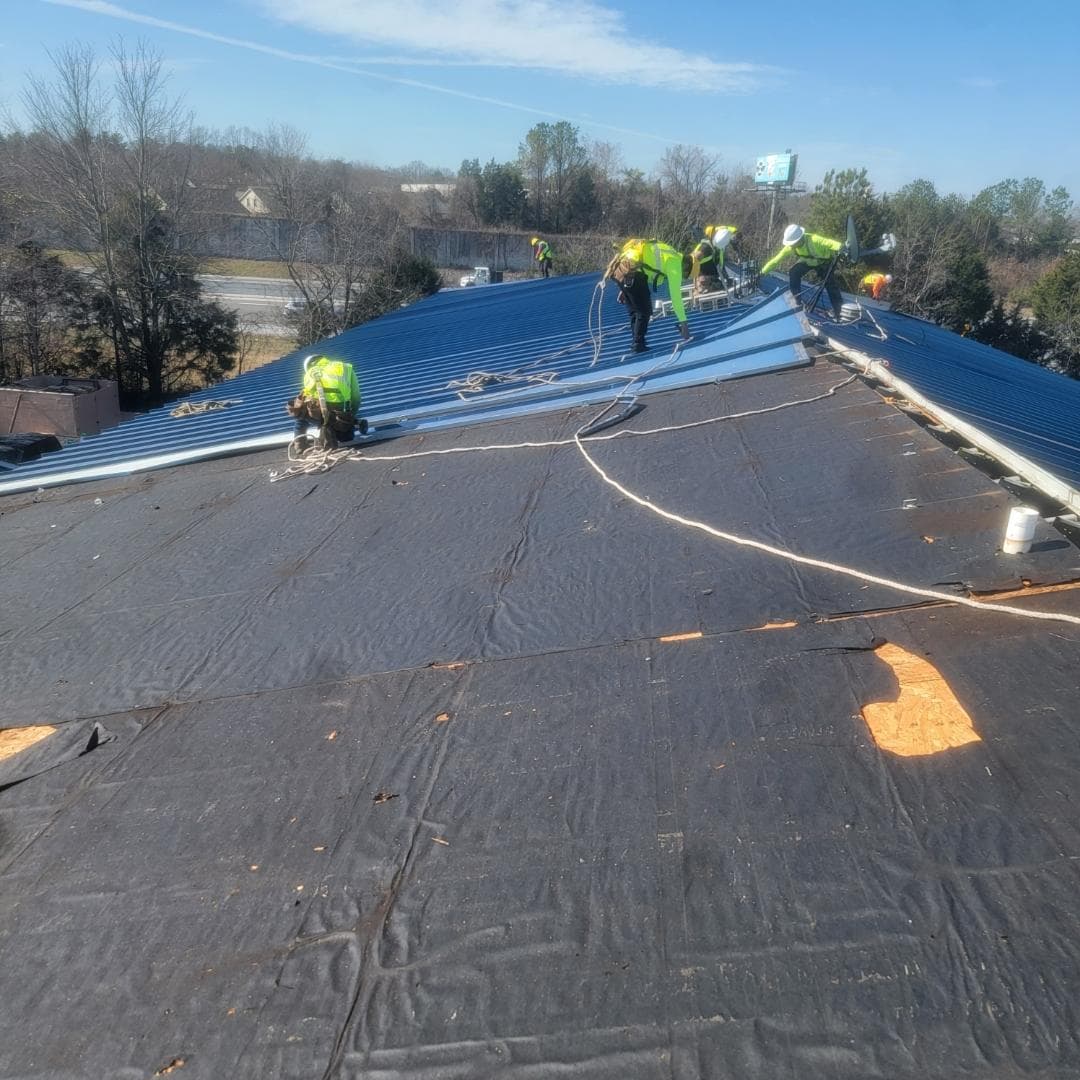
Bessemer's distribution and fulfillment sector anchors the submarket. Amazon's BHM1 fulfillment center sits at the center of a logistics triangle formed by I-459, I-20, and I-22, and the tilt-up warehouse campuses that surround it carry some of the largest single-ply roof footprints in Alabama. A single BHM1-scale roof may exceed one million square feet of TPO or EPDM, which means a re-roof is never a one-pass event - it is a multi-month phased program with daily watertight-transition documentation, mechanical-curb coordination, and tenant-operations sequencing. Red Door Roofing's industrial practice is structured specifically for this scale: we assign dedicated superintendents to each zone, we run moisture surveys before any tear-off, and we photograph every seam and every mechanical-curb flashing during install so the owner has a permanent evidentiary record.
Beyond the marquee fulfillment centers, Bessemer's industrial base includes legacy manufacturing shells carried over from the US Steel Fairfield Works era. Many of these buildings have layered built-up and modified-bitumen assemblies that have been recovered multiple times. When a carrier requires a claim-supportable inspection on an older shell, we perform targeted core samples, document the existing assembly, and deliver a remaining-service-life estimate alongside the photo-keyed evidentiary package. Owners of these older assets frequently convert to single-ply or standing-seam metal at re-roof, and our scopes include mechanical-load verification and parapet-coping renewal.
- Single-ply TPO and EPDM phased re-roof programs
- Mechanical-curb and dock-canopy flashing documentation
- Moisture surveys and core-sample verification
- Daily photo progress logs integrated with facility management
Storm Response Cadence and Claim Documentation Workflow
Because Bessemer sits in Dixie Alley, our storm-response cadence is built around the mid-March through early May supercell window and the secondary fall window in October and November. When the Storm Prediction Center issues a day-one or day-two outlook covering Jefferson County, our Bessemer teams pre-stage crews, drones, and moisture meters so we can reach client properties within hours of the event window closing. The first pass is always a safety-triage and emergency dry-in pass; the second pass is the photo-keyed inspection pass.
The claim-documentation workflow follows a fixed sequence: safety-triage and temporary dry-in first; then a full photo-keyed inspection tied to a numbered roof-plan diagram; then a written narrative with moisture readings, hail-impact counts, and wind-damage indicators; then a deliverable to the owner and, with authorization, to the carrier. We do not negotiate coverage - the carrier makes the final determination - but we supply the evidentiary record the adjuster needs. When no storm-related damage is present, we issue a Certificate of Clearance so the owner can close out any lender or servicer inquiry.
- Pre-staged rapid-response crews for Dixie Alley supercell windows
- Safety triage and emergency dry-in first
- Photo-keyed inspection with roof-plan diagram second
- Certificate of Clearance when no storm damage is found
Multifamily Phased Re-Roofing and Tenant-Notice Workflow
Bessemer's multifamily portfolio is concentrated along Lakeshore Drive, Morgan Road, Academy Drive, and the Bessemer Super Highway corridor, with a mix of garden-style communities and mid-rise assets. Phased re-roofing on occupied multifamily requires a tenant-notice workflow that begins at least ten business days before the first tear-off, a building-by-building schedule that aligns with resident move-in and move-out cycles, and a daily progress log that property management can share with residents through portal or email communications. We coordinate with property-management software workflows where the owner uses one.
Our multifamily scopes typically combine low-slope re-roofing over common areas, stairwells, and mansard returns with pitched composition re-roofing over the residential blocks. We document each building as a discrete unit - pre-condition photos, tear-off, decking inspection, install, and final photos - and we deliver the building-by-building package as a single bound report. Asset managers use this package for lender, carrier, and capital-reserve reporting.
- Ten-business-day tenant-notice cadence
- Building-by-building photo-keyed documentation
- Combined low-slope and pitched scopes
- Bound deliverable for lender and carrier reporting
Why Bessemer Property Owners Choose Red Door Roofing
30+ years, Red Door family
Built on 30 years of commercial experience across the Southeast. Notable clients include Best Western, Harbor Freight, Tractor Supply, and Vanderbilt Medical Clinic.
Carrier-ready documentation
Photo-keyed inspection reports formatted for Bessemer-area adjuster and lender workflows. No guarantees on claim outcomes - the carrier calls that.
Tenant-in-place phasing
Multifamily work phased by building block with tenant-notice templates, noise windows, and operations- team documentation. Tenants stay in place.
No-obligation inspection
If our Bessemer inspection finds no qualifying damage, we issue a Certificate of Clearance - suitable for lender, insurer, and asset-manager files. No further commitment.
Bessemer Commercial Roofing FAQs
How does the I-459 / I-20 / I-22 logistics triangle change roof-maintenance planning in Bessemer?
How do you document hail damage on a large Bessemer distribution center roof?
Do you coordinate with Amazon or national 3PL facility-management programs for scheduled re-roofing?
What does a Bessemer industrial roof inspection deliverable actually contain?
Does Red Door Roofing inspect commercial and industrial roofs in Bessemer?
What is a Certificate of Clearance and when do you issue one?
How do you document hail and wind damage for a Bessemer insurance claim?
Do you work with national insurance carriers for Bessemer commercial claims?
Can you phase a re-roof on an occupied Bessemer distribution center?
What is Red Door Roofing's licensing status in Alabama?
Nearby Alabama Cities We Also Serve
Our commercial roofing coverage extends across Alabama. These three Bessemer-adjacent cities are part of our routine service footprint.
Need a Bessemer inspection?
Call us directly at 1-855-GO4REDD or request a no-obligation inspection online. Most Bessemer-area inspections are scheduled within days of the request.
Request InspectionSchedule a Bessemer Roof Inspection
No obligation. Documented findings you can use for insurance, lender, or asset-manager records.
30+ Years of Red Door Family Experience · 16 States
Free · No obligation · No follow-up sales calls