
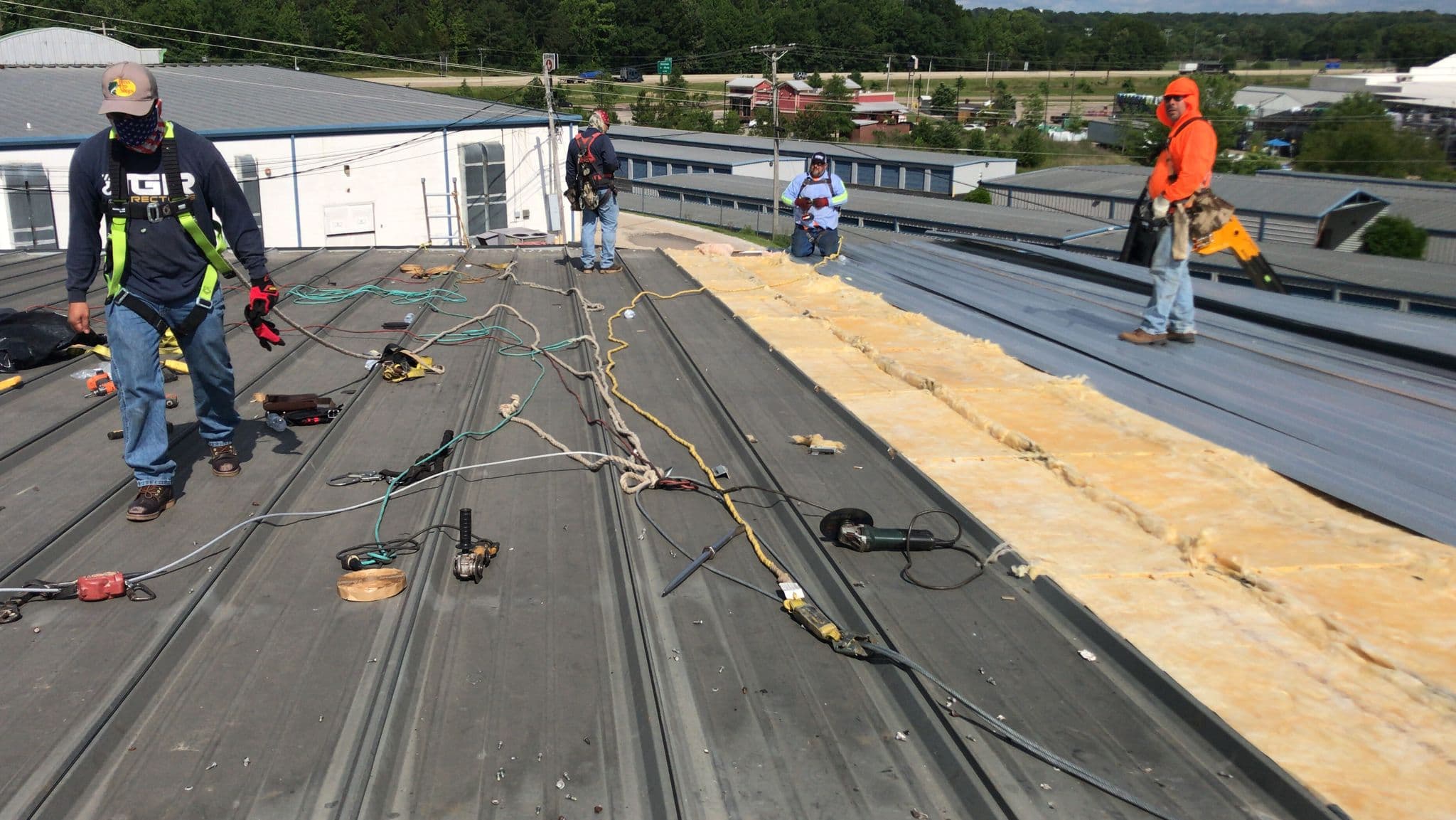
Augusta's Worst Commercial Roof Event Was Frozen, Not Windblown
Georgia commercial roofing conversations default to hail and wind. Augusta is the market where that default is wrong.
From 11 to 14 February 2014, the winter storm that reached the Southeast left the Augusta area the hardest hit in Georgia. Residents woke on 12 February to an inch or more of ice. More than 80 percent of Augusta lost power, and 85 percent of Columbia County households were without power at some point during the event. The ice destroyed roughly 15,000 trees and brought down power lines across the metro. The city subsequently paid more than $17 million to two contractors to remove some 736,000 cubic yards of debris - a hit to reserves that contributed to the Augusta Commission's decision that July to raise property taxes for the first time in seven years.
For commercial roofs, ice events produce a damage signature that looks nothing like hail. Accumulated ice adds dead load the roof was not designed to carry indefinitely. Falling limbs puncture membrane and deform metal panels. Ice dams form at eaves and in valleys on pitched multifamily, backing water under the covering. Drains and scuppers freeze, which turns a functioning low-slope roof into a ponding roof overnight.
None of that is visible from the ground, and most of it does not announce itself until the first significant rain after the thaw.
East Georgia Runs a Three-Part Exposure Profile
Augusta commercial property owners are managing three separate exposure types rather than one.
Winter ice and ice loading. Less frequent than hail but far more consequential when it arrives, and structurally different in how it damages an assembly.
Spring severe weather, March through May. East Georgia sees recurring hail and straight-line wind through the conventional Georgia severe-weather window.
Tornado exposure across the Savannah River. The April 2020 Easter outbreak produced 141 tornadoes across the Southeast, including an EF4 in neighbouring Aiken County, South Carolina, within the Augusta metro's commuting and commercial footprint.
A property inspected only once a year in spring covers one of those three. The workable cadence in Augusta is a late-autumn inspection before winter ice exposure opens and a post-event inspection after any significant ice, hail, or wind event.
The Fort Eisenhower Corridor Is Adding Roof Area Fast
Fort Gordon was redesignated Fort Eisenhower on 27 October 2023. The installation is home to U.S. Army Cyber Command, the Cyber Center of Excellence, the U.S. Army Signal Corps, and the Georgia Cryptologic Center. Army Cyber headquarters occupies Fortitude Hall, a 336,000 square foot facility with construction and fit-out costs of roughly $366 million. The Augusta Economic Development Authority reported approximately 31,155 military and civilian personnel on site and annual economic impact approaching $2.4 billion. The Georgia Cyber Innovation and Training Center represents a further $100 million investment.
That concentration drives commercial and multifamily construction across the Augusta Corporate Park, the Augusta Cyber Gateway, Evans Town Center, and the Martinez and Evans multifamily belt in Columbia County. Two consequences for roof planning follow.
First, a large share of Augusta's newer commercial roof area is under ten years old, which means it sits inside manufacturer warranty windows where the documentation standard for a warranty claim is stricter than for an insurance claim. Unrepaired storm damage can void coverage on an otherwise healthy roof.
Second, facilities supporting defence and cyber tenants carry access and scheduling constraints that most commercial roofing scopes do not account for - badge requirements, escort rules, and restrictions on drone overflight that change how an inspection gets performed.
Medical District and Hospitality Carry Their Own Constraints
Two more Augusta building categories need separate treatment.
The Medical College of Georgia and AU Health district along Walton Way carries continuously occupied buildings with critical interior environments. Phased replacement over occupied clinical space requires work sequencing, dust and odour control, and temporary weather protection standards well beyond a commercial office scope.
The Washington Road hospitality corridor carries a dense concentration of hotel and restaurant roof area, much of it PVC over kitchen exhaust zones where grease exposure drives membrane selection. That corridor also operates under an immovable annual constraint: Masters week. Roof work in the hospitality belt is scheduled around it, not through it.
Our commercial roof maintenance programme is built for exactly these tenant-in-place environments, where scheduled access matters as much as the scope itself.
What Augusta Documentation Needs to Show
Georgia commercial policies commonly apply percentage wind and hail deductibles against insured value. Augusta adjusters and lenders request photo-keyed documentation aligned to NOAA SPC date-of-loss records.
Ice events complicate this. A February ice event and an April hail event can produce overlapping symptoms on the same roof - ponding, seam separation, fastener backout - and a carrier will reasonably ask which event caused which condition. The only thing that answers that question is a documented condition record from before each event.
That makes the late-autumn baseline inspection the load-bearing piece of an Augusta documentation strategy, not an optional extra. Our storm damage documentation service covers the post-event window, and the commercial storm insurance guide sets out how date-of-loss attribution works when multiple events fall in one policy period.
The Practical Takeaway
Augusta is the Georgia market where planning around hail alone leaves the largest gap. The metro's most expensive weather event in living memory was an ice storm that took power from four-fifths of the city and cost eight figures in debris removal alone. Layer on tornado exposure across the river, a cyber corridor adding warranty-period roof area at pace, medical buildings that cannot be taken offline, and a hospitality belt with one immovable week in April, and the result is a market that rewards a documentation habit built around two inspections a year rather than one.
For condition assessment, ice or storm damage documentation, or replacement planning across Richmond and Columbia counties, our Augusta commercial roofing work covers the medical, defence-adjacent, hospitality, and multifamily stock, and our commercial roof inspection service covers the baseline and post-event record the rest depends on.
Want a professional assessment of your property? No-obligation inspection with photo-keyed documentation.
Request InspectionMore From the Blog
- Commercial Roofing in Albany, GASouthwest Georgia's storm record, Hurricane Michael's inland wind field, and what Albany commercial …
- Commercial Roofing in Athens, GAHow a 43,887-student university calendar, dense student-housing stock, and Northeast Georgia's sprin…
- Commercial Roofing in Macon, GALarge-footprint distribution roofs, Middle Georgia's spring hail corridor, and why low industrial va…