The core question every Chattanooga property manager eventually faces
Repair or replace — it's the question that lands in my inbox constantly, and it's the one that costs property managers real money when they get it wrong in either direction. Push a repair when the system is failing systemically and you're buying six months of false confidence while moisture works deeper into your insulation and deck. Pull the trigger on replacement when a targeted repair would've carried the roof another five to eight years, and you've moved a CapEx line item forward by years for no good reason.
There's no universal formula. But there are clear signals. I'll walk through how we read them on Chattanooga properties specifically — because the ridge-and-valley terrain, the storm track that runs right up through the Tennessee River corridor, and the age of the commercial building stock along Broad Street, Amnicola Highway, and the industrial parks out toward East Ridge all matter to this decision.
What "localized failure" actually looks like on the roof
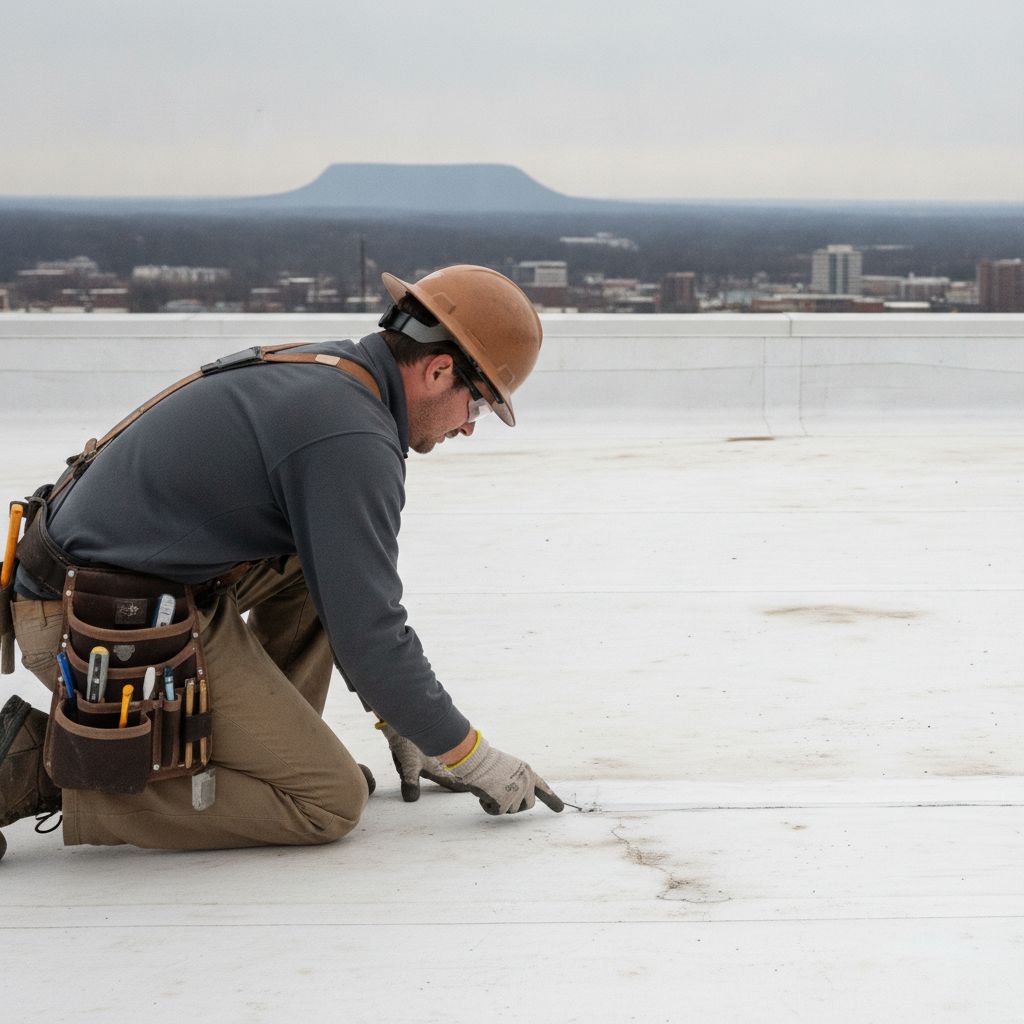
Repair is defensible when the failure is isolated and the surrounding system is in acceptable condition. That means:
- A seam separation on an otherwise-sound TPO field that's not showing broader membrane fatigue
- Flashing compromise at a specific HVAC curb or parapet corner — one or two locations, not a pattern across the whole roofline
- A fastener back-out issue confined to a particular section, often from deck movement
- A single drain that's holding water because the collar seal failed, not because the whole drainage plane is compromised
When we get on a roof and the failure is genuinely contained, repair is the right answer. We can address the specific scope, document what we did, and give you a reasonable expectation of how long the fix holds given the surrounding membrane condition.
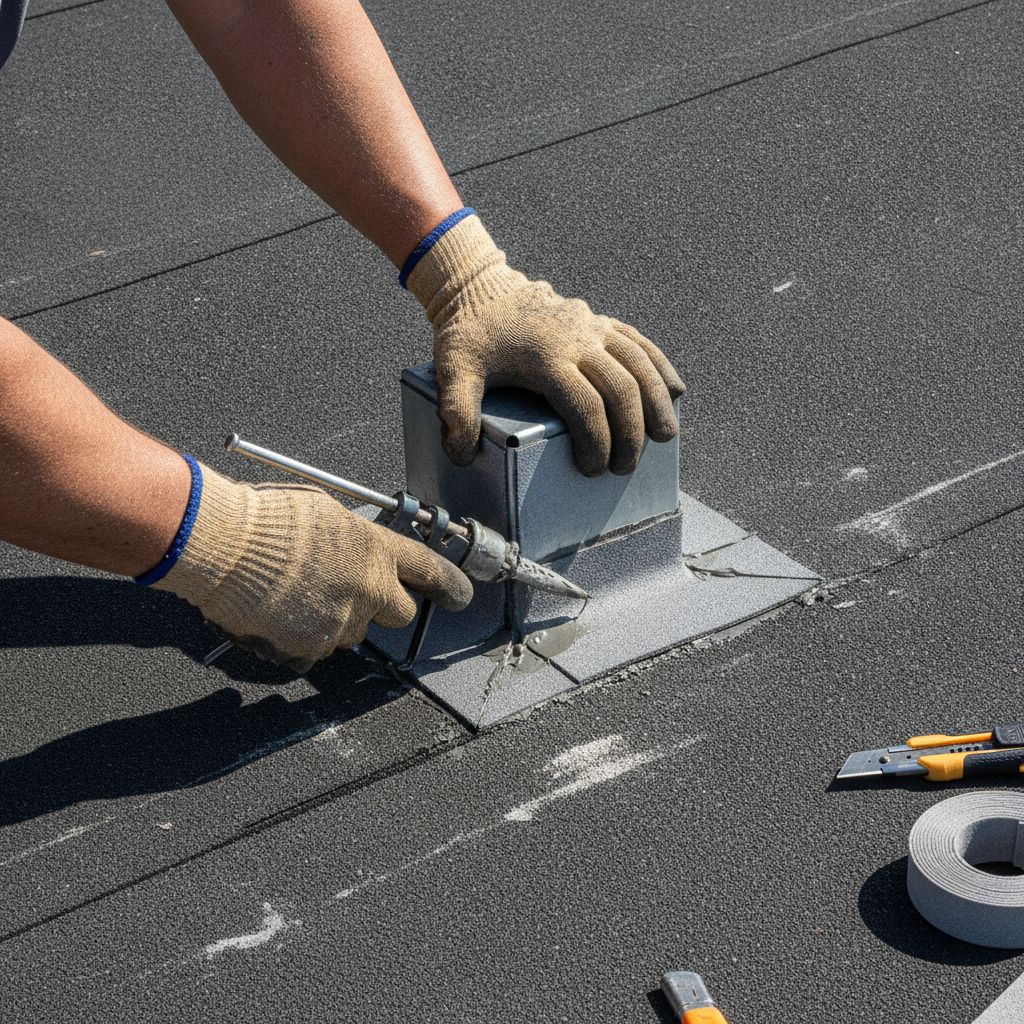
The trap is assuming "localized" based on where the ceiling is staining inside. Water travels. A leak showing up in your tenant's office on the northeast corner may have entered the system at the parapet twenty feet away. That's why we walk the whole roof — not just the area above the stain — before we quote anything.
When repair becomes "throwing good money after bad"
This is the phrase property managers use when they've been in reactive mode for a year or two. They've had the same contractor out three times, paid for repairs each time, and the leaks keep coming back in new spots.
Here's what's usually happening in those situations:
The membrane is at end of useful life. TPO and EPDM systems typically run 15 to 25 years depending on original spec, installation quality, and UV exposure. Modified bitumen and built-up systems have their own curves. When a membrane has been through that many thermal cycles and UV hours, it becomes brittle. Seams that held for twenty years start failing. You repair one, and two more open up six months later. That's not bad luck — that's the system telling you it's done.
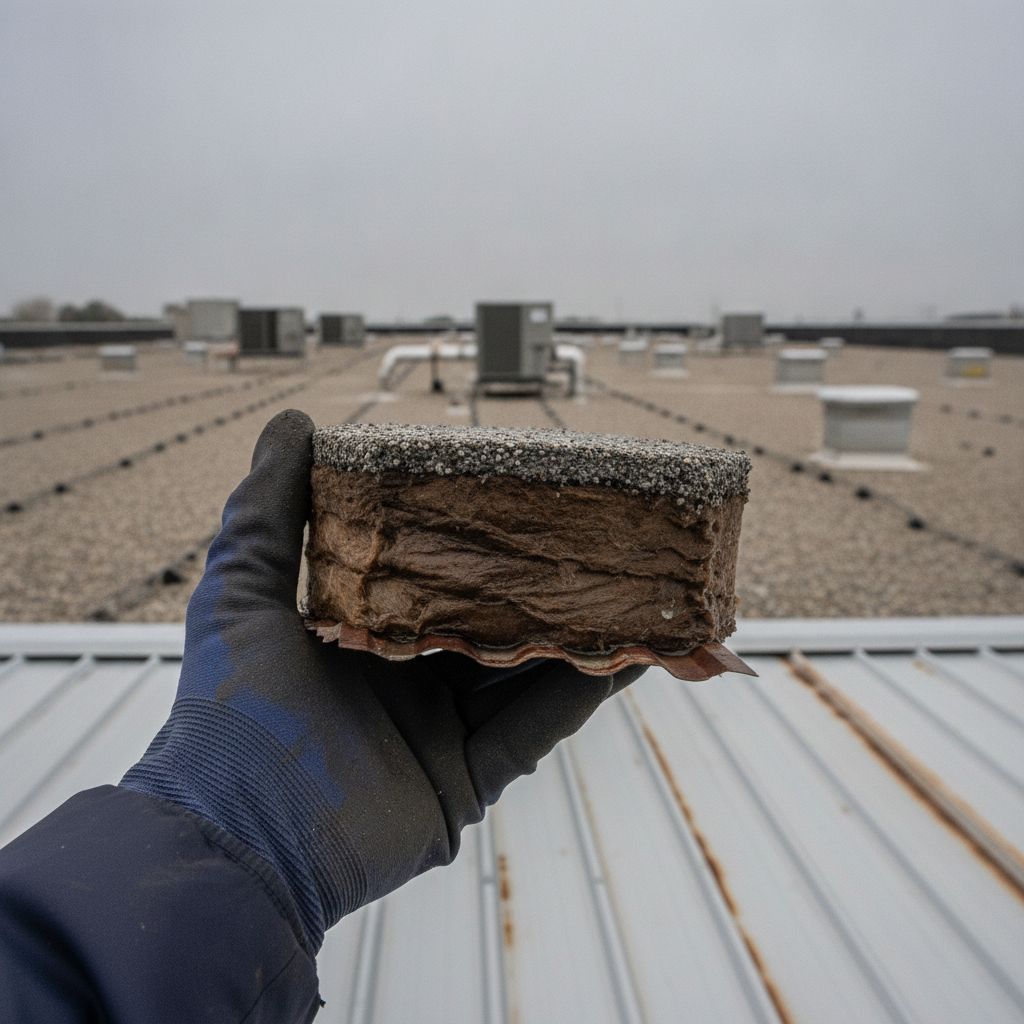
Wet insulation is spreading. This is the one that accelerates cost fastest and is hardest to see without an inspection. Once insulation gets saturated — from a slow leak that went undetected, from condensation, from storm-driven water intrusion — it doesn't dry out on its own under a membrane. It stays wet, degrades, loses R-value, and in humid Tennessee summers it becomes a heat-transfer problem on top of a moisture problem. If core sampling or infrared shows wet insulation across more than a small percentage of the roof area, you're past the repair conversation.
You've got four or more leaks in twelve months across multiple zones. One leak is an incident. Four leaks in different quadrants of the same roof in a year is a pattern. That pattern almost always means systemic membrane failure, not a run of bad luck.
The Chattanooga storm factor
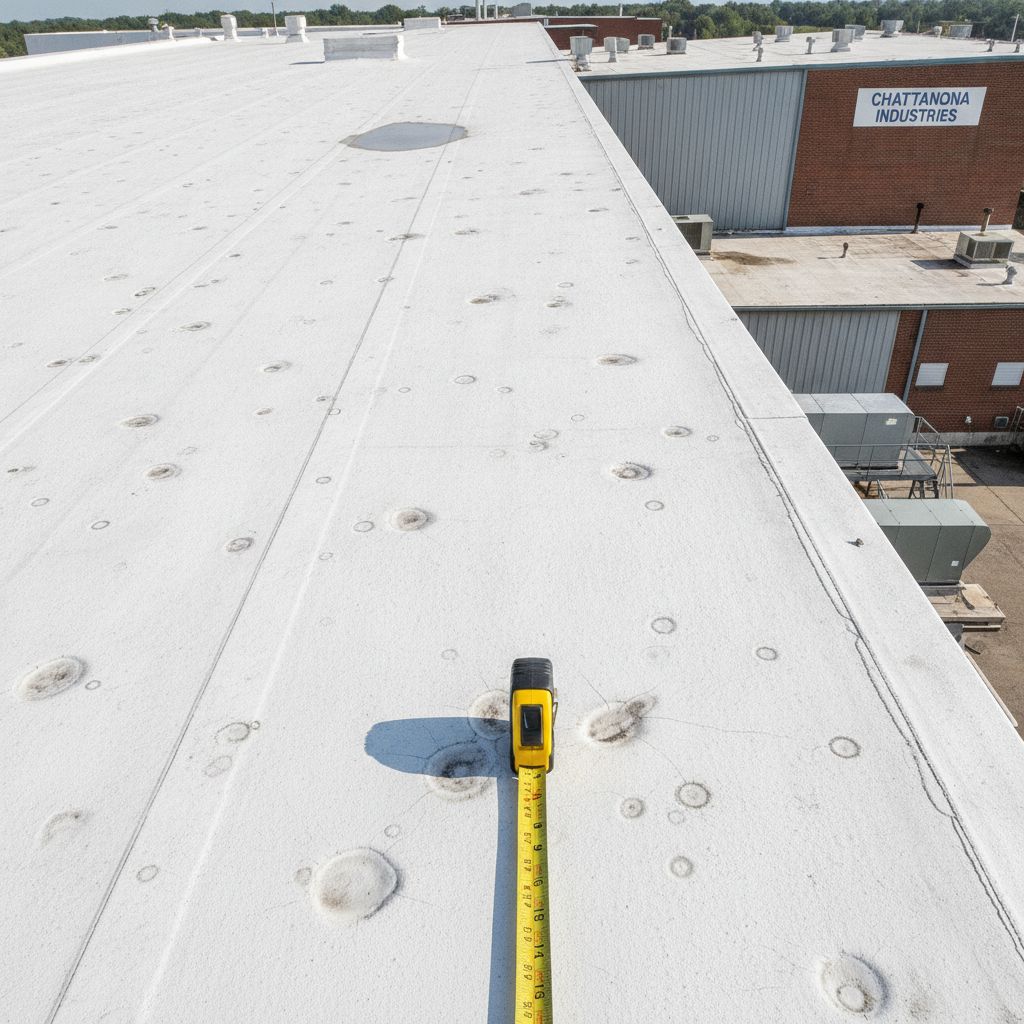
Hamilton County gets hit. The storm track that comes up through north Georgia and follows the ridgelines tends to produce hail events that are disproportionately damaging to single-ply membranes — and we've seen significant hail events in the Chattanooga market that left marks on every unprotected flat roof in their path. The 2020 and 2023 hail events that touched the Eastgate and Hamilton Place corridors are good examples of the kind of widespread impact damage that changes the repair-vs.-replace math fast.
Here's why storm events matter to this decision: hail damage on a single-ply membrane is often not visible from grade, but it fractures the membrane at the impact point. Water doesn't necessarily come through immediately. It may take six months to a year before those fracture points open into active leaks — by which time the insulation beneath has been wet for months.
If your property took a documented hail event in the last two to three years and you haven't had an inspection, that's the first step before you commit to another repair cycle. A documented hail event may also open an insurance-supported replacement path — which changes the capital math entirely. We never guarantee carrier approval, but thorough photo-keyed documentation of date-of-loss damage is what separates a strong claim from a denied one.
A practical decision framework
We use a six-factor matrix when we're scoping a roof and the answer isn't obvious on arrival. The factors are:
- Remaining useful life — based on system age, membrane condition, and original spec
- Scope of current damage — localized vs. pattern vs. systemic
- Wet insulation extent — confirmed by core sampling or infrared thermography
- Leak history — frequency and geographic spread across the roof
- Repair cost as a percentage of replacement cost — when repair quotes start climbing toward 30–40% of what replacement would cost, the math shifts
- Insurance-claim opportunity — documented storm damage that may support a carrier-funded replacement
If most of those factors are pointing the same direction, the answer is usually clear. When they're split — say, the membrane still has life but you've had three leaks this year — that's when on-roof inspection findings become the deciding evidence, not the spreadsheet.
The inspection we produce is photo-keyed, documents specific failure locations, and gives you an honest remaining-useful-life estimate. The decision stays with you. Our job is to make sure you have real information, not a sales pitch dressed up as a recommendation.
Coatings: the option that often gets skipped
There's a middle path that's underused in the Chattanooga market, particularly on aging but structurally sound modified bitumen and metal roofs: coatings and restoration. If the membrane is still intact, insulation is dry, and seams and flashings can be addressed first, a fluid-applied coating can extend useful life by ten to fifteen years at a fraction of replacement cost.
It's not a repair and it's not a replacement — it's a life-extension strategy that makes sense at a specific point in a roof's lifecycle. We cover the conditions that make coatings the right call in our commercial roof coatings and restoration service, and it's worth understanding before you commit to either a repair cycle or a full replacement.
Questions we get
Q: Our roof is 18 years old but has only had one leak. Should we still be planning for replacement?
Age alone doesn't dictate the answer. An 18-year-old TPO roof that was installed at 60-mil spec, has never had significant storm damage, and shows no brittleness or seam fatigue on inspection may have meaningful life remaining. An 18-year-old 45-mil TPO that's been through repeated hail events and shows seam cracking across multiple zones is probably at or past end of life. Get an inspection that documents actual membrane condition — don't plan off the calendar alone.
Q: We've repaired the same section three times in two years. Is that a sign we need replacement?
Possibly, but the question is whether those repairs are in the same location or spreading to new locations. Repeated failures at a single penetration or flashing detail can sometimes indicate a workmanship issue with the repair itself. Failures spreading to new zones across the roof each time is a stronger indicator of systemic membrane decline. We'd want to see the pattern before recommending either way.
Q: How do we know if our Chattanooga property took hail damage that would support an insurance claim?
Start with weather data — there are services that can confirm hail size and track by address for a specific date range. Then get a physical inspection that documents impact marks, membrane fracture, and any metal component damage (fascia, HVAC units, skylights). Impact marks on soft metals like AC fins and gutters are often the most legible early evidence. We document all of it in photo-keyed reports that support the claim process, though we never predict or guarantee how a carrier will respond.
Q: What's the real risk of delaying replacement when we know the roof is failing?
The interior damage cost compounds fast. A failing roof over an occupied tenant space means water intrusion risk, potential mold liability, HVAC inefficiency from degraded insulation, and — in a worst-case scenario — tenant lease concessions or early termination. Deferred replacement on a building you're actively managing rarely saves money over a two- to three-year horizon. It usually shifts cost from a single CapEx line into a string of emergency repairs, interior remediation, and tenant-relations problems that don't show up neatly on the roof line of the budget.
Q: We got two repair quotes and one replacement quote. How do we compare them honestly?
Ask each contractor to document the condition findings that support their recommendation — not just the scope and price. If the repair contractors can't show you evidence of why repair is sufficient, and the replacement contractor can't show you evidence of why repair is inadequate, you don't have enough information to make the decision. Push for photo documentation and a clear explanation of remaining useful life before you sign anything.
If you're managing a property in Chattanooga and you're not sure which side of this line you're on, the right first move is a documented inspection — not another repair without one. Our commercial roof inspection service is designed to give you the evidence to make this call with confidence, and our commercial roof repair service and commercial roof replacement service both start from honest scoping, not from a predetermined outcome.
Want a professional assessment of your property? No-obligation inspection with photo-keyed documentation.
Request InspectionMore From the Blog
- Commercial Roof Maintenance Plan: Huntsville GuideHow Huntsville property managers build a commercial roof maintenance plan that prevents emergency re…
- Flat Roof Ponding Water in Memphis: Causes and FixesPonding water on Memphis flat roofs causes membrane damage and structural load. Here's how to diagno…
- Commercial Roofing in Albany, GASouthwest Georgia's storm record, Hurricane Michael's inland wind field, and what Albany commercial …