
The short answer before we get into it
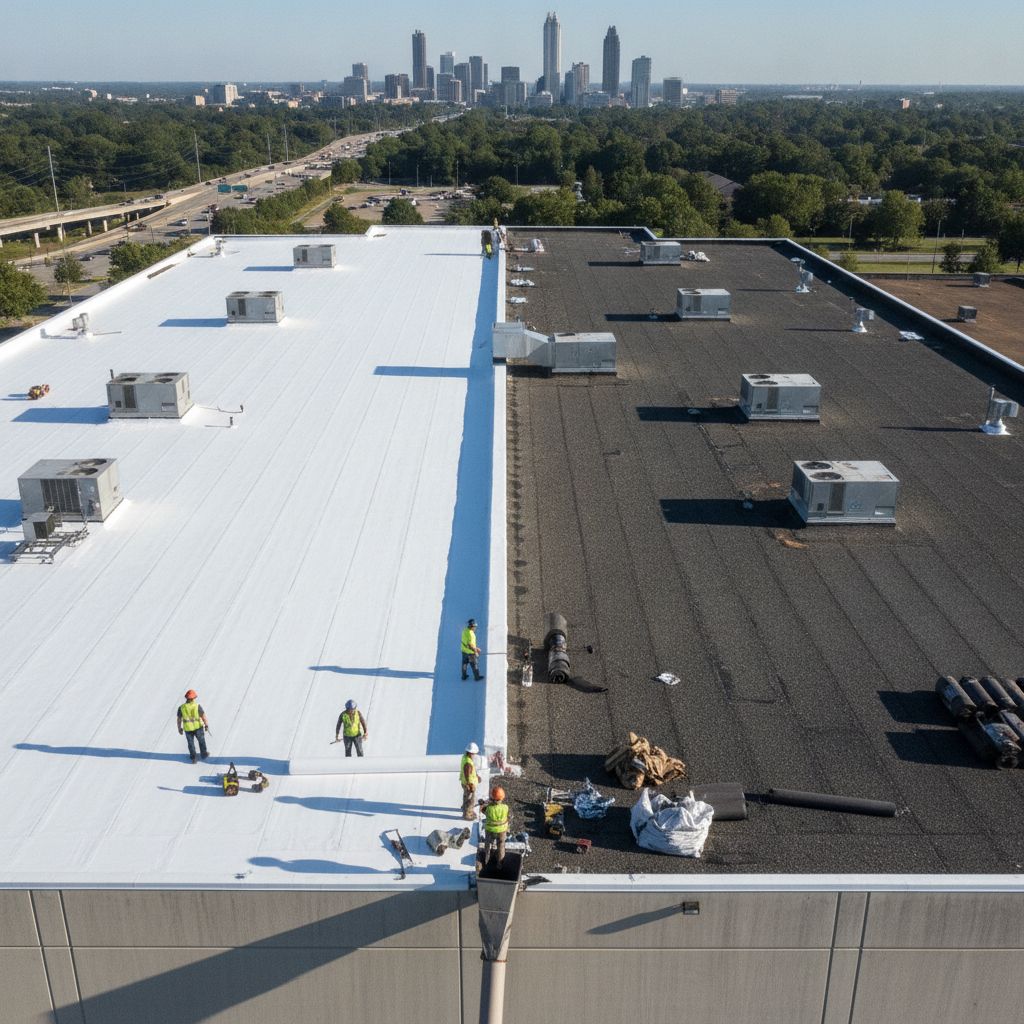
If you're managing a standard Atlanta office building, retail strip, warehouse, or multifamily property and you're staring down a flat roof replacement, TPO is the default worth starting with. Better solar reflectance in a market that runs HVAC hard from April through October, faster installation, and a cost-to-performance ratio that's tough to beat on open low-slope decks.
Modified bitumen still earns its place — on heavy-foot-traffic roofs, phased work over occupied space, and buildings where the site constraints or existing assembly make a single-ply system harder to detail correctly.
Neither membrane is universally right. What follows is how we actually think through the decision for properties in this market.
What Atlanta's climate actually does to flat roofs
Atlanta sits in ASHRAE Climate Zone 3A — hot and humid. That matters for membrane selection in a few specific ways.
UV exposure here is relentless from May through September. A membrane that degrades faster under sustained UV load — or one that absorbs heat rather than reflects it — runs up your HVAC bill and shortens its own service life at the same time. The Perimeter Center corridor, Buckhead office parks, and the big warehouse corridors out near I-20 east and west all share the same problem: large, flat, low-slope rooftops baking under a Georgia summer.
Atlanta also gets meaningful convective storm activity. We've tracked significant hail events across the metro in recent years — nothing like the frequency you'd see in north Texas, but enough that impact resistance is a real conversation, not a checkbox. The spring storm season runs long here.
And then there's heat-island effect in the denser submarkets — Midtown, Downtown, the Old Fourth Ward — where rooftop temperatures on a dark membrane can run 150°F-plus on a July afternoon. That's mechanical stress on any system, but it hits some membranes harder than others.
TPO on Atlanta commercial roofs: where it performs and where it doesn't
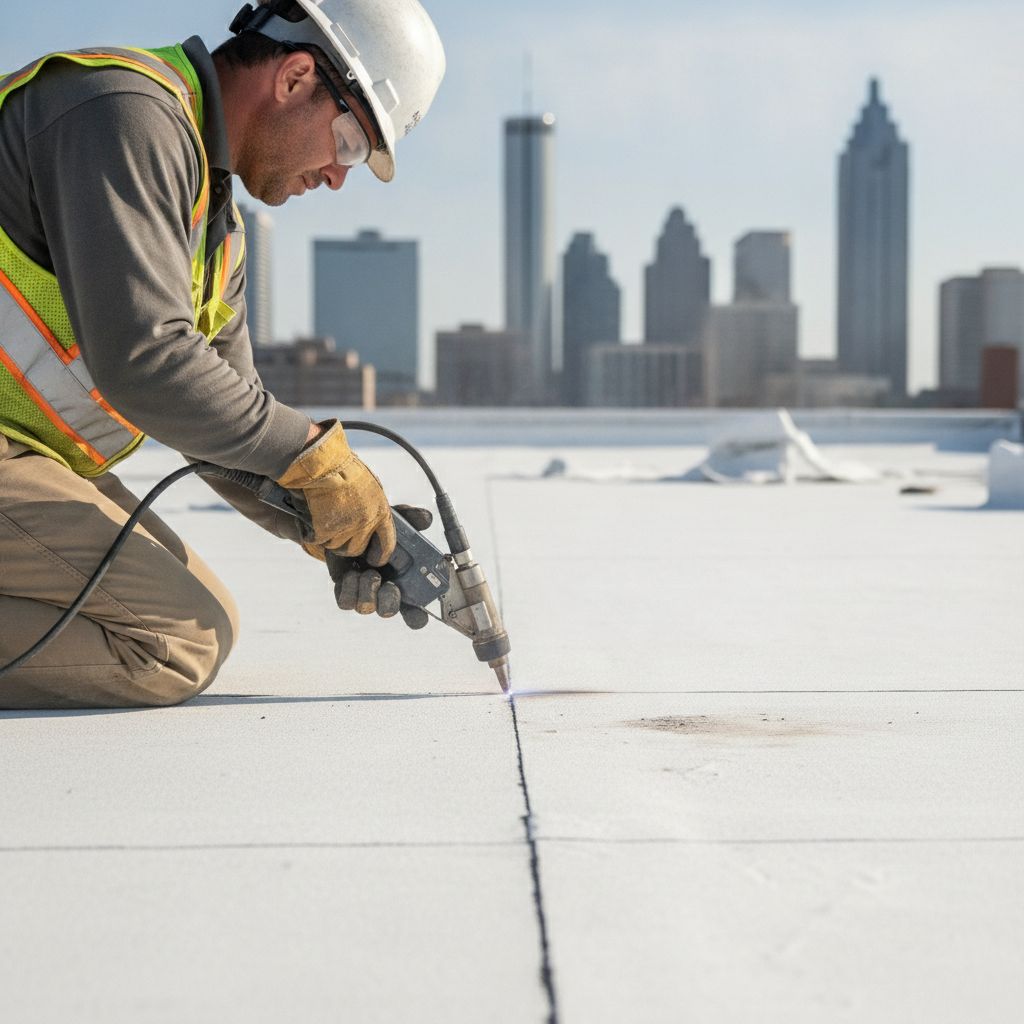
TPO's biggest advantages in this climate are straightforward. White TPO membrane carries a Solar Reflectance Index in the 78–90+ range depending on manufacturer and formulation. On a 40,000-square-foot office roof in Dunwoody or Sandy Springs, that reflectance translates to a measurable reduction in cooling load — documentable in your operating expenses across the life of the system.
Heat-welded seams are the other defining characteristic. When they're done right, the weld is stronger than the membrane itself. A properly welded TPO field is essentially monolithic — there's no seam to lap or adhesive to fail. That matters in Atlanta's summer rain patterns, where you can get an inch of rain in 45 minutes and ponding water sits longer on flatter decks.
Where TPO gets into trouble here:
Foot traffic. TPO's surface will take occasional maintenance foot traffic fine. But if you have rooftop HVAC equipment that your mechanical team is servicing weekly, or a penthouse amenity deck with regular access, the membrane needs protection boards or heavier mil-thickness to hold up. A 60-mil TPO on a heavily trafficked mechanical roof will show wear in places that a properly specified mod-bit system would shrug off.
Existing assembly compatibility. If you're recovering over an existing modified bitumen or built-up roof, the attachment method and substrate condition drive the conversation more than the membrane preference. We've seen cases on older Midtown Atlanta buildings — 1980s and 1990s construction — where the deck condition made a fully adhered single-ply harder to pull off correctly than a torchdown recover.
Thinner mil on high-UV roofs. In our experience across Georgia, 45-mil TPO in full southern exposure tends to show premature aging at the seam edges. If you're specifying TPO in Atlanta, 60-mil is the minimum we'd stand behind for a standard commercial replacement, and 80-mil is worth the conversation on any roof with above-average UV exposure or hail history. See our TPO Roofing guide for the full mil-thickness breakdown.
Modified bitumen on Atlanta commercial roofs: where it still makes sense
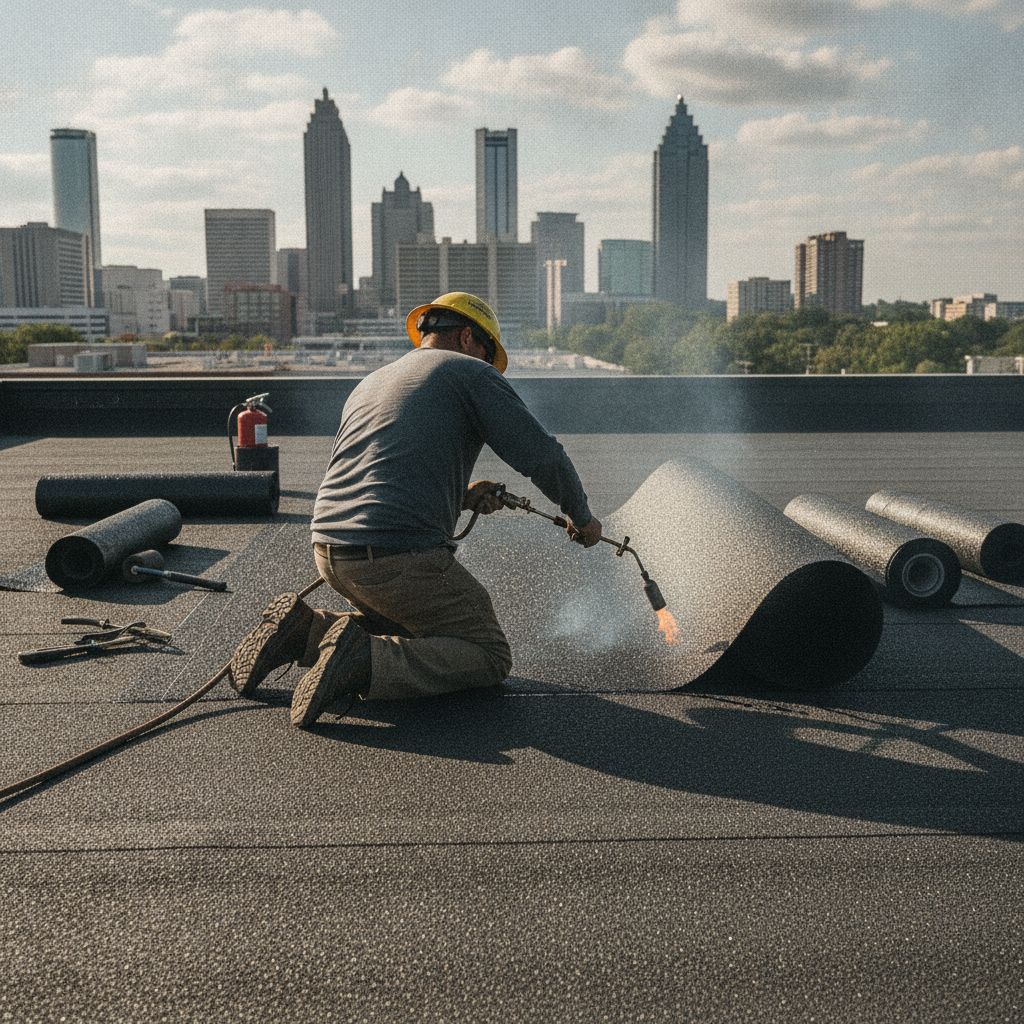
Modified bitumen — "mod bit" on the jobsite — is a multi-layer system. Typically you're looking at a base sheet (mechanically fastened or adhered) and a granulated cap sheet applied by torch, cold adhesive, or heat-weldable method depending on the specific product. The granulated surface gives it durability under foot traffic that single-ply systems have to work harder to match.
In Atlanta, mod bit holds on in a few specific use cases:
Heavy rooftop traffic. Restaurant and hospitality properties in Buckhead, mixed-use developments with mechanical penthouses, any building where your maintenance team or mechanical contractors are up there constantly — mod bit's granulated surface handles that abuse better out of the box.
Phased work over occupied space. Torchdown mod-bit application is controllable in a way that large-roll single-ply installation sometimes isn't on constrained urban sites. If you're doing a partial replacement on a building that can't shut down, or working around active rooftop equipment in a way that limits your working area, mod bit gives you more flexibility in how you phase the scope.
Recover applications over existing systems. When we're recovering over a sound but aging base on an older Atlanta building and the substrate isn't clean enough for a fully adhered single-ply, a mechanically fastened base sheet with a torchdown cap is often the cleanest path. No adhesive compatibility questions, no substrate prep issues that blow up your schedule.
Where mod bit struggles in this climate: it's dark. A granulated modified bitumen cap sheet is absorbing Atlanta's summer heat rather than reflecting it. There are lighter-colored mineral-surfaced cap sheets available, and some properties add a coating to address this — but if energy performance is a priority, you're fighting uphill compared to white TPO.
Installation is also slower and more labor-intensive on large open roofs. On a 100,000-square-foot warehouse distribution center off I-285, the labor differential between a TPO specification and a mod-bit specification is significant. That cost gap matters when you're working a capital budget.
How we actually frame the decision
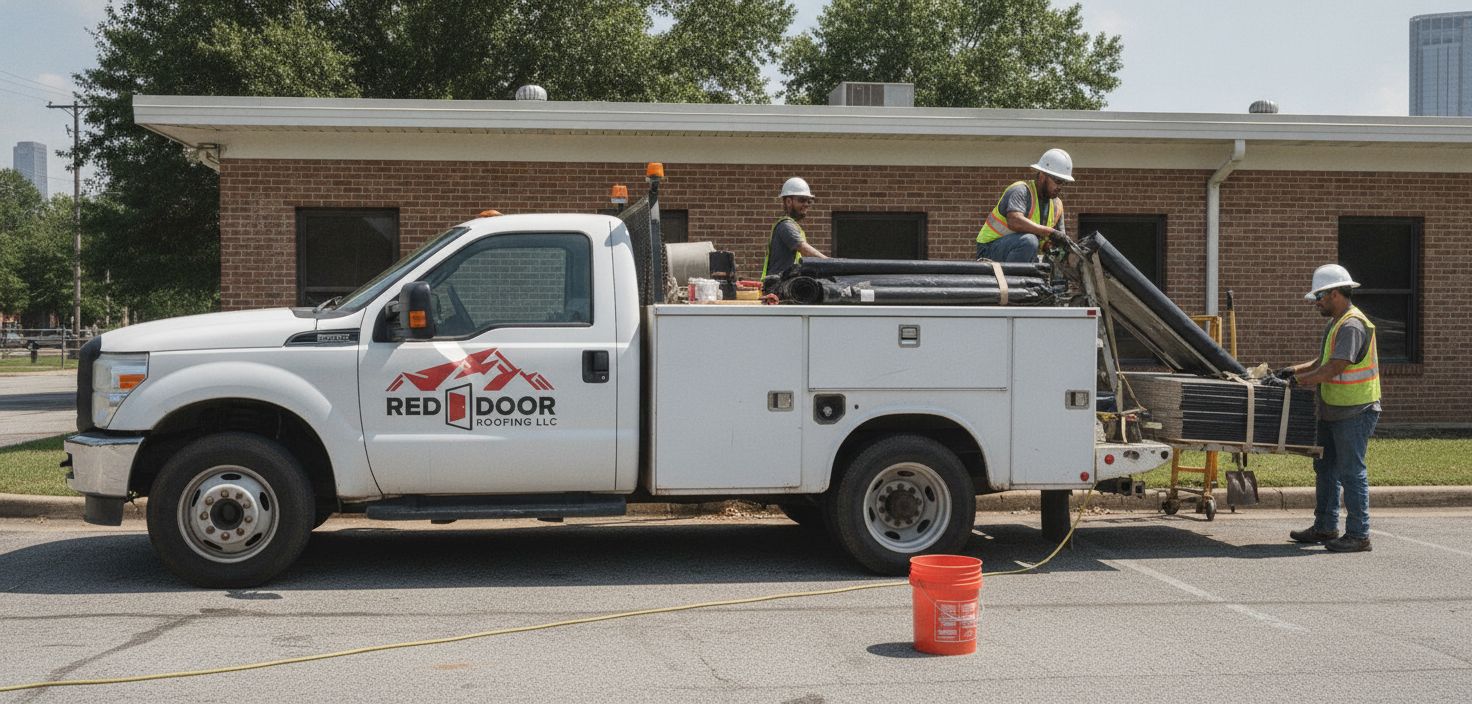
When a property manager calls us about a flat roof replacement in Atlanta, here's roughly how the conversation goes:
Building type and tenant mix first. Office, retail, and warehouse? TPO is usually the starting point. Restaurant, food service, or heavy mechanical? We're asking more questions before we land on a spec.
What's on the roof now, and what shape is the deck in? Existing assembly compatibility shapes the attachment method, which shapes the membrane options. An old BUR (built-up roof) on a 1970s Buckhead office building is a different conversation than a clean steel deck on new construction in Alpharetta.
Foot traffic volume. Not just "does anyone go up there" but how often and why. Weekly mechanical service versus annual inspections is a meaningful difference in spec.
Project timeline and phasing constraints. Are you working around tenants? Around active HVAC systems? TPO's wide-roll speed advantage matters more when you have an open deck and weather window. Mod bit's flexibility matters more when you're phasing.
Budget. TPO typically runs lower on material and labor for large open scopes. Mod bit's labor intensity can close that gap on smaller or more complex jobs. Get actual numbers for your specific scope — square footage, access, insulation condition, and detail complexity all move the final cost more than the membrane choice alone.
What we're not covering here
This post focuses specifically on the TPO vs. mod-bit comparison for Atlanta properties. If EPDM or PVC is on your radar — or if you're weighing a coating/restoration approach on an existing system — our flat roof systems overview covers all four membrane families side by side. PVC, in particular, is the right conversation for any property with kitchen exhaust, grease, or chemical exposure.
Questions we get
Q: Can I recover TPO over my existing modified bitumen roof?
Sometimes, yes — but it depends on the condition of the existing system. If the existing mod-bit assembly is dry, well-adhered, and passes a core cut (no moisture in the insulation), a recover with a mechanically fastened TPO can work and saves you tear-off cost and landfill fees. If there's moisture in the assembly or the insulation has deteriorated, you need to tear off. We always recommend moisture scanning before making that call. A recover over a wet assembly just traps the problem and shortens the new system's life.
Q: How do Atlanta building codes affect membrane selection?
For commercial low-slope work in the City of Atlanta and across Fulton, DeKalb, Gwinnett, and Cobb counties, you're working under the Georgia State Minimum Standard Building Code (which adopts the IBC with state amendments). Wind-uplift requirements, insulation R-value minimums, and fire-resistance ratings all affect how a system is specified — not just the membrane itself. FM Global-rated assemblies are often required or preferred on larger commercial properties with specific insurance carriers. This is a reason to work with a contractor who pulls permits and specs to code rather than working from a generic material list.
Q: Is TPO or mod bit more insurance-friendly after a hail event?
In our experience, the insurance conversation after a storm turns more on the documentation of damage than on the membrane type. Both systems can sustain hail damage that's claimable. Reinforced TPO in 80-mil or 90-mil with a UL 2218 Class 4 impact rating does offer better physical resistance to hail penetration — and some carriers offer premium credits for Class 4-rated assemblies. We'd never promise a specific insurance outcome, but the impact rating is worth asking your carrier about before you spec a replacement.
Q: Modified bitumen has been around longer — does that make it more reliable?
Longevity in the market doesn't automatically mean better for your building. Mod bit has a proven track record, and well-installed systems regularly hit 20-plus years. TPO has been commercially installed since the early 1990s and has a deep enough field history now that we can speak to real-world lifespan with confidence. The installation quality and system design matter more than which technology is older. A poorly welded TPO roof will fail early. An improperly torched mod-bit cap sheet will blister and delaminate. Neither membrane saves a bad installation.
Q: What's a realistic budget difference between the two for an Atlanta commercial property?
It varies enough by scope that I'm hesitant to throw out a single number. On a large, simple, open deck — say a 50,000-square-foot warehouse — TPO typically comes in meaningfully lower on total installed cost because of labor speed. On a smaller, more complex roof with a lot of penetrations and detail work, the gap narrows. Get line-item proposals on both systems for your specific scope and compare them directly. The membrane material cost difference is often less significant than the labor and access factors for your particular building.
Want a professional assessment of your property? No-obligation inspection with photo-keyed documentation.
Request InspectionMore From the Blog
- Commercial Roof Maintenance Plan: Huntsville GuideHow Huntsville property managers build a commercial roof maintenance plan that prevents emergency re…
- Flat Roof Ponding Water in Memphis: Causes and FixesPonding water on Memphis flat roofs causes membrane damage and structural load. Here's how to diagno…
- Commercial Roofing in Albany, GASouthwest Georgia's storm record, Hurricane Michael's inland wind field, and what Albany commercial …