
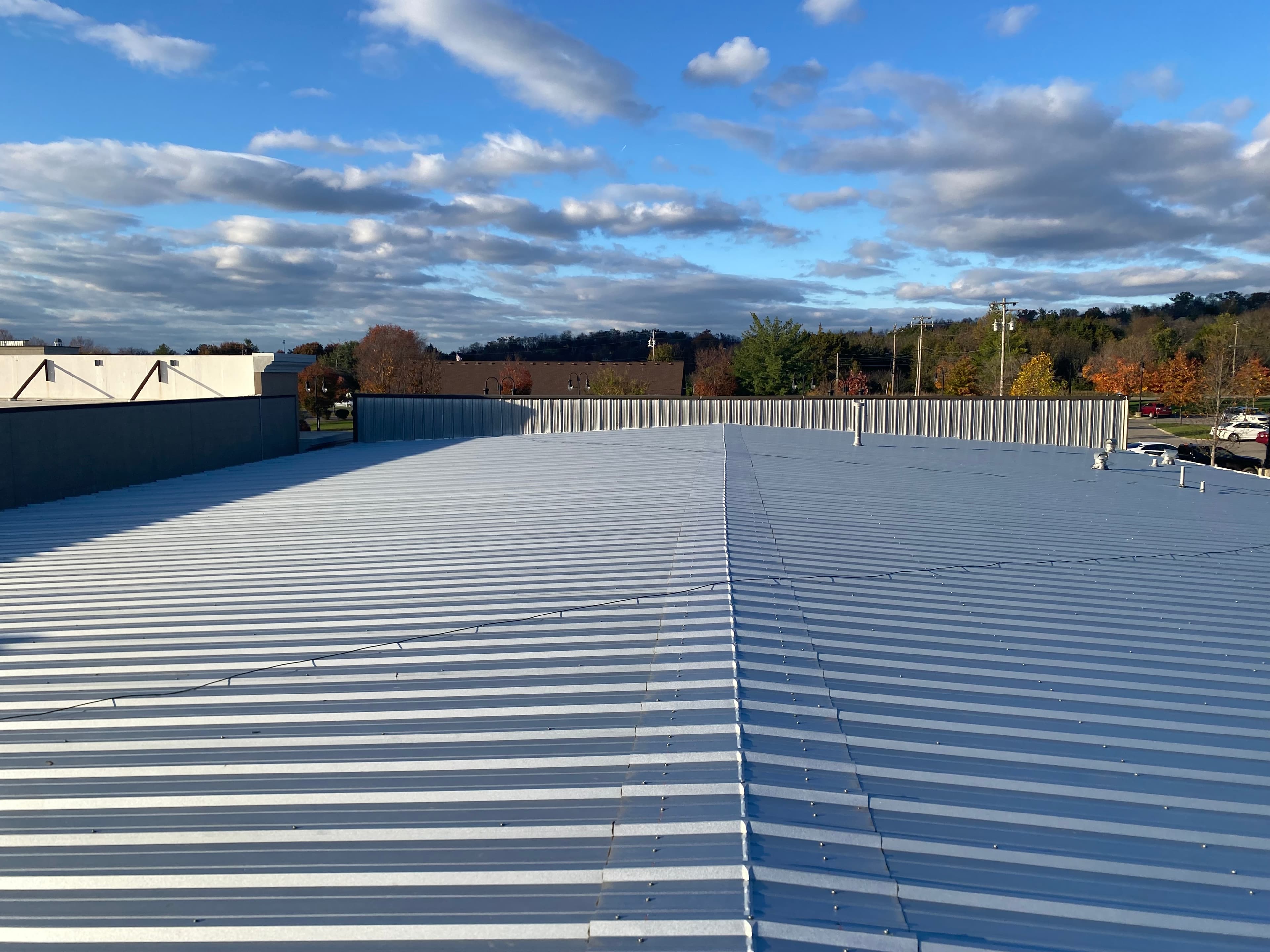
Why Fall Is the Right Time to Find These Problems
Birmingham doesn't get the brutal winters you see in the Midwest, but that's part of what catches property managers off guard. We get enough freeze-thaw cycles in January and February — plus the occasional ice storm that shuts the city down — that any existing roof weakness gets exploited hard and fast. The water that's been sitting in a low spot since September freezes, expands, and forces open a seam that was marginal all summer. What would've been a $4,000 repair in October becomes a $40,000 emergency call in January with interior damage on top.
I've been on roofs across the Birmingham-Hoover metro for two decades. The calls that hurt the most — the ones where we're doing emergency tarping in 28-degree weather — almost always involve a building that had visible warning signs the previous fall. Someone saw the signs, made a note to "keep an eye on it," and then winter arrived before anyone got back up there.
This post is about what to look for before that window closes.
Warning Sign 1: Ponding Water That's Still There After 48 Hours
Flat and low-slope warehouse roofs — TPO, EPDM, modified bitumen, built-up — are designed to drain, not to pond. If water is sitting on your roof 48 hours after a rain event, you have a drainage problem and possibly a structural one.
Ponding does two things. First, it adds dead load. A 10,000 square foot area with two inches of standing water is somewhere around 50,000 pounds that wasn't in your structural engineer's calculations. Second, it accelerates membrane degradation. UV, biological growth, and freeze-thaw cycling all hit standing water areas hardest.
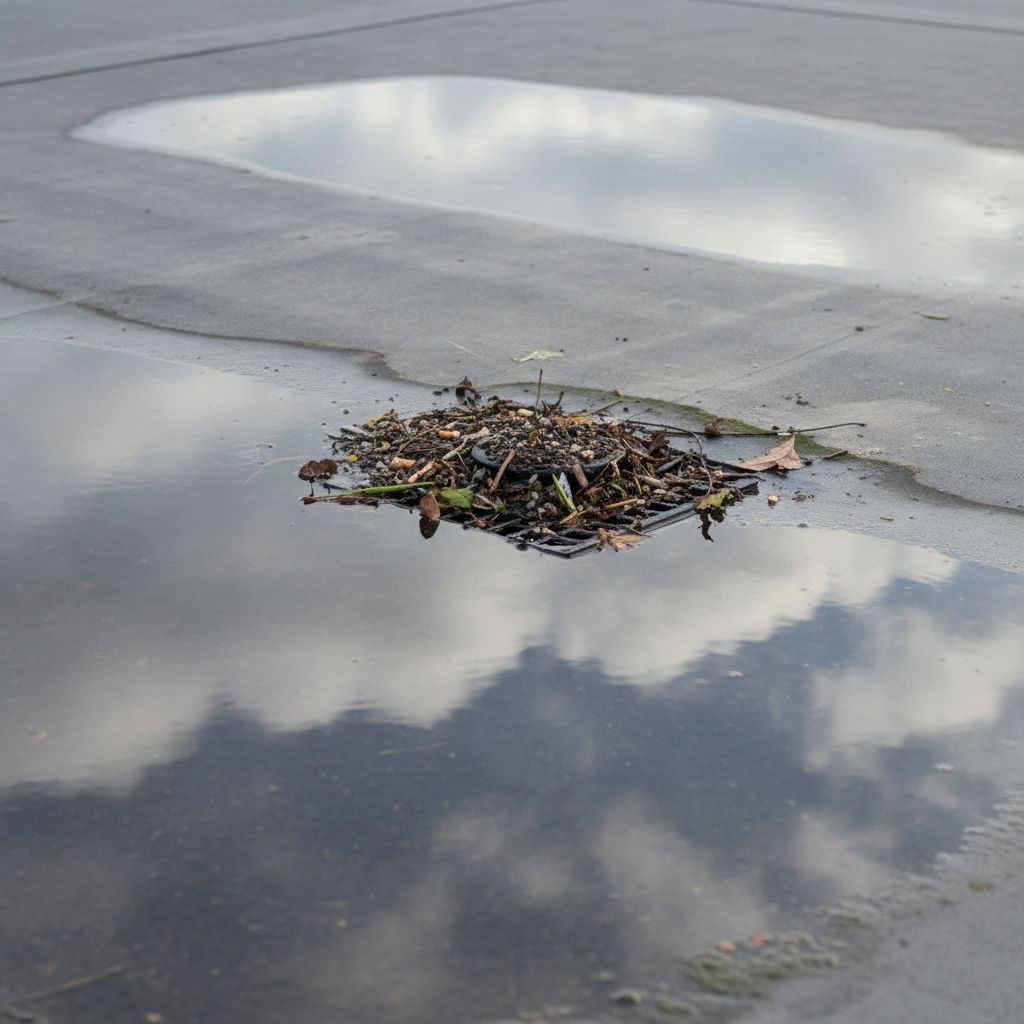
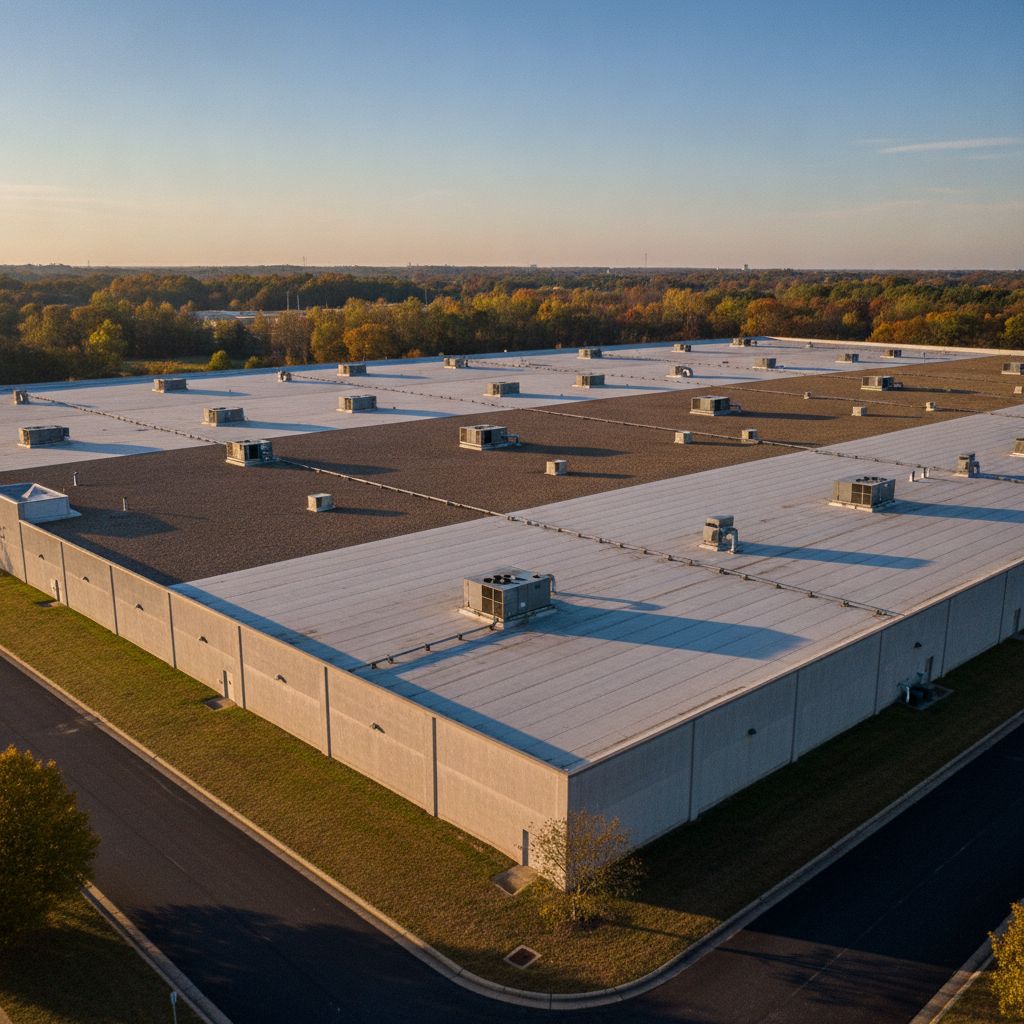
In the Birmingham area, a lot of the warehouse stock along I-20/59, the Oxmoor corridor, and out toward Bessemer was built in the 1980s and '90s. We see deflected decks on buildings that age — the structure has settled or the insulation has compressed over decades, creating low spots that weren't there originally. Those spots collect water now. Before winter, have someone physically verify your drains and scuppers are clear, and if you've got known low spots, get a roofer up there to assess whether the drainage can be corrected.
Warning Sign 2: Flashing Separation at Parapets, Penetrations, and Curbs
Flashings are where roofs fail. That's not an opinion — it's just where water finds its way in. The membrane field in the middle of your roof is usually fine. The seams, the transitions, the edges — that's where you're going to have problems.
On a warehouse, the places to look are:
- Parapet wall counterflashing: Metal counterflashing that's lifted, separated, or showing daylight at the base is an active entry point.
- HVAC curbs: Every rooftop unit has a curb, and the flashing around that curb takes abuse from foot traffic, equipment vibration, and thermal cycling. Caulk fails. Seams open.
- Pipe penetrations: Any pipe stack, conduit, or vent that punches through the membrane has a flashing collar around it. Those collars crack and shrink over time.
- Expansion joints: Often overlooked on large warehouse roofs. If the cover detail is deteriorated, that's a direct water path.
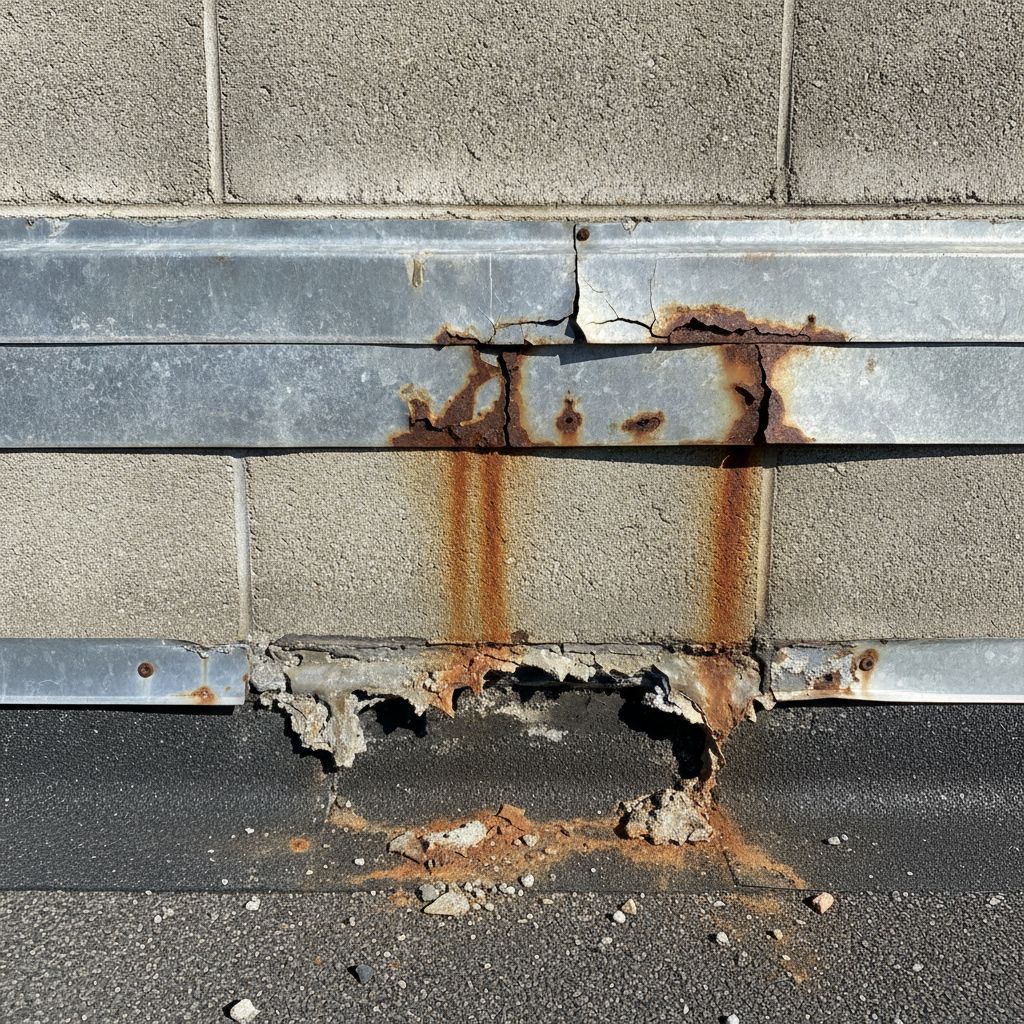
None of these failures are visible from the ground. That's the honest answer to why property managers miss them — you can't see a parapet cap that's lifted from the parking lot. A simple on-roof walk in the fall takes maybe an hour on a standard warehouse and will find most of these before they become interior damage.
Warning Sign 3: Interior Stains or Wet Insulation You Haven't Traced
If someone on your facilities team mentioned a ceiling stain, or you've seen rust streaks on the metal deck, or there's a musty smell in a section of the building — don't assume it's the HVAC. In our experience, a significant number of "mystery moisture" calls in warehouse buildings trace back to roof issues that had been written off as condensation or plumbing.
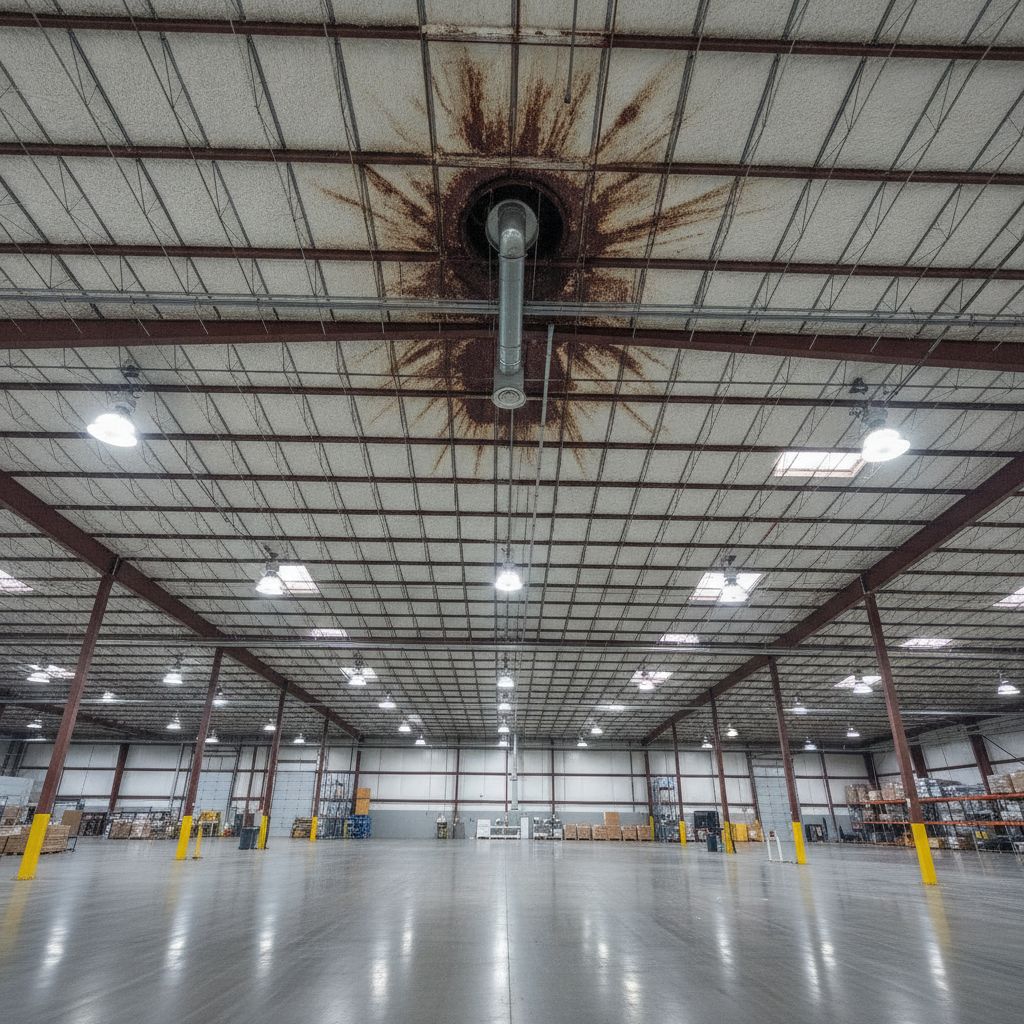
The challenge with flat commercial roofs is that water travels. It enters through a failed flashing at a penetration, runs along the top of the deck or through the insulation, and shows up as a stain eight feet away from the actual breach. Patching the spot directly under the stain rarely fixes it.
We use infrared thermography to map trapped moisture in the insulation layer — IR scanning at dusk or dawn picks up temperature differentials between wet and dry insulation that are completely invisible from the surface. If you've got an unexplained interior stain and winter's coming, that's worth a proper inspection, not just a visual from the roof. Wet insulation under a membrane that then freezes does real structural damage to the assembly.
Warning Sign 4: Membrane Blistering or Visible Surface Deterioration
Walk the roof (or have someone do it) and look for raised bubbles in the membrane — blisters. On modified bitumen, they show up as obvious domes. On TPO or EPDM, they can be subtler. Blisters indicate trapped moisture or air between plies, and they're vulnerable points. They're also a sign that the broader assembly may have a moisture problem below the surface.
On older gravel-surface built-up roofs — and there's still plenty of that on Birmingham's industrial stock — look at the surface condition of the cap sheet. If the gravel is sparse or washed out and you're seeing bare asphalt, that's accelerated degradation waiting to happen once UV keeps cooking it through the fall and temperature drops crack whatever elasticity is left.
Warning Sign 5: Seam Failures on Single-Ply Systems
TPO and EPDM seams are the backbone of those systems. A TPO roof lives or dies at the heat-welded seams. If a seam is opening — you can see daylight, feel it lift when you press, or notice the weld looks narrow and brittle — that needs attention before cold weather stresses it further.
Thermal cycling through Birmingham's mild-but-variable winters (temperatures that can drop from 65°F to 28°F in 24 hours, which we see multiple times a season) puts real mechanical stress on membrane seams. A seam that's 80% intact in September may be fully open by February.
Getting a Formal Inspection Before Winter
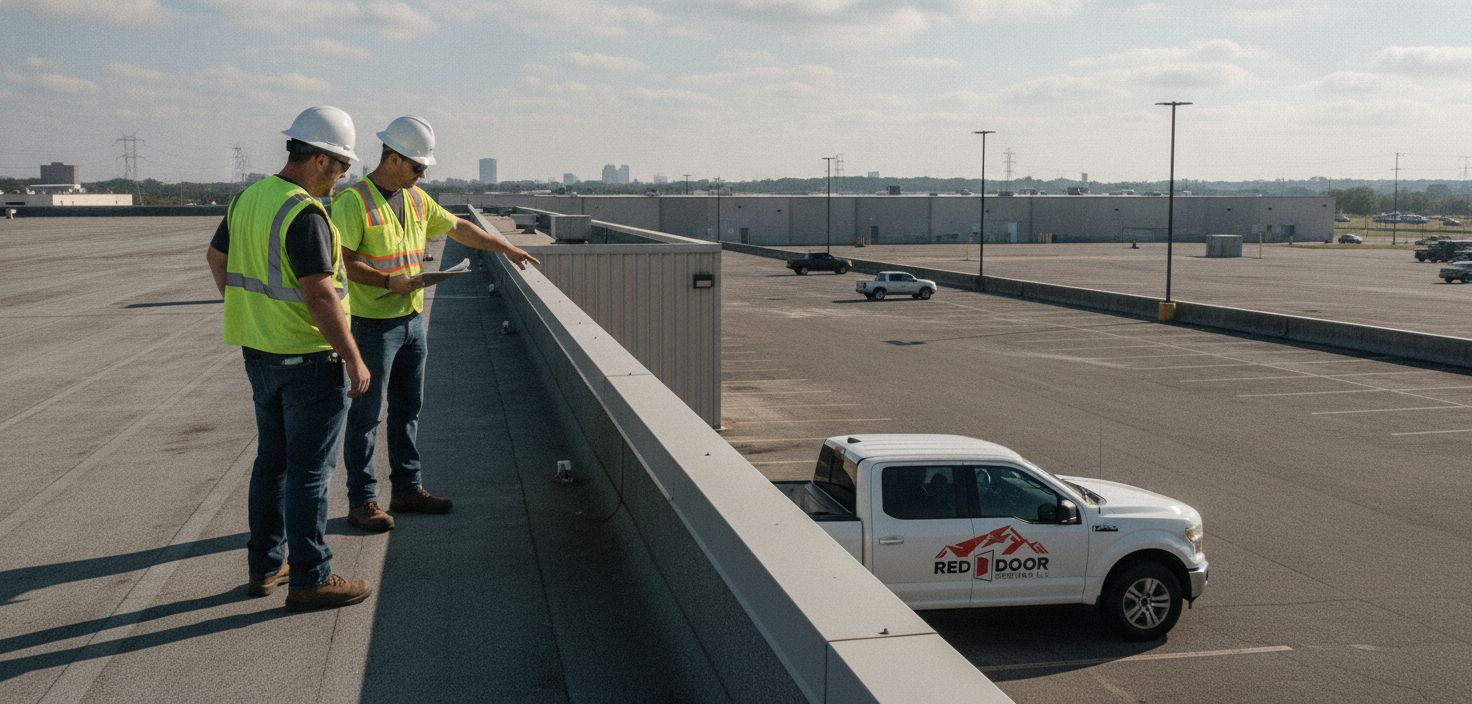
A professional commercial roof inspection does more than confirm what you already suspect. Our process includes drone-assisted aerial mapping, infrared thermography for trapped moisture, and photo-keyed defect documentation that maps every finding to a roof schematic. If you're heading into a capital planning cycle, refinancing, or just want documented baseline condition before severe-weather season, that report gives you something to work from — not just a roofer's verbal opinion.
If an inspection finds no actionable damage, we issue a Certificate of Clearance you can put in your asset file. If it finds problems, you'll have prioritized repair-versus-replacement recommendations with enough documentation to act on.
For most warehouses in the Birmingham metro, scheduling that inspection in September or October gives crews time to address findings before the first hard freeze. By November, everyone's calendar fills up fast.
For context on what a full inspection report includes and how we scope repairs versus replacements, see our commercial roof inspection service page and the commercial roof replacement overview.
Questions We Get
Q: My warehouse roof is only 8 years old. Do I really need a pre-winter inspection?
Age isn't the only factor. Installation quality, storm history, and maintenance gaps matter just as much. Birmingham took multiple significant hail events in the last few years — if your building is in Jefferson or Shelby County and you haven't had a post-event inspection, you may have damage that's been aging for two or three seasons already.
Q: What's the difference between me walking the roof myself and hiring someone?
You can spot obvious ponding and visible flashing issues from a basic walk. What you can't do is identify trapped moisture in the insulation, detect micro-fractures in TPO membrane from hail impact, or produce documentation that's useful to an insurer or lender. If you're just doing a quick check, a self-walk has value. If you need to know the actual condition and remaining useful life of the roof, that requires the equipment and methodology of a formal inspection.
Q: Can you tell from the ground whether I have a problem?
Sometimes. Drone imagery gets us a lot more than a ground walk. But infrared, moisture meters, and tactile inspection require boots on the roof. Drone-only assessments have real limits — we use aerial mapping as the first step, not the whole process.
Q: How long does a warehouse inspection take?
Depends on square footage and roof complexity. A straightforward 50,000 square foot warehouse with a single-ply system and basic penetrations — typically two to three hours on-site including drone flight, IR scan, and ground-level documentation. Larger or more complex buildings take longer. The report turnaround is usually within a few business days.
Q: If I find problems now, how long do repairs actually take to schedule?
October is manageable. November gets tight as weather windows close and crews fill up with post-storm work from the region. If your inspection finds something that needs addressing before winter, earlier in the fall gives you the most scheduling flexibility and the best chance of getting crews in good weather conditions.
Want a professional assessment of your property? No-obligation inspection with photo-keyed documentation.
Request InspectionMore From the Blog
- Commercial Roof Maintenance Plan: Huntsville GuideHow Huntsville property managers build a commercial roof maintenance plan that prevents emergency re…
- Flat Roof Ponding Water in Memphis: Causes and FixesPonding water on Memphis flat roofs causes membrane damage and structural load. Here's how to diagno…
- Commercial Roofing in Albany, GASouthwest Georgia's storm record, Hurricane Michael's inland wind field, and what Albany commercial …