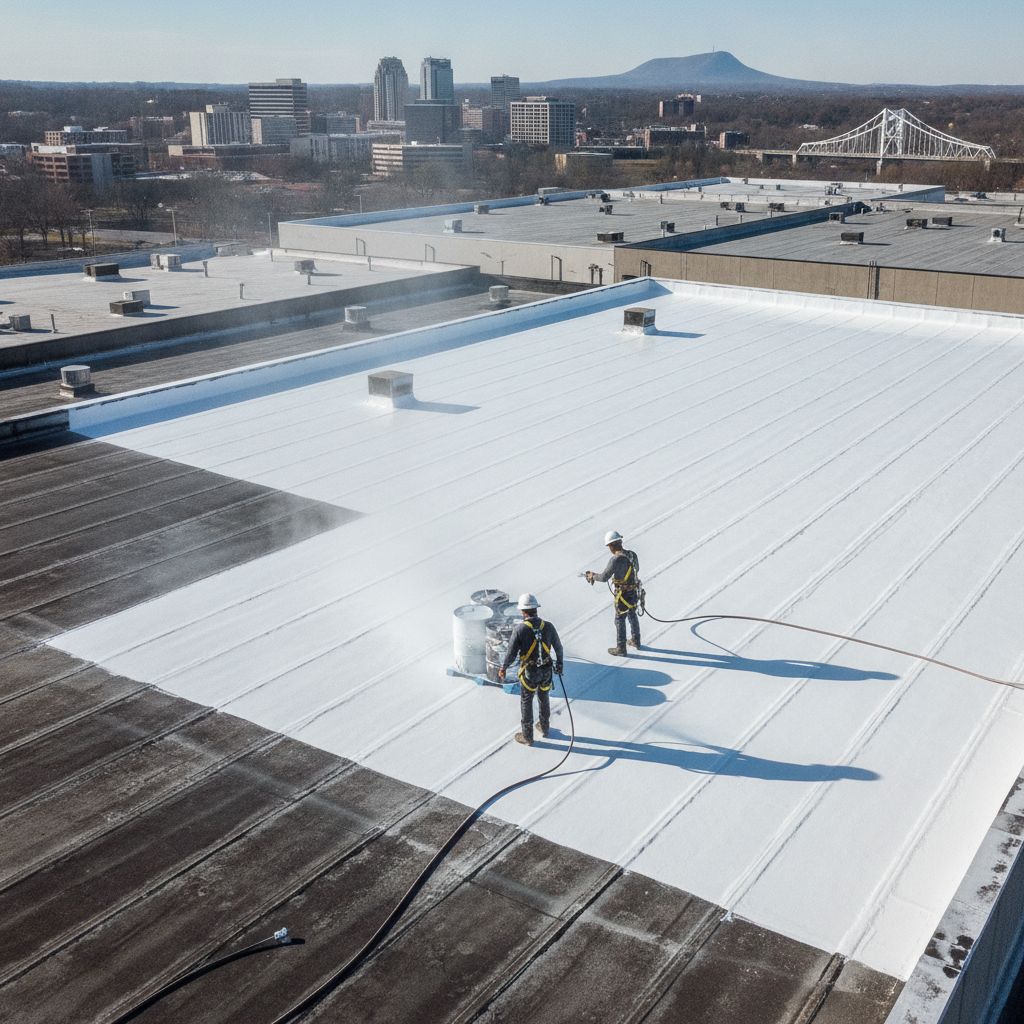
If your Greenville commercial roof is aging but the deck underneath is still solid, a full tear-off may not be your only option — or your best one. A fluid-applied commercial roof coating can restore waterproofing, add meaningful solar reflectance, and extend useful life by 10 to 20 years at roughly 30 to 50 percent of what replacement costs. The catch: coatings only work on roofs that genuinely qualify. Applying one to the wrong substrate is how property managers end up with the same leaks they started with and a coating bill on top.
This post walks you through how to figure out whether your building is a real candidate, what the process looks like on the ground here in the Upstate, and where the economics actually pencil out.
Why Greenville Properties Come Up for Coating Conversations
The Woodruff Road corridor, the older flex industrial around Haywood and Laurens Road, the multifamily stock along Augusta Road, the strip centers scattered through Mauldin and Simpsonville — a lot of this building stock was put up in the late 1980s through early 2000s. Modified bitumen and built-up roofs from that era are well past their original warranty cycles. TPO systems from the mid-2000s are getting long in the tooth. We're seeing a steady wave of owners and asset managers who know a replacement is coming eventually but are looking at the capital budget and asking whether "eventually" can be pushed out another decade.
Greenville's weather makes the question more urgent. The Upstate gets hit by the tail ends of Gulf systems more than most people expect — we've seen significant wind-driven rain events track through here, and the afternoon convective storms in July and August put real stress on aging seams and flashings. When a 15-year-old modified bitumen roof starts showing up with soft spots and some seam lifting, the question isn't just maintenance — it's a capital planning decision.
The First Question: Does Your Roof Actually Qualify?
This is where a lot of coating conversations go sideways. The coating industry sales pitch can make it sound like almost any old roof is a candidate. It isn't.
The three things that determine whether your roof can be coated rather than replaced:
The deck has to be sound. On metal-deck commercial construction — which covers most of the warehouse and flex industrial in the Greenville market — that means no widespread rust, no structural movement, no soft spots where the deck has been compromised by long-term moisture. On older buildings with wood decks, we're looking for rot. If the deck is questionable, coating doesn't fix it. It just covers it up temporarily and buys you nothing.
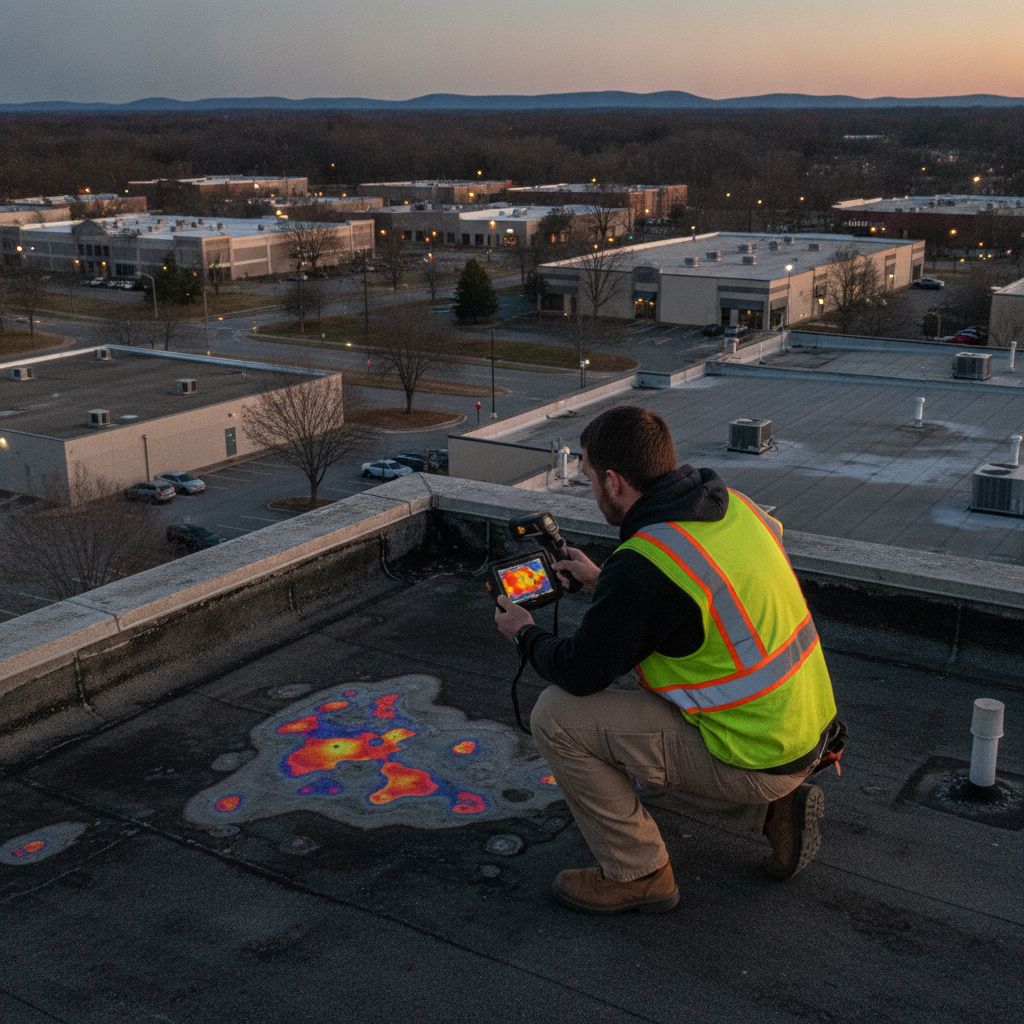
The insulation has to be dry. Saturated insulation under a membrane is a coating disqualifier. Wet insulation doesn't compress uniformly, promotes ongoing deck deterioration, and creates the conditions for blistering and adhesion failure in the new coating. We verify this with infrared thermography — an evening scan after a warm day shows wet areas clearly because they hold heat differently than dry insulation. Core sampling confirms what the IR suggests.
The membrane itself has to be aging, not failed. There's a real difference between a membrane that's oxidized, lost flexibility, or has localized seam issues — and one with systemic failure, widespread brittleness, or multiple active penetration leaks. Coatings work on the former. The latter needs replacement, full stop.
If all three conditions check out, you have a coating candidate. At that point, the economic case is usually clear: coating costs roughly $2 to $6 per square foot installed depending on the chemistry, versus the $8 to $14 per square foot range for tear-off-and-replace on comparable commercial scopes in this market. On a 50,000 square foot warehouse roof, that difference is $300,000 to $400,000 or more. That's real capital that stays in the asset.
What the Right Coating Chemistry Looks Like Here
Not every coating chemistry is appropriate for every substrate. A few specifics that apply to common Greenville building types:
Modified bitumen and built-up roofs: The large inventory of older institutional and commercial buildings in Greenville — churches along White Horse Road, school and government buildings, older strip retail — often have modified bitumen cap sheets that have lost granules but still have a sound underlying assembly. Asphalt-emulsion restoration coating with reinforcing fabric at seams is typically the right chemistry here. It bonds chemically to the asphalt substrate in ways that elastomeric systems don't.
TPO and EPDM membranes: Acrylic or silicone systems, depending on roof slope and ponding-water exposure. If the roof has documented areas where water sits for 48 hours or more after rain — common on large flat warehouse roofs with inadequate drainage — silicone is the only chemistry that tolerates that exposure without degrading. Acrylic will break down in standing water over time.
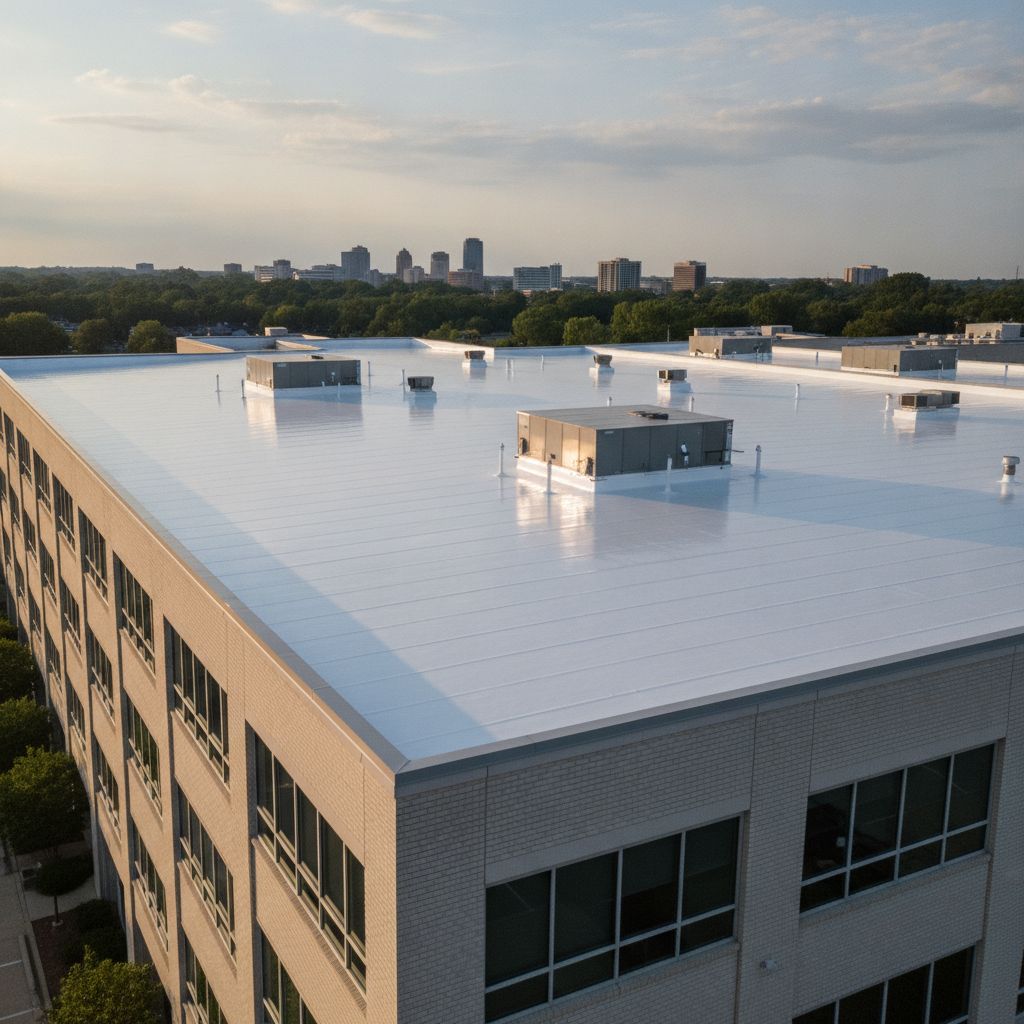
Metal roofs: Standing-seam metal roofs on commercial and light industrial buildings are excellent coating candidates when the panel substrate is sound. Acrylic and silicone both perform well on Galvalume and painted steel, and the reflectance gain is significant — a dark metal roof in Greenville summer is a meaningful HVAC load. White silicone can deliver Solar Reflectance Index values in the 80 to 95+ range.
What Preparation Actually Involves
This is where coating jobs succeed or fail. A coating applied over a poorly prepped surface doesn't adhere properly, and adhesion failure means you've spent coating money for nothing.
On a legitimate scope, preparation includes:
- Pressure washing the entire roof surface (coatings don't bond to dirt, debris, or biological growth)
- Repairing all seams, flashings, penetration details, and edge metal before any coating goes down
- Installing reinforcing fabric into the wet coating at seams and detail areas — not optional, not a shortcut worth taking
- Priming where the existing surface chemistry or condition requires it
- Addressing any localized wet insulation areas through cut-and-patch before coating
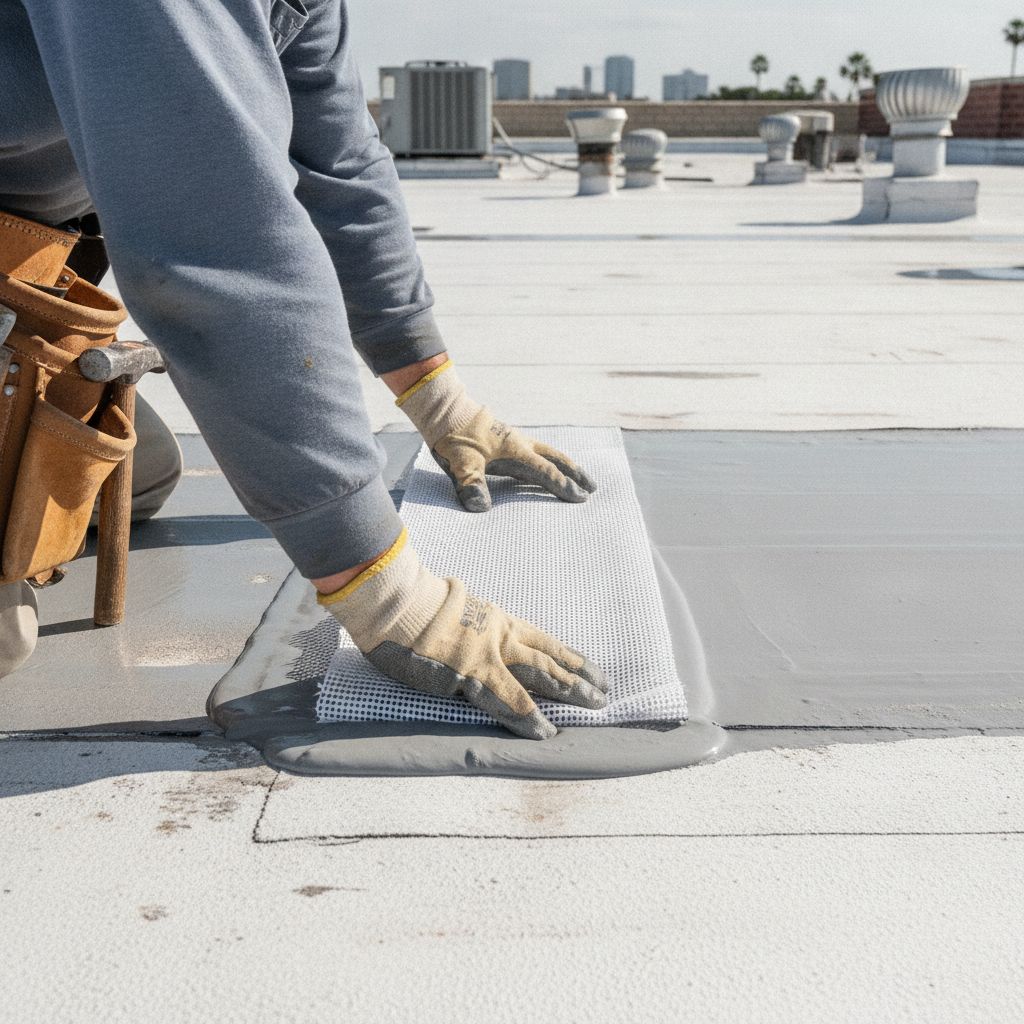
The prep phase is typically 30 to 50 percent of the total labor cost on a coating scope. If a contractor is quoting a price that seems too lean, prep is usually where they're cutting corners. We've gone behind low-bid coating jobs in the Upstate and found seams that weren't repaired, flashings that weren't addressed, and fabric that wasn't installed. Those roofs fail early, and the property manager is left with no warranty recourse and a decision about whether to re-coat or replace.
The Permit and Warranty Picture in Greenville
South Carolina follows the IBC, and Greenville County requires permits for commercial roofing work including coating scopes above certain thresholds. The City of Greenville proper has its own permitting process. Get this confirmed before work starts — unpermitted roofing work can create complications on insurance claims and property transfers.
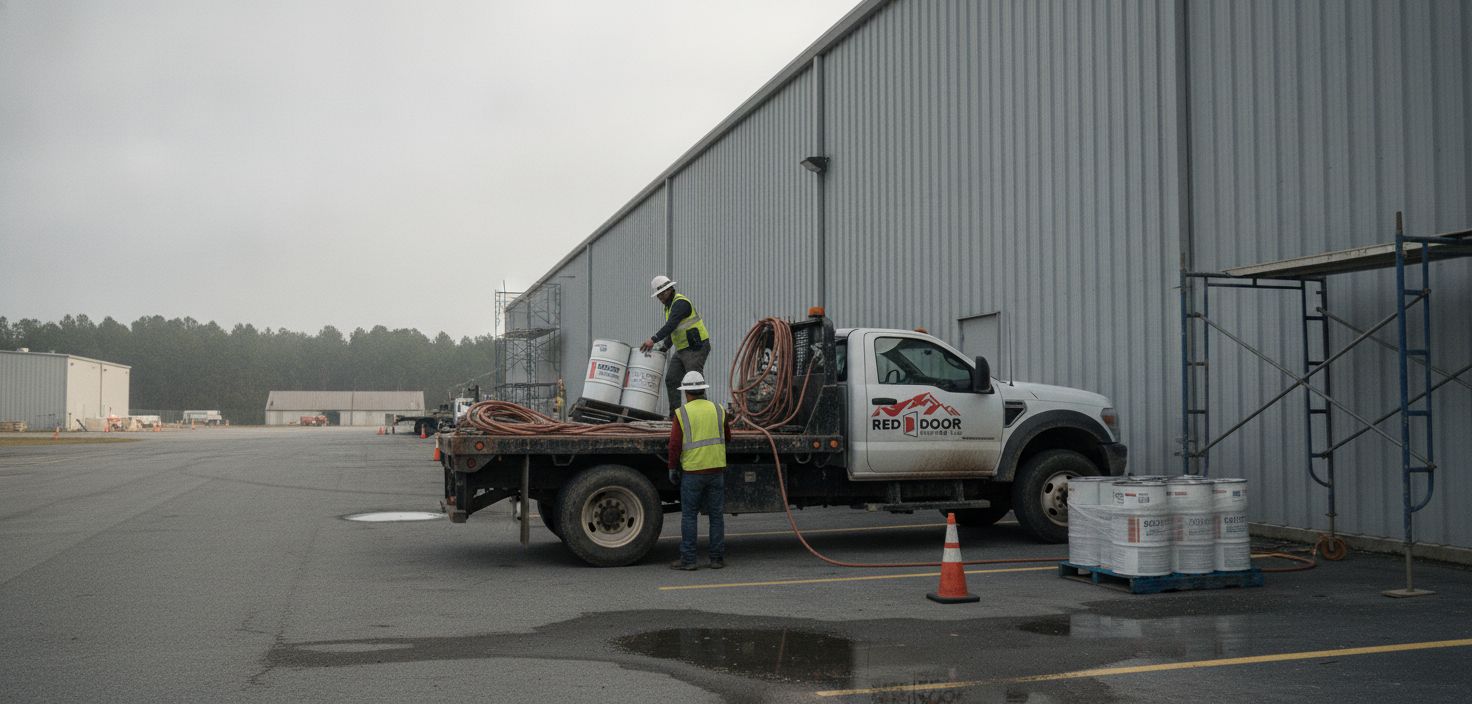
On the warranty side: manufacturer warranties on silicone and polyurethane systems commonly run 15 to 20 years when installed by a credentialed applicator at specified mil thickness. Acrylic systems typically run 10 to 15 years. These warranties are only as good as the manufacturer approval behind them — verify that the contractor is actually credentialed by the coating manufacturer, not just buying the product retail and applying it.
The Capital Planning Angle
For asset managers holding Greenville commercial properties on a long-term basis, coating is fundamentally a capital-deferral tool. If your 20-year-old modified bitumen roof would otherwise need replacement in the next three to five years, a well-executed coating can push that event out by 10 to 15 years — while also reducing your annual maintenance spend on leak calls in the interim.
Run that against your hold period and your cost of capital, and coating often wins clearly. It won't win on every asset — if you're repositioning for sale, a new-roof certification may matter more to buyers than a coating warranty. But for stabilized long-hold commercial and multifamily, deferring a $600,000 capital event by a decade is meaningful.
Questions We Get
Our roof has a few leaks. Can we coat it and call it fixed?
Depends entirely on where the leaks are coming from. If they're localized — a flashing detail, a penetration, a seam that's opened up — those can be repaired as part of the coating prep and the scope makes sense. If leaks are tracking from multiple locations and we can't find clean dry insulation on the scan, that's a systemic problem. Coating over it won't solve it.
How long does the work take? We have tenants in the building.
On a standard commercial scope in the 20,000 to 50,000 square foot range, figure four to seven working days depending on prep complexity, weather windows, and coating cure time between coats. Silicone and most acrylic systems need dry conditions and temperatures above roughly 50°F to cure properly — Greenville summers give us good application weather but we watch afternoon storms closely. Tenant disruption is minimal compared to a tear-off scope; there's no demo noise, no dumpsters, significantly less mess.
What happens if we coat it and it still leaks after?
If prep and installation were done correctly and the leak locations were addressed before coating, that shouldn't happen. If it does, the manufacturer warranty and contractor warranty are what you're relying on — which is why both need to be solid before you sign anything. Get the warranty terms in writing before work starts, not after.
We got a quote that was significantly lower than others. Should we take it?
We'd want to know what's different. If the low bid is using acrylic where the spec calls for silicone, or skipping the fabric reinforcement at seams, or proposing thinner mil coverage than the manufacturer requires, those aren't equivalent scopes. A coating installed below specified mil thickness won't earn the manufacturer warranty, and thinner coating fails earlier. Compare scopes line by line, not just totals.
Does coating qualify for any energy incentives in South Carolina?
High-reflectance coatings can qualify for energy efficiency deductions under federal tax provisions — your tax advisor needs to confirm what applies to your specific asset type and ownership structure. We don't give tax advice, but it's worth the conversation with your CPA before the fiscal year closes.
The bottom line for Greenville property managers: if your building's deck is sound and the insulation is dry, a commercial roof coating is worth a serious look before you budget for replacement. Get an honest inspection first — infrared scan, core samples if the scan shows anything questionable, and a condition assessment that tells you straight whether you have a coating candidate or a replacement situation. That clarity is what the rest of the capital planning conversation depends on.
Want a professional assessment of your property? No-obligation inspection with photo-keyed documentation.
Request InspectionMore From the Blog
- Storm Damage Roof Documentation: What Carriers NeedWhat a carrier-ready storm damage roof report must include to get Charlotte commercial insurance cla…
- Warehouse Roof Warning Signs Before Birmingham WintersCatch commercial roof problems before cold weather turns them into emergencies. A Birmingham roofer'…
- Multifamily Roof Replacement Cost: A Portfolio Budget GuideHow Nashville property managers can forecast multifamily roof replacement costs across a portfolio a…