
Macon's Roof Inventory Is Shaped by an Interchange
Macon-Bibb County sits where Interstate 75 crosses Interstate 16 - the point at which freight moving between Atlanta and the Port of Savannah meets north-south traffic running the length of the Eastern Seaboard. That geography has done more to shape the local commercial roof inventory than anything else about the market.
Amazon operates a 640,000 square foot robotics-enabled fulfilment centre in the Macon-Bibb County Industrial Park, moving over 100,000 boxes a day with roughly 1,200 employees. UPS and FedEx Ground both run distribution operations within minutes of the interchange. Speculative development continues to deliver new Class A space into a market where industrial vacancy has run between 3.5 and 5.2 percent.
For a roofing assessment, the relevant fact in all of that is square footage per building. A distribution roof is not a large version of an office roof. It is a different structure with a different failure pattern, and it needs a different inspection approach.
Large-Footprint Roofs Fail at the Edges First
On a 200,000-plus square foot single-ply or metal roof, the field membrane is rarely the first thing to go. Wind uplift concentrates at perimeters and corners, where pressures run substantially higher than across the open field. Fastener backout, seam separation at the edge detail, and flashing displacement at parapets and curbs are where a large-footprint roof starts failing.
That has two practical consequences for Middle Georgia property owners.
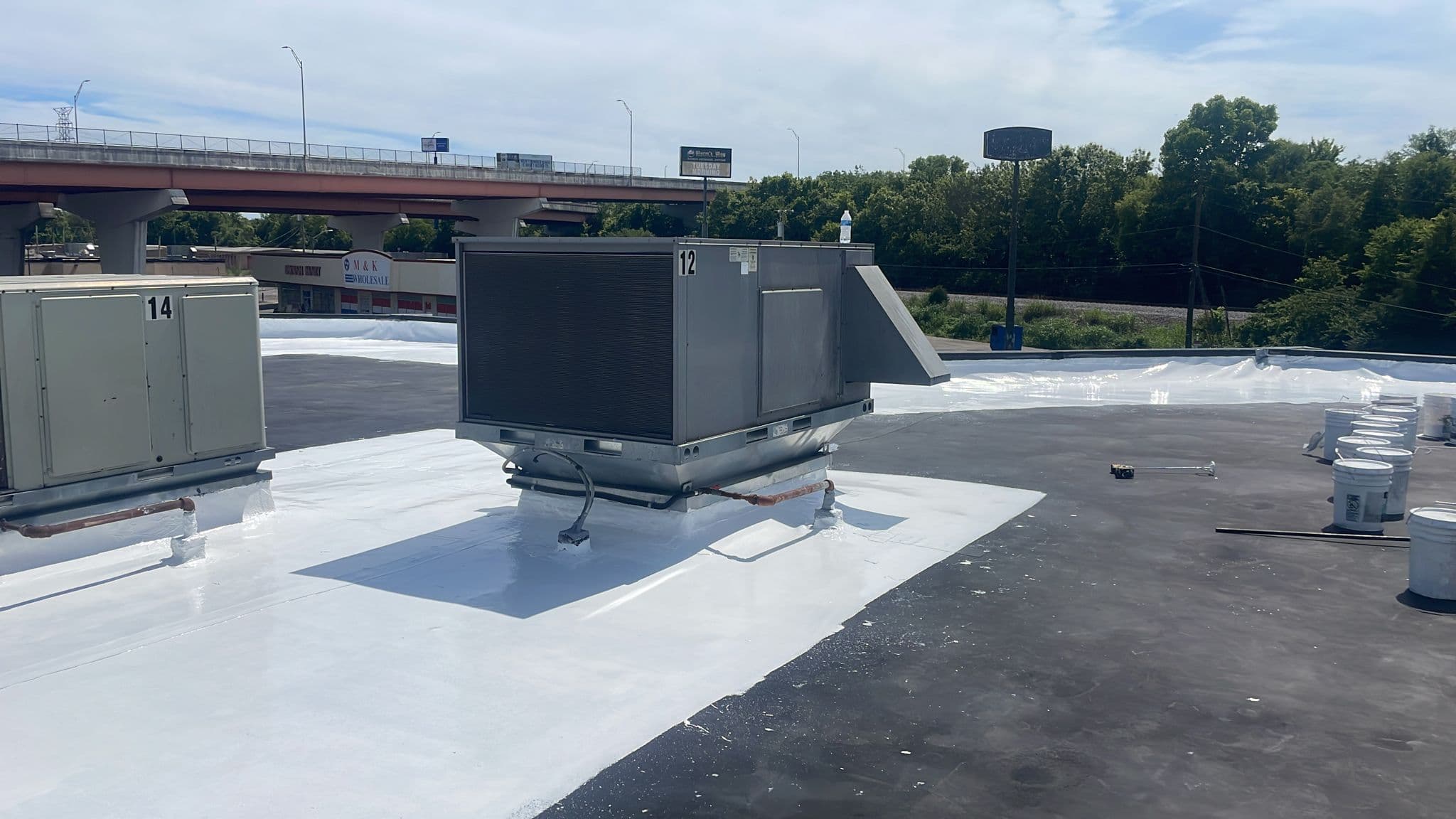
A walk of the field tells you almost nothing. An inspection that does not systematically document perimeters, corners, curbs, and every rooftop-equipment penetration has not inspected the roof. On a building this size there may be dozens of HVAC curbs, exhaust penetrations, and conduit supports, each one a potential entry point.
Damage stays invisible until it is expensive. Water entering at a displaced edge detail can track across a deck for a long distance before it appears inside. By the time a distribution tenant reports a leak over a racking aisle, the insulation is frequently saturated well beyond the visible area, and what looked like a repair becomes a section replacement.
Our commercial roof maintenance programme is built around scheduled documentation of exactly those details, because on large-footprint roofs the inspection cadence is what determines whether a problem stays a repair.
Low Vacancy Changes the Replacement Conversation
Industrial vacancy between 3.5 and 5.2 percent means there is effectively nowhere for a Macon distribution tenant to go. A property owner facing a failing roof over an operating fulfilment or freight operation cannot empty the building and work on an open deck.
That makes phased, tenant-in-place production the default. In practice that means night and weekend production windows around shipping schedules, daily dry-in with no open deck left overnight, material staging that does not obstruct dock doors or fire lanes, and interior protection over racking and conveyor.
It also changes the economics of deferral. On a building that cannot be vacated, the cost of a roof failure is not just the roof - it is the operational disruption, the inventory exposure, and in some cases a tenant claim. That pushes the sensible decision point earlier than it would be on a building that could absorb downtime.
Middle Georgia's Storm Record
Macon and Bibb County sit at the southern edge of Georgia's most active spring severe-weather corridor. NOAA Storm Prediction Center records show recurring hail and straight-line wind events from March through May, with a secondary late-summer peak driven by tropical remnants from the Gulf and Atlantic.
Three events mark the pattern. An EF2 tornado tracked through Bibb County on 11 May 2008, damaging commercial and multifamily stock. Tropical Storm Irma's remnants produced sustained wind through Middle Georgia in September 2017, generating commercial roof and rooftop-equipment claims across Macon. The Easter outbreak of 12 to 13 April 2020 - 141 tornadoes across the Southeast, with at least seven confirmed in Georgia - brought widespread hail and wind through the middle of the state.
Rooftop equipment is worth calling out separately. On distribution and large retail buildings, hail frequently damages condenser coils, exhaust fans, and equipment housings before it visibly damages the membrane. That equipment damage is claimable and routinely missed, because a roof inspection that only assesses the roof covering does not document it.
The Rest of the Market
Macon holds about 157,000 residents in the consolidated city-county inside an MSA approaching 235,000, and the non-industrial inventory needs its own treatment.
- Regional medical. The Atrium Health Navicent campus area carries continuously occupied buildings with critical interior environments and no tolerance for water intrusion during phased work.
- Downtown and Mercer Village. Older commercial sections near Mercer University carry legacy modified bitumen and built-up roofing over older decks, where deck condition drives the repair-versus-replace decision.
- Multifamily. The Vineville Avenue, Riverside Drive, Hartley Bridge, and North Macon Bass Road corridors carry garden-style multifamily on a mix of architectural asphalt shingle and low-slope TPO and EPDM. Our multifamily replacement playbook covers phased production with tenants in place.
- Hospitality and restaurant. PVC is common on restaurant rooftops along Riverside Drive and Eisenhower Parkway, selected for grease resistance around kitchen exhaust.
What Macon Documentation Needs to Show
Georgia commercial policies in the Middle Georgia market commonly carry percentage wind and hail deductibles applied against insured value. On a large-footprint industrial building, a 2 percent deductible on a high insured value is a substantial number, and whether a claim clears it depends on the completeness of the documentation.
Macon-area adjusters cross-reference NOAA SPC records for date-of-loss validation. The documentation that holds up is photo-keyed by slope orientation with date-aligned damage notes, covering the full perimeter, every curb and penetration, and rooftop equipment as a separate line item.
For property owners working through a claim, our insurance claim support service covers carrier-ready documentation, and the commercial storm insurance guide sets out how date-of-loss attribution works across a policy period.
The Practical Takeaway
Macon is a large-footprint roof market in a spring hail corridor with almost no industrial vacancy. That combination means damage concentrates at edges and equipment where it is easy to miss, buildings cannot be emptied to fix it, and deferral carries operational cost well beyond the roof itself.
The property owners who handle this well run scheduled perimeter-and-penetration documentation rather than reactive inspections, and have scope and carrier paperwork ready before a production window opens rather than during it.
For condition assessment, storm documentation, or phased replacement planning in Bibb County, our Macon commercial roofing work covers the distribution, medical, downtown, and multifamily stock, and our commercial roof inspection service covers the detail-level record the rest depends on.
Want a professional assessment of your property? No-obligation inspection with photo-keyed documentation.
Request InspectionMore From the Blog
- Commercial Roofing in Albany, GASouthwest Georgia's storm record, Hurricane Michael's inland wind field, and what Albany commercial …
- Commercial Roofing in Athens, GAHow a 43,887-student university calendar, dense student-housing stock, and Northeast Georgia's sprin…
- Commercial Roofing in Augusta, GAIce-load exposure, Fort Eisenhower's cyber build-out, and medical-district tenant constraints that s…