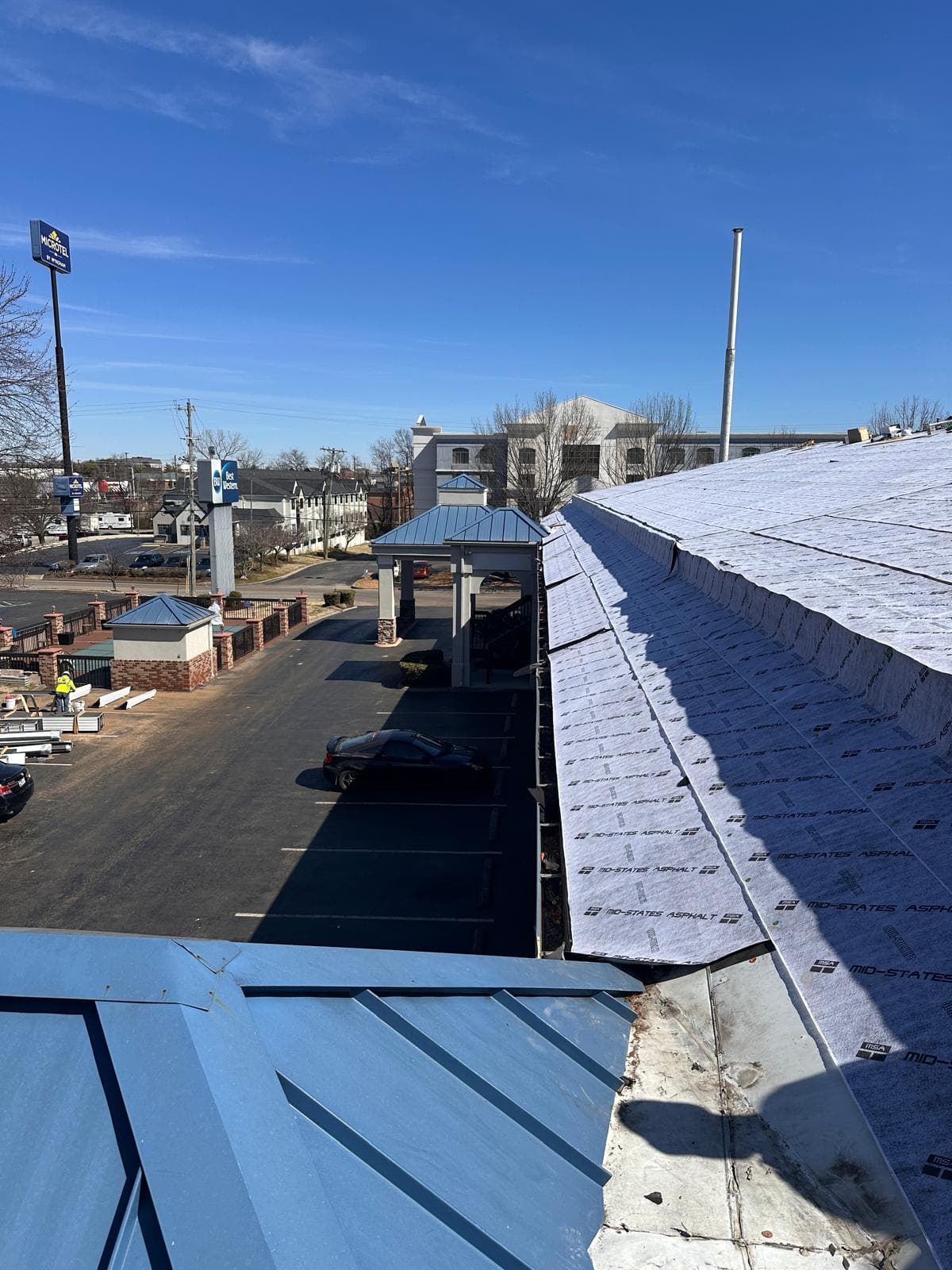
Commercial Roofing in Conyers, Georgia
Inspection, documentation, and insurance-supported roof replacement for commercial and multifamily properties across Conyers.
Commercial & Multifamily Roofing Across the Atlanta-Sandy Springs-Alpharetta
Conyers's commercial roof inventory is concentrated along the I-20 logistics and distribution corridor, the Rockdale Medical Center healthcare cluster, the GA-138 retail frontage, and the hospitality and retail stock around the Georgia International Horse Park. Assembly mix runs heavily to mechanically fastened and fully adhered TPO on newer distribution, retail, and medical-office roofs, with modified bitumen and aging built-up roofing on older industrial and institutional buildings. Standing-seam metal appears on select flex-industrial and hospitality outparcels. Multifamily garden communities use asphalt-shingle pitched roofs. Our Conyers scope is commercial only; we do not take single-family shingle work. Every inspection produces a photo-keyed PDF tied to a numbered roof plan, and we issue a Certificate of Clearance when no functional damage is present. Carriers make the final determination on all insurance outcomes. Portfolio owners who hold multiple properties across the submarket receive the same deliverable format for each asset, so inspection data can move between stakeholders, be integrated into asset management systems, and support long-term capital planning without reformatting. Owners who are new to commercial documentation sometimes ask whether a residential-style drive-by inspection is sufficient. It is not. Commercial assemblies require plan-keyed photography, penetration-by-penetration evaluation, and assembly-class-specific detailing, and brokers, lenders, and carriers increasingly expect that level of documentation for every asset they underwrite or finance in this submarket.
Red Door Roofing serves commercial, multifamily, healthcare, hospitality, and light-industrial property owners across Conyers and the Rockdale County commercial market along the I-20 east corridor. Conyers is best known nationally as the 1996 Olympic equestrian venue at the Georgia International Horse Park, and the city's commercial inventory reflects a mixed economy anchored by Rockdale Medical Center, the I-20 logistics and distribution corridor, automotive-supplier and light-manufacturing inventory, and grocery-anchored retail along GA-138 and Iris Drive. For commercial property owners and managers, the roof assemblies we document in Conyers are predominantly low-slope single-ply TPO and PVC, modified bitumen and aging built-up roofing on older institutional and industrial buildings, standing-seam metal on select flex-industrial and hospitality outparcels, and asphalt-shingle pitched roofs on the garden-style multifamily communities that cluster along GA-138 and toward Milstead. Red Door Roofing's Conyers scope is commercial only. We do not take single-family shingle work. Our crews, documentation standards, and warranty registration workflows are tuned to 10,000-square-foot-and-larger properties where owners, lenders, and carriers expect a photo-keyed PDF inspection report tied to a numbered roof plan. Every Conyers inspection produces that deliverable. When documentation shows no functional damage we issue a Certificate of Clearance describing current serviceable condition with photographic evidence, which owners use to defend renewal premiums, respond to lender recertification asks, and support acquisition due diligence. We are licensed through the Red Door family of companies' Georgia general contractor licensure, and our field teams are trained on TPO, PVC, EPDM, modified bitumen, standing-seam metal, and phased multifamily reroof sequencing. The I-20 logistics corridor, the Rockdale Medical Center healthcare cluster, the Olde Town Conyers professional services district, and the hospitality and retail inventory around the Georgia International Horse Park are all part of our regular service area. Property owners and managers in Conyers and adjacent Covington, Lithonia, and Stockbridge who need a current PDF roof report for renewal, refinancing, due diligence, or claim documentation can request a commercial inspection directly. Our Certificate of Clearance is not a warranty, not a guarantee of any premium outcome, and does not bind any carrier or lender. It is simply a signed, photo-keyed record of the current condition of the assembly at the time of inspection, built from the same documentation standard we apply to every commercial property we inspect across this market.
Conyers Business Parks & Office Districts We Serve
Our commercial roofing work in Conyers concentrates around the metro's largest office parks and corporate districts. Each of these business parks contains multiple commercial and mixed-use tenants where tenant-in-place scheduling, after-hours production windows, and coordinated material staging matter as much as the roof scope itself. Commercial-grade flat roof systems and pitched multifamily assemblies are both well represented across these parks - our inspections walk every roof section, every transition, and every drain to build a complete condition document suitable for carrier, lender, and asset-manager review.
- I-20 East logistics corridor industrial park
- Rockdale Industrial Boulevard cluster
- Sigman Road commerce corridor
- Dogwood Drive industrial area
- Pine Log Road industrial cluster
- Highway 138 commerce district
- Salem Road industrial zone
- Milstead industrial area
Primary Conyers Commercial Corridors
Conyers's commercial and multifamily stock clusters along a handful of primary corridors. Our inspection and replacement work tracks along these corridors where commercial density, tenant complexity, and storm exposure concentrate. Routing and material staging around these corridors is part of every Conyers project plan - peak commuter hours, event calendars, and fire-lane requirements all factor into how we schedule.
- I-20 east retail and hospitality frontage
- GA-138 (Iris Drive) retail corridor
- GA-20 Salem Road commercial corridor
- Olde Town Conyers professional district
- Sigman Road commerce corridor
- Klondike Road commercial frontage
Conyers Multifamily Districts
Multifamily roof replacement demands phased scheduling so tenants stay in place. Our work across Conyers's multifamily districts follows building-by-building production schedules with tenant-notice templates and noise-window coordination per property. Asset managers receive portfolio-level closeout documentation; property managers receive a phased Gantt-style schedule they can share with residents and operations teams; leasing teams receive advance notice for unit-turn and move-in coordination.
- GA-138 corridor garden communities
- Klondike Road multifamily cluster
- Salem Road apartment corridor
- Milstead-adjacent garden communities
- Sigman Road multifamily frontage
Conyers Storm & Severe-Weather History
Rockdale County's severe-weather exposure peaks in the March-through-May spring supercell window with a secondary late-summer and early-fall peak from tropical-remnant systems. Hail reports cluster along I-20 east where storm motion channels across the southern Piedmont. Straight-line wind is the most frequent commercial claim driver, producing perimeter metal lifts, HVAC-curb flashing separation, and isolated membrane punctures. We recommend a documented pre-season inspection in late January or February so the PDF is on file before the first supercell cycle and before renewal submissions.
Conyers and Rockdale County sit along metro Atlanta's I-20 east corridor and fall squarely within the spring-supercell exposure band with additional risk from tropical-remnant systems tracking inland. The 2011-04-27 Super Outbreak delivered widespread wind and hail through the Atlanta basin and generated a major commercial claim wave across the I-20 corridor including Conyers. Tropical Storm Irma remnants on 2017-09-11 produced sustained tropical-force winds through Rockdale County, lifting perimeter metal and damaging HVAC-curb flashings at retail, medical-office, and light-industrial sites. The 2019-03-03 severe-weather outbreak added hail and straight-line wind along I-20. The 2023-01-12 central Alabama outbreak drove hail and wind through the broader Atlanta basin reaching Conyers commercial stock, with reports concentrated along GA-138. A 2024-03-14 spring thunderstorm cycle produced another hail and wind round through the I-20 east corridor with documented damage at retail and multifamily properties. For commercial assemblies we document hail bruising on modified bitumen and aging BUR, mechanical-fastener backout and seam fatigue on older TPO, membrane punctures at rooftop curbs, perimeter-metal displacement, and sealant failure at pipe penetrations and pitch pans. Each condition is captured in a photo-keyed PDF inspection tied to the property's numbered roof plan. When an inspection finds no functional damage we issue a Certificate of Clearance rather than push a borderline claim, and we advise owners on pre-season preparation ahead of each spring cycle. Carriers make the final determination on every claim. Owners who maintain an annual or biennial inspection rhythm, particularly before spring supercell season and before renewal submissions, are best positioned to support any future claim with comparable before-and-after documentation of each assembly.
Notable documented Conyers-area events
2011-04-27 · Super Outbreak tornadoes and hail
Widespread wind and hail through metro Atlanta including Rockdale County, major commercial claim wave.
2017-09-11 · Tropical Storm Irma remnants
Sustained tropical-force winds through Rockdale County, perimeter metal and HVAC-curb damage across commercial low-slope assemblies.
2019-03-03 · Severe weather outbreak
Hail and straight-line wind along I-20 east, commercial membrane and flashing damage.
2024-03-14 · Spring supercell thunderstorms
Hail and wind reports along I-20 east corridor into Conyers commercial stock.
Insurance Process in Conyers
Conyers commercial policies commonly carry percentage wind and hail deductibles from 1 percent to 5 percent of insured building value. Owners should verify current deductible structure, named insured, and property addresses before each storm season and keep a current photo-keyed PDF inspection accessible for rapid transmission after an event. Carriers make the final determination on every claim. Policies with scheduled-location sublimits or per-building caps should be reviewed annually because a commercial policyholder’s exposure changes as assembly age, occupancy, and tenant mix shift over time.
Rockdale County lenders and carriers commonly request current roof condition reports at renewal, refinancing, and acquisition. A photo-keyed PDF tied to a numbered roof plan usually satisfies underwriting asks. Certificate of Clearance substitutes when no damage is documented. We provide the PDF in a format the broker or lender can attach directly to their underwriting file.
Commercial Roof Systems Common in Conyers
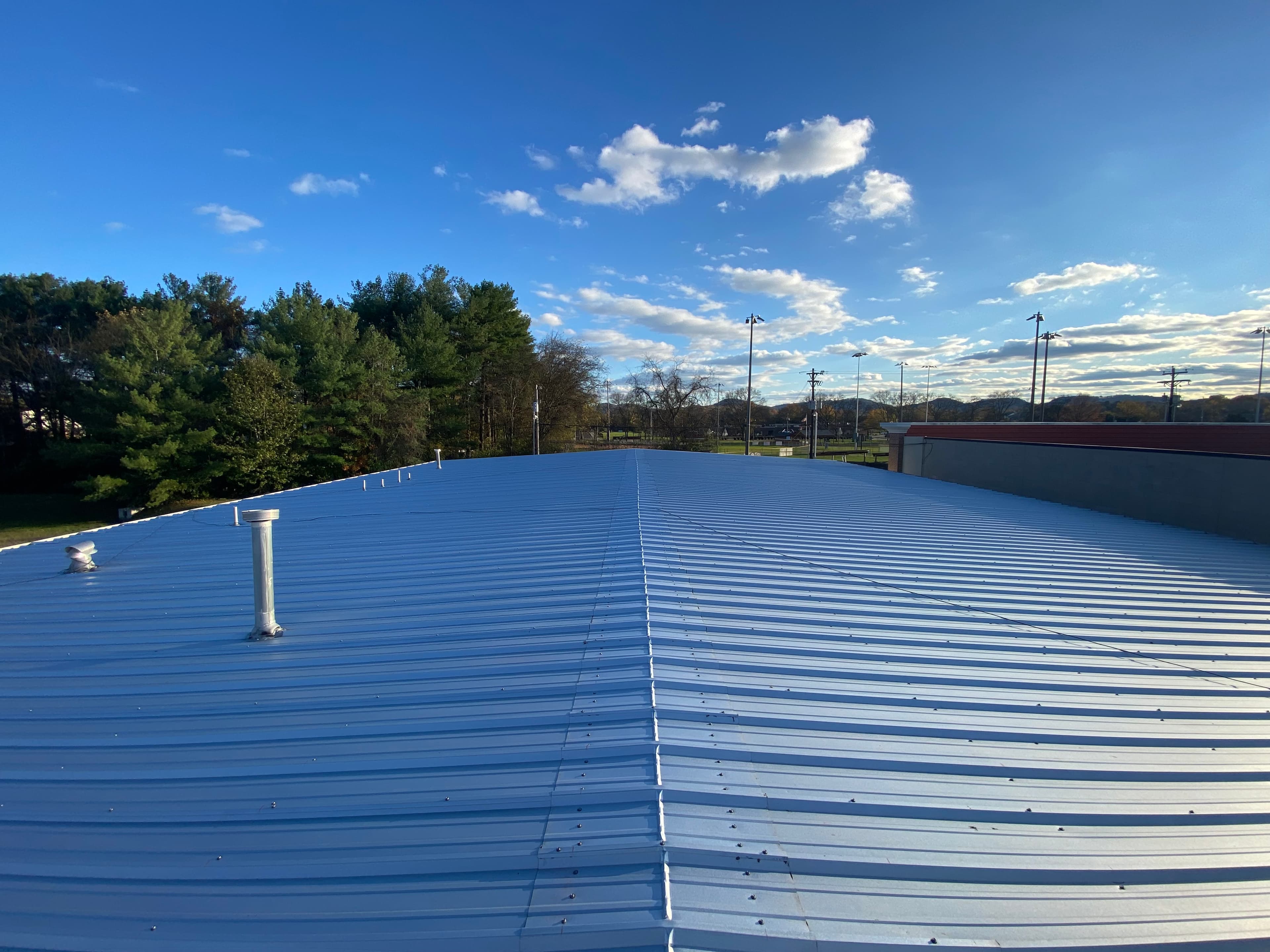
Mechanically fastened and fully adhered TPO dominate newer retail, medical-office, and distribution assemblies. PVC appears on select restaurant buildings. Modified bitumen and aging BUR persist on older institutional and industrial properties. Standing-seam metal appears on select flex-industrial and hospitality outparcels. Garden-style multifamily use asphalt-shingle pitched roofs with ridge and soffit ventilation. Cover-board composition, insulation fastener density, and membrane thickness are documented in every inspection because each of those attributes factors into wind-uplift performance and the carrier’s underwriting model for the assembly.
Conyers Landmarks & Properties We've Served Near
Our commercial and multifamily roofing work crosses paths with Conyers's most recognizable properties and corridors. These landmarks anchor the commercial districts we work in daily - they're not just tourism references, they're the neighborhoods where property managers ask us to inspect multifamily, retail, hospitality, and office stock.
- Georgia International Horse Park
- Rockdale Medical Center
- Monastery of the Holy Spirit
- Olde Town Conyers historic district
- I-20 east corridor
- GA-138 Iris Drive
- Salem Road corridor
- Klondike Road
Property Types We Serve in Conyers
- Rockdale Medical Center healthcare campus
- Georgia International Horse Park
- Olde Town Conyers professional district
- I-20 east distribution and logistics stock
What a Conyers Commercial Roof Inspection Includes
Every Conyers commercial inspection we perform produces a photo-keyed PDF report built for the way Georgia adjusters, lenders, and asset managers actually work. We walk the full roof system - every slope, every drain, every penetration, every transition - and document what we see with photos referenced to a building or unit location. No generic stock photos. No marketing filler. Just the evidence a carrier needs to make a scope determination on a real commercial property.
On multifamily buildings we document building-by-building, which matters because a 300-unit Conyers complex may show damage concentrated on two of eight roofs. Adjusters want that level of granularity, and the documentation protects the owner from a blanket-scope claim that gets pared back in review.
The inspection report identifies your existing roof system (TPO, EPDM, PVC, modified bitumen, BUR, asphalt shingle, metal, or a mixed portfolio), estimates remaining useful life, flags flashing and penetration condition, and notes any observed damage with date-of-loss alignment where applicable. We also call out situations where we recommend repair rather than replacement - our business is not built on upselling.
Working With Conyers Adjusters and Carriers
Most Conyers commercial claims don't fail on the damage - they fail on documentation gaps or scope- supplement misunderstandings with the adjuster. Our inspection reports are formatted to match what Conyers-area commercial adjusters routinely request: photo-keyed damage evidence, roof-system identification, a priced scope against local labor and material norms, and a repair-vs-replacement recommendation grounded in observed condition.
When an adjuster's initial scope misses legitimate work - underlayment, code-required upgrades, perimeter metal, additional penetrations - we submit a supplement with supporting documentation. Reasonable supplements with good evidence are typically approved. We don't submit questionable supplements, and we don't push scope that wasn't clearly warranted by what we photographed. Conyers adjusters are experienced, and credibility is the currency we operate on.
Typical Conyers Commercial Roof Project Timeline
A typical Conyers commercial roof project runs 30–120 days from inspection to installation completion. Here's how that calendar breaks down on a mid-size property:
- Week 1: on-site inspection, photo-keyed report delivered to owner
- Weeks 2–3: claim filed, adjuster assigned, on-roof walk with adjuster + contractor
- Weeks 3–6: initial scope received, supplement filed for any missed work, approved scope returned
- Weeks 6–10: material procurement, tenant-notice distribution, phased production schedule built
- Weeks 10–16: on-roof production, daily photo documentation, weekly progress check-ins
- Weeks 16–17: final walk, punch-list completion, closeout documentation to lender and carrier
Multifamily properties in Conyers with 100–300 units typically run on the longer end of that range; smaller commercial buildings close faster. Material lead times on TPO, EPDM, and PVC are the usual timeline variables. We share a phased Gantt schedule so operations, leasing, and asset-management teams can plan around the work.
I-20 east distribution and logistics commercial roofs
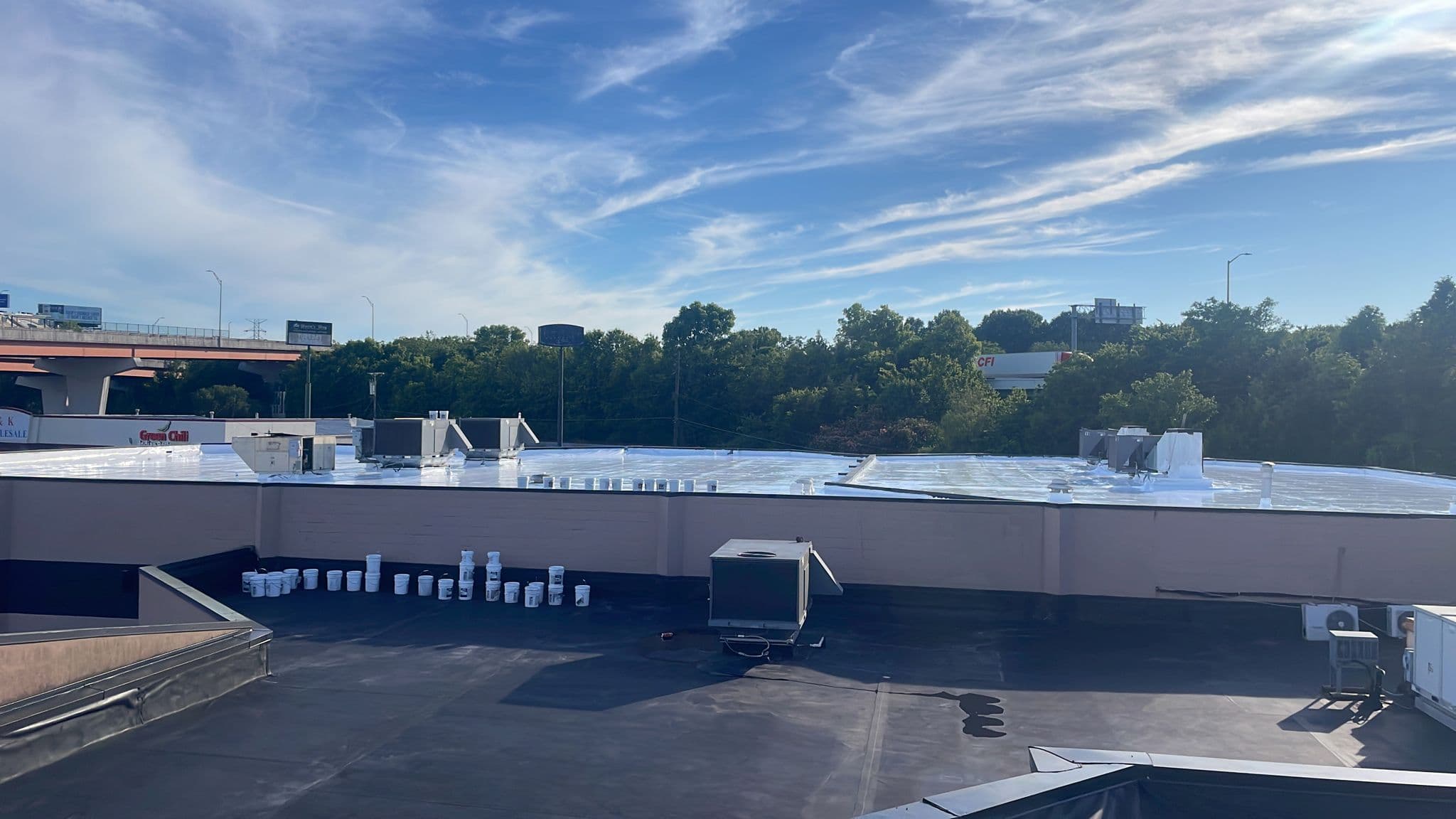
The I-20 east corridor through Conyers has become one of metro Atlanta's most active logistics and light-industrial submarkets, and the commercial roof inventory reflects that growth. Newer distribution and flex-industrial buildings typically carry mechanically fastened or fully adhered TPO over polyisocyanurate insulation, with tapered drainage sloping to internal drains or perimeter scuppers. Perimeter metal, termination bars, and rooftop HVAC curb flashings are the most common failure points we document, followed by sealant fatigue at pipe penetrations and pitch pans. The inspection workflow we use in this submarket is the same one we apply across every commercial property class we serve: a numbered roof plan, photo-keyed defect documentation, assembly and penetration cataloging, and a closeout PDF that owners can share directly with brokers, lenders, and carriers without reformatting or additional interpretation.
We document each distribution roof with a numbered plan identifying elevations, drain and scupper locations, rooftop units, skylights, hatches, and any ponding patterns observable during inspection. Photos are keyed to plan locations and captioned with assembly and repair context. Owners use the PDF for lender recertification, acquisition due diligence, and carrier renewal. When an inspection shows no functional storm damage we issue a Certificate of Clearance describing current condition. Any related carrier determination depends on policy terms in force at time of loss. Cover-board composition, insulation fastener spacing, and membrane thickness all factor into wind-uplift performance and remaining-service-life estimates, and we record each of those attributes in the PDF so portfolio owners can evaluate assets consistently across multiple properties.
- Mechanically fastened and fully adhered TPO dominate newer distribution roofs
- Perimeter metal and HVAC curbs are the most common defect sites
- Numbered roof plans key every photo to a plan location
Rockdale Medical Center healthcare roof documentation
Healthcare-support buildings in the Rockdale Medical Center corridor require additional documentation beyond typical commercial inspection formats. Facilities teams need assembly and penetration documentation tied into their capital planning process, infection-control awareness during any rooftop work, and protection of rooftop air-intake units during membrane repair or replacement. Our inspection PDFs identify every rooftop HVAC and exhaust unit, note conditions that could affect interior air quality, and document findings in a format that integrates with the facility's capital planning records. Pre-event baseline documentation matters because post-event comparison becomes straightforward when a recent PDF is already on file. That pre-event-to-post-event comparison is the single most important factor in how carriers evaluate storm-related claim submissions on commercial assemblies, and maintaining an annual or biennial inspection rhythm substantially improves that comparison.
Replacement projects on healthcare properties are phased around patient-sensitive windows and coordinated with facilities management in writing. We stage materials to limit rooftop traffic over occupied clinical areas, protect rooftop air-intake units with temporary shrouds during demolition, and provide daily progress documentation tied to room and suite numbers. The closeout PDF includes the complete photographic record, manufacturer warranty registration, and any air-intake protection verification required by facilities or regulatory stakeholders. We coordinate with the owner’s broker from first inspection through adjuster assignment, supplemental documentation if requested, and final disposition, but we do not make representations about payout, timing, or coverage scope. Those determinations belong to the carrier and depend on policy terms, deductibles, exclusions, and endorsements in force at time of loss.
Multifamily phasing and tenant-notice workflow
Conyers's garden-style multifamily inventory along GA-138, Klondike Road, and Salem Road follows phased-reroof patterns designed around leasing calendars, school schedules, and amenity programming. We break projects into building groups, publish a written tenant-notice schedule through on-site management, and sequence tear-off and dry-in so no unit is exposed overnight. Material staging is coordinated to keep leasing offices, amenity areas, and pool decks accessible throughout the project. Building selection within each phase prioritizes weather windows, material delivery cadence, and dumpster placement so residents see a predictable pattern rather than disruption that moves unexpectedly between buildings. Communication flows through the on-site management team so residents receive a single consistent voice during the project.
Daily progress photos are keyed to unit numbers and building labels. At closeout we deliver a phased-project PDF including pre-construction condition, in-progress documentation, final condition, and manufacturer warranty registration. Owners and lenders receive a single defensible record of what was replaced, when, and how, which supports refinancing, acquisition due diligence, and carrier renewal submissions through the asset's remaining life cycle. The closeout package also supports any future disposition because a buyer conducting due diligence years after the reroof has a complete photographic record of the installed assembly, fastening pattern, and penetration detailing rather than having to reconstruct that information from invoices, permits, or partial manufacturer files.
- Phased schedule published through on-site management
- Unit-keyed daily progress photos throughout the project
- Closeout PDF includes warranty registration documentation
Why Conyers Property Owners Choose Red Door Roofing
30+ years, Red Door family
Built on 30 years of commercial experience across the Southeast. Notable clients include Best Western, Harbor Freight, Tractor Supply, and Vanderbilt Medical Clinic.
Carrier-ready documentation
Photo-keyed inspection reports formatted for Conyers-area adjuster and lender workflows. No guarantees on claim outcomes - the carrier calls that.
Tenant-in-place phasing
Multifamily work phased by building block with tenant-notice templates, noise windows, and operations- team documentation. Tenants stay in place.
No-obligation inspection
If our Conyers inspection finds no qualifying damage, we issue a Certificate of Clearance - suitable for lender, insurer, and asset-manager files. No further commitment.
Conyers Commercial Roofing FAQs
Do you inspect facilities at the Georgia International Horse Park?
Can you document a Conyers distribution facility along I-20 during tenant transition?
Do you handle healthcare-support buildings near Rockdale Medical Center?
How do you handle reroofs on occupied garden-style multifamily in Conyers?
Does Red Door Roofing handle residential roofs in Conyers?
What does a Conyers commercial inspection deliver?
How is a Certificate of Clearance useful to a Conyers property owner?
What assemblies dominate Rockdale County commercial inventory?
Do you work on healthcare buildings at Rockdale Medical Center?
How should Conyers owners prepare for spring storm season?
Nearby Georgia Cities We Also Serve
Our commercial roofing coverage extends across Georgia. These three Conyers-adjacent cities are part of our routine service footprint.
Need a Conyers inspection?
Call us directly at 1-855-GO4REDD or request a no-obligation inspection online. Most Conyers-area inspections are scheduled within days of the request.
Request InspectionSchedule a Conyers Roof Inspection
No obligation. Documented findings you can use for insurance, lender, or asset-manager records.
30+ Years of Red Door Family Experience · 16 States
Free · No obligation · No follow-up sales calls