
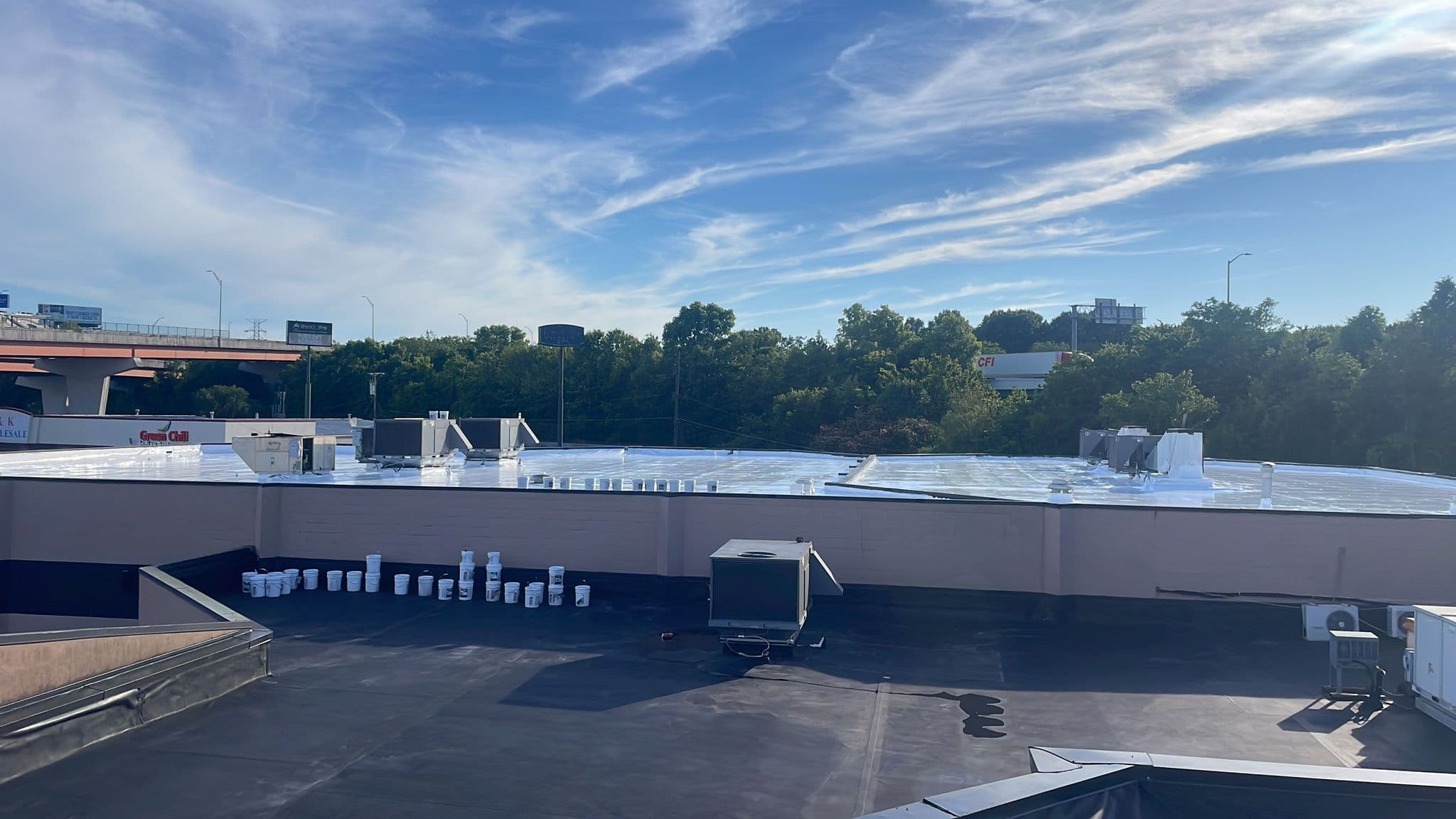
Commercial Roofing in Winder, Georgia
Inspection, documentation, and insurance-supported roof replacement for commercial and multifamily properties across Winder.
Commercial & Multifamily Roofing Across the Atlanta-Sandy Springs-Alpharetta
Winder's commercial roof stock reflects a transitional Barrow County economy: legacy industrial and poultry-processing buildings in the core, newer distribution and flex-industrial shells along GA-316, grocery-anchored retail and medical-office on GA-53 and GA-81, and garden-style multifamily clustered toward Bethlehem and Auburn. Assembly mix leans to mechanically fastened TPO on newer boxes, modified bitumen and aging built-up roofing on older industrial, standing-seam metal on select flex-industrial and hospitality outparcels, and asphalt shingles on multifamily pitched roofs. Our Winder work is entirely commercial: we do not take single-family shingle jobs. Every engagement starts with a photo-keyed PDF inspection tied to a numbered roof plan, and when no functional damage is documented we issue a Certificate of Clearance rather than push a claim. Owners, asset managers, brokers, and lenders all receive the same deliverable format so documentation can move between stakeholders without reformatting or re-interpretation. Carriers make the final determination on all insurance outcomes, and we never represent otherwise in any communication with owners or brokers.
Red Door Roofing serves commercial, multifamily, healthcare, hospitality, and light-industrial property owners across Winder and the Barrow County commercial market, a rapidly growing corridor anchored by the US-29 and GA-316 junction linking Athens-Clarke County to metro Atlanta. Winder sits in a transitional economy where former textile and poultry-processing facilities continue operating alongside newer distribution, automotive-supplier, and flex-industrial properties drawn by highway access and the Barrow County Airport. For commercial property owners and managers, this mix means roof assemblies on site range from legacy built-up roofing (BUR) and modified bitumen over aging industrial buildings to newer single-ply TPO and mechanically fastened EPDM systems on modern distribution boxes, grocery-anchored retail, and medical-office buildings along GA-53 and GA-81. Our scope in Winder is commercial only. We do not take residential shingle work here. Instead, we concentrate on the assemblies, warranties, and documentation frameworks that owners of 10,000-square-foot and larger properties rely on when insurance carriers, lenders, and asset managers ask for current roof condition reports. Every inspection produces a photo-keyed PDF tied to elevations, drains, penetrations, perimeter flashing, and mechanical curbs so the owner has a single defensible document for underwriting, lender recertification, due-diligence review, or claim documentation. When an inspection shows no functional damage, we provide a Certificate of Clearance that documents the assembly's current serviceable condition with photographic evidence. That certificate is a useful tool for property owners defending renewal premiums against carriers who are pricing interior-Georgia wind and hail aggressively after the last several active convective seasons. Red Door Roofing is licensed to perform commercial roofing through the Red Door family of companies' Georgia general contractor licensure, and our field crews are trained specifically on low-slope single-ply, modified bitumen, standing-seam metal, and multifamily phased reroof sequencing. The Chateau Elan and Braselton retail trade area immediately north of Winder is an active service market for us, and the hospitality, medical-office, and multifamily inventory along that corridor follows similar assembly patterns to what we document here. Property owners in Winder, Bethlehem, Auburn, and Statham who need a current PDF roof report for renewal, acquisition, or a storm-event claim can request an inspection directly through our Barrow County intake.
Winder Business Parks & Office Districts We Serve
Our commercial roofing work in Winder concentrates around the metro's largest office parks and corporate districts. Each of these business parks contains multiple commercial and mixed-use tenants where tenant-in-place scheduling, after-hours production windows, and coordinated material staging matter as much as the roof scope itself. Commercial-grade flat roof systems and pitched multifamily assemblies are both well represented across these parks - our inspections walk every roof section, every transition, and every drain to build a complete condition document suitable for carrier, lender, and asset-manager review.
- Winder Industrial Park
- Barrow Crossing
- GA-316 Commerce Corridor
- Barrow County Airport business area
- Patrick Mill Road industrial cluster
- Loganville Highway commerce zone
- Atlanta Highway industrial frontage
- Auburn Industrial Park (adjacent)
Primary Winder Commercial Corridors
Winder's commercial and multifamily stock clusters along a handful of primary corridors. Our inspection and replacement work tracks along these corridors where commercial density, tenant complexity, and storm exposure concentrate. Routing and material staging around these corridors is part of every Winder project plan - peak commuter hours, event calendars, and fire-lane requirements all factor into how we schedule.
- US-29 (Atlanta Highway) retail corridor
- GA-316 University Parkway corridor
- GA-53 medical and retail corridor
- GA-81 commercial frontage
- Downtown Winder historic district
- Broad Street professional corridor
Winder Multifamily Districts
Multifamily roof replacement demands phased scheduling so tenants stay in place. Our work across Winder's multifamily districts follows building-by-building production schedules with tenant-notice templates and noise-window coordination per property. Asset managers receive portfolio-level closeout documentation; property managers receive a phased Gantt-style schedule they can share with residents and operations teams; leasing teams receive advance notice for unit-turn and move-in coordination.
- GA-316 corridor garden-style communities
- Patrick Mill Road multifamily cluster
- Bethlehem-adjacent apartment corridor
- Auburn-adjacent garden communities
- Carl-Winder Road multifamily zone
Winder Storm & Severe-Weather History
Barrow County sees the bulk of its severe-weather exposure during the March-through-May spring supercell window, with a secondary late-summer and early-fall peak when tropical-remnant systems track inland from the Gulf or Atlantic. Hail reports cluster along the GA-316 corridor where topography channels storm motion between the Athens plateau and Atlanta basin. Straight-line wind is the more frequent claim driver for commercial accounts, producing perimeter metal lifts, HVAC-curb flashing separation, and isolated membrane punctures rather than the widespread field damage typical of significant hail. We recommend a documented pre-season inspection in late January or February so the PDF is on file before the first supercell cycle.
Winder and Barrow County sit in northeast Georgia's spring-supercell corridor with documented wind and hail exposure through the March-through-May peak window and occasional tropical-remnant impacts in September. The 2011-04-27 Super Outbreak produced EF3 and EF4 damage across northwest Georgia and northeast Alabama and generated widespread hail and straight-line-wind reports through the broader Atlanta-Athens corridor, triggering a large wave of commercial claim activity that reset underwriting baselines for interior-Georgia accounts. Tropical Storm Irma remnants on 2017-09-11 drove sustained tropical-force winds through Barrow and surrounding counties, lifting perimeter metal and ballast on older low-slope assemblies and damaging sign and rooftop-HVAC curbs at retail and light-industrial sites. The 2019-03-03 severe-weather outbreak produced additional hail and wind claims across northeast Georgia. The 2023-01-12 tornado outbreak concentrated most damage across central Alabama but drove hail and straight-line wind through the I-20 and I-85 corridors reaching into Barrow County. A 2024-03-14 spring thunderstorm cycle delivered another round of hail and wind damage reports across the Athens-Winder-Braselton corridor. For commercial assemblies, the cumulative effect of these events is cosmetic hail bruising on modified bitumen and aging BUR, membrane puncture at flashing transitions, seam fatigue on older mechanically fastened TPO, edge-metal displacement, and HVAC-curb flashing separation. We document all of these conditions with photo-keyed PDF inspection reports. When an inspection finds no functional damage, we issue a Certificate of Clearance instead of pushing a claim the carrier is unlikely to pay. Carriers make the final determination on every claim.
Notable documented Winder-area events
2011-04-27 · Super Outbreak tornadoes and hail
Widespread wind and hail across NE Georgia corridor including Barrow and surrounding counties, heavy commercial claim activity.
2017-09-11 · Tropical Storm Irma remnants
Sustained tropical-force winds through Barrow County, perimeter metal and HVAC-curb damage on low-slope assemblies.
2019-03-03 · Severe weather outbreak
Hail and straight-line wind across NE Georgia generated commercial membrane and flashing damage.
2024-03-14 · Spring supercell thunderstorms
Hail and wind across Athens-Winder-Braselton corridor, additional round of commercial claim activity.
Insurance Process in Winder
Most commercial policies in Barrow County carry percentage wind and hail deductibles ranging from 1 percent to 5 percent of insured building value, materially higher than the flat dollar deductibles on many older or smaller policies. Owners should confirm current deductible structure with their broker before storm season and keep a current photo-keyed PDF roof report on file. Carriers make the final determination on every claim.
Barrow County lenders and carriers increasingly request current roof condition reports at renewal, recertification, and refinancing. A photo-keyed PDF tied to a numbered roof plan, with clear assembly documentation and repair history, satisfies most underwriting and lender asks without additional back-and-forth. Certificate of Clearance can substitute when no damage is present.
Commercial Roof Systems Common in Winder
Newer Winder commercial boxes typically carry mechanically fastened or fully adhered TPO over polyisocyanurate insulation. Older industrial and institutional buildings show modified bitumen or aging built-up roofing. Standing-seam metal appears on select flex-industrial and hospitality outparcels. Multifamily garden communities run asphalt-shingle pitched roofs over plywood or OSB decking with ridge and soffit ventilation.
Winder Landmarks & Properties We've Served Near
Our commercial and multifamily roofing work crosses paths with Winder's most recognizable properties and corridors. These landmarks anchor the commercial districts we work in daily - they're not just tourism references, they're the neighborhoods where property managers ask us to inspect multifamily, retail, hospitality, and office stock.
- Fort Yargo State Park
- Barrow Regional Medical Center
- Chateau Elan Winery and Resort
- Barrow County Airport
- Winder-Barrow High School
- Downtown Winder historic square
- GA-316 University Parkway
- US-29 Atlanta Highway
Property Types We Serve in Winder
- Barrow Regional Medical Center
- Fort Yargo State Park gateway retail
- Chateau Elan adjacent hospitality corridor
- Winder-Barrow Industrial Park tenants
What a Winder Commercial Roof Inspection Includes
Every Winder commercial inspection we perform produces a photo-keyed PDF report built for the way Georgia adjusters, lenders, and asset managers actually work. We walk the full roof system - every slope, every drain, every penetration, every transition - and document what we see with photos referenced to a building or unit location. No generic stock photos. No marketing filler. Just the evidence a carrier needs to make a scope determination on a real commercial property.
On multifamily buildings we document building-by-building, which matters because a 300-unit Winder complex may show damage concentrated on two of eight roofs. Adjusters want that level of granularity, and the documentation protects the owner from a blanket-scope claim that gets pared back in review.
The inspection report identifies your existing roof system (TPO, EPDM, PVC, modified bitumen, BUR, asphalt shingle, metal, or a mixed portfolio), estimates remaining useful life, flags flashing and penetration condition, and notes any observed damage with date-of-loss alignment where applicable. We also call out situations where we recommend repair rather than replacement - our business is not built on upselling.
Working With Winder Adjusters and Carriers
Most Winder commercial claims don't fail on the damage - they fail on documentation gaps or scope- supplement misunderstandings with the adjuster. Our inspection reports are formatted to match what Winder-area commercial adjusters routinely request: photo-keyed damage evidence, roof-system identification, a priced scope against local labor and material norms, and a repair-vs-replacement recommendation grounded in observed condition.
When an adjuster's initial scope misses legitimate work - underlayment, code-required upgrades, perimeter metal, additional penetrations - we submit a supplement with supporting documentation. Reasonable supplements with good evidence are typically approved. We don't submit questionable supplements, and we don't push scope that wasn't clearly warranted by what we photographed. Winder adjusters are experienced, and credibility is the currency we operate on.
Typical Winder Commercial Roof Project Timeline
A typical Winder commercial roof project runs 30–120 days from inspection to installation completion. Here's how that calendar breaks down on a mid-size property:
- Week 1: on-site inspection, photo-keyed report delivered to owner
- Weeks 2–3: claim filed, adjuster assigned, on-roof walk with adjuster + contractor
- Weeks 3–6: initial scope received, supplement filed for any missed work, approved scope returned
- Weeks 6–10: material procurement, tenant-notice distribution, phased production schedule built
- Weeks 10–16: on-roof production, daily photo documentation, weekly progress check-ins
- Weeks 16–17: final walk, punch-list completion, closeout documentation to lender and carrier
Multifamily properties in Winder with 100–300 units typically run on the longer end of that range; smaller commercial buildings close faster. Material lead times on TPO, EPDM, and PVC are the usual timeline variables. We share a phased Gantt schedule so operations, leasing, and asset-management teams can plan around the work.
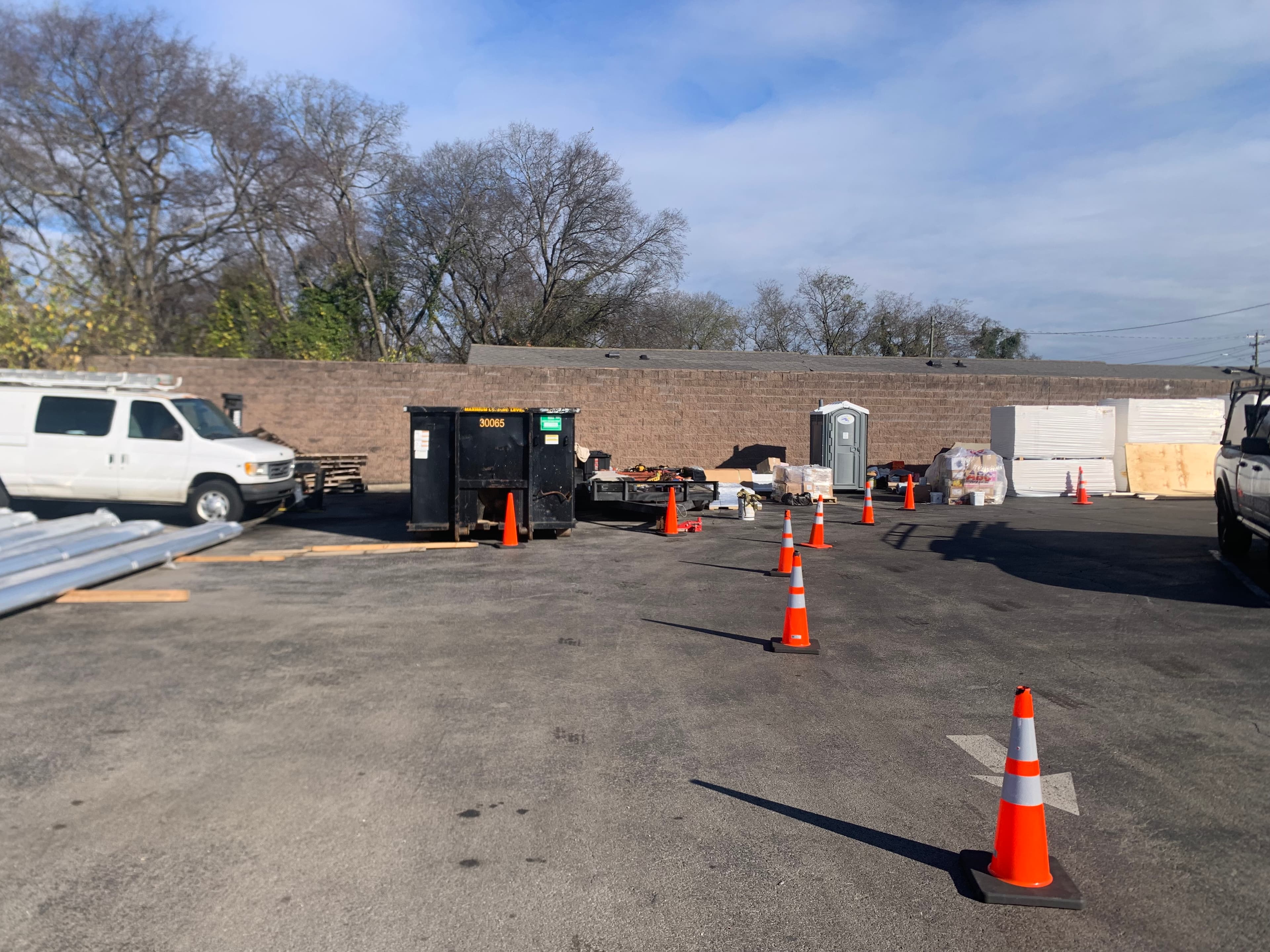
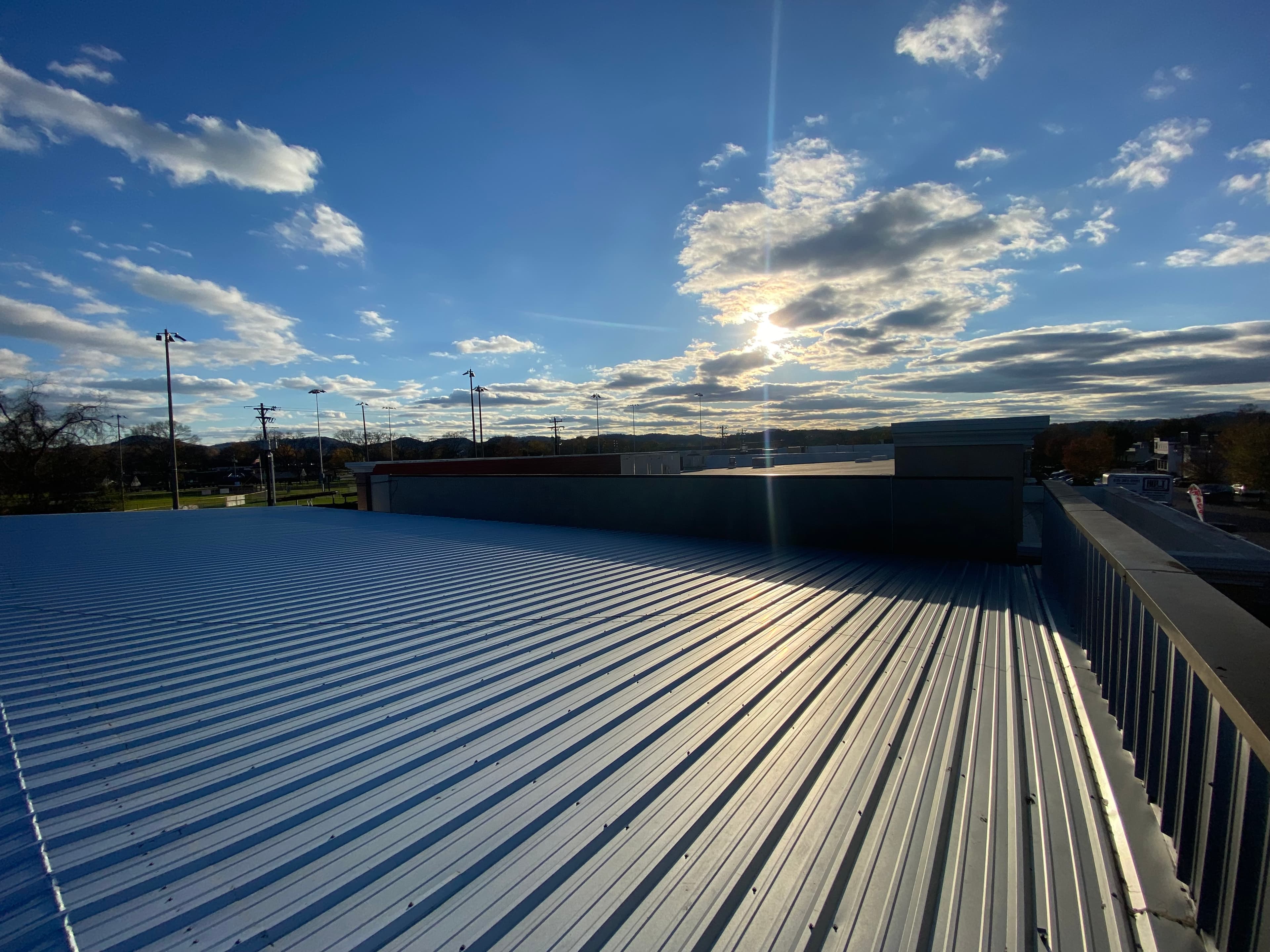
GA-316 and US-29 light-industrial distribution roofs
The GA-316 University Parkway corridor between Winder and Athens has become one of northeast Georgia's most active light-industrial development zones, and the commercial roof assemblies we document there reflect that growth. Newer distribution and flex-industrial buildings typically carry mechanically fastened or fully adhered TPO over polyisocyanurate insulation, with tapered drainage packages sloping to internal drains or perimeter scuppers. Perimeter metal, termination bars, and rooftop HVAC curb flashings are the most common failure points we find on inspections, followed by sealant fatigue at pipe penetrations and pitch pans. Cover-board composition, insulation fastener spacing, and membrane thickness all factor into wind-uplift performance, and the photo-keyed PDF records each of those attributes so owners and lenders can evaluate remaining service life without guesswork. Tenant-improvement build-outs on flex space often introduce new rooftop penetrations that, if not detailed correctly, become the first failure points in the next convective cycle.
We document each distribution roof with a numbered plan that identifies elevations, drain and scupper locations, rooftop units, skylights, hatches, and any ponding patterns observable during inspection. Photos are keyed to plan locations and captioned with assembly and repair context. Owners use the resulting PDF for lender recertification, acquisition due diligence, and carrier renewal support. When an inspection shows no functional storm damage, we issue a Certificate of Clearance describing current condition. Carriers make the final determination on any related claim. The PDF format is intentionally the same across all Winder commercial property types so a portfolio owner reviewing multiple assets receives a consistent deliverable, which simplifies capital-planning budget cycles and shortens the time brokers need to assemble renewal submissions. Consistent documentation over multiple inspection years also creates a longitudinal record of each assembly's condition trajectory.
- Mechanically fastened and fully adhered TPO dominant on newer distribution boxes
- Perimeter metal, HVAC curbs, and penetrations are the most common defect sites
- Numbered roof plans key every photo to a plan location
Storm cadence and claim-documentation workflow
Barrow County's commercial claim cadence is driven by spring supercells, occasional late-summer tropical remnants, and cumulative wind-fatigue on older assemblies. When a significant event passes through the corridor, we deploy a same-week or next-week inspection wave to Winder commercial accounts on file, document each assembly with photo-keyed PDFs tied to the property's numbered roof plan, and hand the owner a deliverable they can transmit directly to their broker and carrier. Pre-event baseline documentation matters: when a property has a recent inspection PDF on file, post-event comparison becomes straightforward because every defect visible after the storm can be evaluated against a documented prior condition. That pre-event-to-post-event comparison is the single most important factor in how carriers evaluate storm-related claim submissions on commercial assemblies.
Our workflow is deliberately conservative. Where damage is present, we describe it factually, document it photographically, and include assembly context so the adjuster has enough information to assess covered peril. Where damage is absent, we issue a Certificate of Clearance rather than push a borderline claim. That discipline keeps our owner relationships durable through multiple renewal cycles and keeps carriers willing to engage with our documentation packages. No outcome is guaranteed, and the carrier remains the decision-maker on every claim. We coordinate with the owner's broker from the first inspection through the carrier's adjuster assignment, supplemental documentation if requested, and final disposition, but we do not make representations about expected payout, timing, or coverage scope. Those determinations belong to the carrier and depend on policy terms in force at the time of loss, applicable deductibles, exclusions, and any endorsements.
Multifamily phasing across Barrow and adjacent county lines
Winder's garden-style multifamily inventory, along with the larger clusters in Bethlehem, Auburn, and adjacent Braselton, follows phased-reroof patterns designed around leasing calendars, school schedules, and amenity programming. We break projects into building groups, publish a written tenant-notice schedule through on-site management, and sequence tear-off and dry-in so no unit is exposed overnight. Material staging is coordinated to keep leasing offices, amenity areas, and pool decks accessible throughout the project. Building selection within each phase prioritizes weather windows, material delivery cadence, and dumpster placement so residents see a predictable pattern rather than disruption that moves unexpectedly between buildings. Tenant communication is driven through the on-site management team so residents receive a single consistent voice during the project.
Daily progress photos are keyed to unit numbers and building labels. At closeout we deliver a complete phased-project PDF including pre-construction condition photos, in-progress documentation, final condition photos, and manufacturer warranty registration forms. Owners and their lenders receive a single defensible record of what was replaced, when, and how, which supports future refinancing, acquisition due diligence, and carrier renewal without additional reconstruction of project history. The closeout package also supports any future disposition because a buyer conducting due diligence years after the reroof has a complete photographic record of the installed assembly, fastening pattern, and penetration detailing rather than having to reconstruct that information from invoices, permit records, or a partial manufacturer file that may no longer be complete at the time of sale.
- Phased schedule published through on-site management
- Unit-keyed daily progress photos throughout the project
- Warranty registration documentation delivered at closeout
Why Winder Property Owners Choose Red Door Roofing
30+ years, Red Door family
Built on 30 years of commercial experience across the Southeast. Notable clients include Best Western, Harbor Freight, Tractor Supply, and Vanderbilt Medical Clinic.
Carrier-ready documentation
Photo-keyed inspection reports formatted for Winder-area adjuster and lender workflows. No guarantees on claim outcomes - the carrier calls that.
Tenant-in-place phasing
Multifamily work phased by building block with tenant-notice templates, noise windows, and operations- team documentation. Tenants stay in place.
No-obligation inspection
If our Winder inspection finds no qualifying damage, we issue a Certificate of Clearance - suitable for lender, insurer, and asset-manager files. No further commitment.
Winder Commercial Roofing FAQs
Do you service the Chateau Elan commercial corridor north of Winder?
Can you inspect a property during active acquisition due diligence in Barrow County?
How do you stage a phased reroof on a garden-style multifamily community in Winder?
Do you install standing-seam metal on Winder light-industrial properties?
Do you handle residential roofing in Winder?
How do you document a Winder commercial roof inspection?
What is a Certificate of Clearance?
Which roof systems are most common in Barrow County commercial?
Do you coordinate with tenants during multifamily reroofs?
How should Barrow County owners prepare for spring storm season?
Nearby Georgia Cities We Also Serve
Our commercial roofing coverage extends across Georgia. These three Winder-adjacent cities are part of our routine service footprint.
Need a Winder inspection?
Call us directly at 1-855-GO4REDD or request a no-obligation inspection online. Most Winder-area inspections are scheduled within days of the request.
Request InspectionSchedule a Winder Roof Inspection
No obligation. Documented findings you can use for insurance, lender, or asset-manager records.
30+ Years of Red Door Family Experience · 16 States
Free · No obligation · No follow-up sales calls