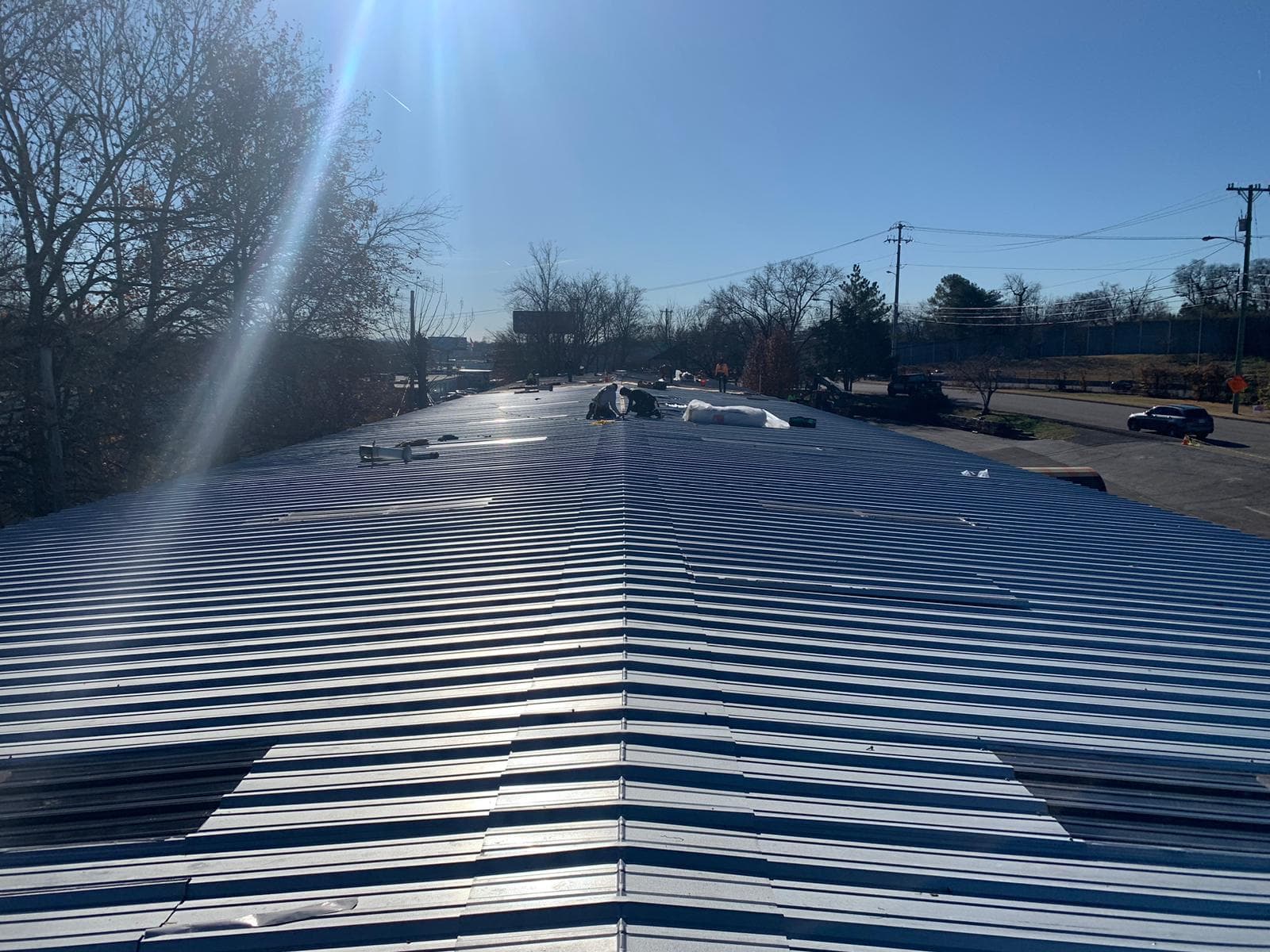
Commercial Roofing in Hartsville, South Carolina
Inspection, documentation, and insurance-supported roof replacement for commercial and multifamily properties across Hartsville.
Commercial & Multifamily Roofing Across the Pee Dee region
Red Door Roofing serves Hartsville commercial, industrial, multifamily, healthcare, educational, and hospitality property owners across Darlington County, a Pee Dee manufacturing and education hub anchored by Sonoco Products Company's global headquarters, Carolina Pines Regional Medical Center, and Coker University. Our scope covers low-slope TPO, EPDM, modified bitumen, and built-up assemblies on corporate office, manufacturing, healthcare, and retail; metal-panel systems on manufacturing and light-industrial buildings; asphalt, slate, and specialty systems on historic campus and downtown buildings. Every engagement produces a photo-keyed PDF inspection packet with drone imagery, moisture and core results where indicated, and a scaled roof-plan overlay. When no damage is found, we issue a Certificate of Clearance. Work is performed under Red Door's family of companies' South Carolina general contractor licensure with no guarantees on carrier outcomes.
Red Door Roofing serves commercial, multifamily, industrial, healthcare, educational, and hospitality property owners across Hartsville and the broader Darlington County commercial market, a Pee Dee manufacturing and education hub anchored by Sonoco Products Company - a global packaging-industry corporate headquarters - alongside Coker University, Carolina Pines Regional Medical Center, and a vibrant downtown commercial district. Hartsville's commercial roofing inventory is defined by its Tier-1 packaging-manufacturing heritage: Sonoco's global headquarters and the surrounding manufacturing, corporate office, and research footprint require specialized roofing considerations for paper-processing environments including heavy mechanical curbs, process-exhaust stacks, sawdust and fiber accumulation exposure, and large low-slope fields that serve continuous-operation manufacturing. Beyond Sonoco, Carolina Pines Regional Medical Center anchors healthcare roofing demand, Coker University anchors educational roofing across a historic campus, downtown Hartsville's Fourth Street corridor holds a concentration of restored early-twentieth-century commercial, and multifamily rental inventory serves Sonoco employees, hospital staff, and university populations. Our commercial roofing work in Hartsville is built around photo-keyed PDF inspection documentation - every drone orbit, every walk-through observation, every core cut, every single-ply seam review, every process-exhaust curb inspection, every parapet flashing review, and every metal-panel fastener pull-test is captured, numbered, geotagged to a scaled roof-plan overlay, and delivered as a single indexed report. Property managers, corporate facilities teams, lenders, and carriers all rely on the packet. When inspection finds no actionable damage, we issue a written Certificate of Clearance. We operate under Red Door's family of companies' South Carolina general contractor licensure, coordinating with corporate facilities leadership, manufacturing plant managers, hospital operations, university facilities, and multifamily property managers. Hartsville absorbs Pee Dee severe-weather cycles, tropical remnants routing inland from the coast, and a routine spring convective window, and our specifications reflect each.
Hartsville Business Parks & Office Districts We Serve
Our commercial roofing work in Hartsville concentrates around the metro's largest office parks and corporate districts. Each of these business parks contains multiple commercial and mixed-use tenants where tenant-in-place scheduling, after-hours production windows, and coordinated material staging matter as much as the roof scope itself. Commercial-grade flat roof systems and pitched multifamily assemblies are both well represented across these parks - our inspections walk every roof section, every transition, and every drain to build a complete condition document suitable for carrier, lender, and asset-manager review.
- Sonoco Products headquarters campus
- Sonoco manufacturing complex
- Carolina Pines Regional Medical Center campus
- Coker University campus
- US-15 commercial corridor
- US-151 commercial frontage
- Fourth Street downtown commercial
- Industrial Park Road light-industrial
Primary Hartsville Commercial Corridors
Hartsville's commercial and multifamily stock clusters along a handful of primary corridors. Our inspection and replacement work tracks along these corridors where commercial density, tenant complexity, and storm exposure concentrate. Routing and material staging around these corridors is part of every Hartsville project plan - peak commuter hours, event calendars, and fire-lane requirements all factor into how we schedule.
- US-15 North-South
- US-151
- SC-102
- Fourth Street downtown
- Chesterfield Highway (SC-102)
- West Carolina Avenue
Hartsville Multifamily Districts
Multifamily roof replacement demands phased scheduling so tenants stay in place. Our work across Hartsville's multifamily districts follows building-by-building production schedules with tenant-notice templates and noise-window coordination per property. Asset managers receive portfolio-level closeout documentation; property managers receive a phased Gantt-style schedule they can share with residents and operations teams; leasing teams receive advance notice for unit-turn and move-in coordination.
- Sonoco-employee rental area
- Coker University adjacent multifamily
- Carolina Pines-area multifamily
- Fourth Street downtown rental
- US-15 corridor rental stock
Hartsville Storm & Severe-Weather History
Hartsville's storm cadence is bimodal. The primary driver is the June through November Atlantic hurricane season, where Pee Dee Darlington County absorbs named-storm wind and rainfall as systems track inland from the coast. The secondary driver is the February through May severe-thunderstorm window with hail, microburst winds, and embedded tornadoes. A summer convective window adds intense short-duration rainfall. Owners should schedule semiannual inspections - pre-season in late spring and post-season in December - plus rapid-response inspections after named-storm or significant severe-weather events.
Hartsville and Darlington County sit in the Pee Dee corridor where tropical remnants, severe thunderstorms, and occasional winter weather converge over a decade-plus documented record. Hurricane Matthew on 2016-10-08 delivered tropical winds and heavy rainfall across the Pee Dee. Hurricane Florence on 2018-09-14 remains the defining modern storm for the region, with catastrophic multi-day rainfall, prolonged low-slope saturation, and historic flooding that stressed scupper and drain capacity across aged commercial and industrial assemblies in Darlington County. Hurricane Dorian on 2019-09-05 added another named-storm wind episode. Hurricane Ian remnants on 2022-09-28 produced late-season wind and saturation. Hurricane Idalia on 2023-08-30 brought additional rainfall exposure. Beyond named storms, Hartsville absorbs the routine February through May severe-thunderstorm window with hail, microburst straight-line winds, and embedded tornadoes along frontal boundaries - a cadence that has repeatedly tested metal-panel fastener integrity on manufacturing buildings and low-slope single-ply perimeter attachment on office and retail. A summer convective window adds intense short-duration rainfall that stresses scupper and drain capacity. For Pee Dee manufacturing, healthcare, educational, and commercial owners, the practical outcome is that roofs must be specified and maintained to a Pee Dee tropical-rainfall and severe-thunderstorm standard with robust edge-metal, perimeter fastening, drainage validation, and disciplined post-event documentation. We inspect for uplift at perimeter and corner zones, fastener pull-through, seam peel, flashing displacement, scupper and drain blockage, infrared moisture findings, and panel-edge corrosion. Carrier makes the final determination on coverage - our role is to produce the photo-keyed PDF evidence record that supports it.
Notable documented Hartsville-area events
2016-10-08 · Hurricane Matthew
Tropical winds and heavy rainfall across the Pee Dee with commercial wind and water intrusion exposure.
2018-09-14 · Hurricane Florence
Defining Pee Dee event: catastrophic rainfall, prolonged low-slope saturation, drainage capacity stress.
2019-09-05 · Hurricane Dorian
Tropical-force winds inland from the Carolina coast.
2023-08-30 · Hurricane Idalia
Coastal-plain wind and rainfall producing additional uplift and saturation stress on aged assemblies.
Insurance Process in Hartsville
Commercial policies on Hartsville properties commonly apply percentage wind and hail deductibles based on insured value. Named-storm deductibles may apply on certain Pee Dee accounts. Industrial and manufacturing policies often carry specialized endorsements for process-exhaust, combustible-fiber, and equipment exposure. Photo-keyed PDF documentation supports claim adjudication, but carrier makes the final determination on coverage, scope, and depreciation. We do not guarantee insurance outcomes.
Hartsville lenders and Pee Dee regional carriers expect photo-keyed PDF documentation, core or infrared moisture evidence on aged low-slope fields, and Xactimate-ready scope on claim work. Industrial and corporate facilities accounts often require additional process-exhaust and combustible-debris documentation. Our packet format is built to satisfy both standard and specialty diligence without rework.
Commercial Roof Systems Common in Hartsville
Low-slope TPO, EPDM, modified bitumen, and legacy built-up dominate corporate office, healthcare, and retail; metal panels (standing-seam and exposed-fastener) serve manufacturing, light-industrial, and warehouse; asphalt shingles and specialty slate appear on Coker University and historic downtown buildings; multifamily mixes low-slope and sloped. Specifications account for Pee Dee severe-weather and Sonoco process-exhaust exposure.
Hartsville Landmarks & Properties We've Served Near
Our commercial and multifamily roofing work crosses paths with Hartsville's most recognizable properties and corridors. These landmarks anchor the commercial districts we work in daily - they're not just tourism references, they're the neighborhoods where property managers ask us to inspect multifamily, retail, hospitality, and office stock.
- Sonoco Products Company
- Coker University
- Carolina Pines Regional Medical Center
- Kalmia Gardens
- Hartsville Historic District
- Byerly Park
- Burry Bookstore
- Hartsville Museum
Property Types We Serve in Hartsville
- Sonoco Products global headquarters
- Carolina Pines Regional Medical Center
- Coker University historic campus
- Historic downtown Hartsville Fourth Street district
What a Hartsville Commercial Roof Inspection Includes
Every Hartsville commercial inspection we perform produces a photo-keyed PDF report built for the way South Carolina adjusters, lenders, and asset managers actually work. We walk the full roof system - every slope, every drain, every penetration, every transition - and document what we see with photos referenced to a building or unit location. No generic stock photos. No marketing filler. Just the evidence a carrier needs to make a scope determination on a real commercial property.
On multifamily buildings we document building-by-building, which matters because a 300-unit Hartsville complex may show damage concentrated on two of eight roofs. Adjusters want that level of granularity, and the documentation protects the owner from a blanket-scope claim that gets pared back in review.
The inspection report identifies your existing roof system (TPO, EPDM, PVC, modified bitumen, BUR, asphalt shingle, metal, or a mixed portfolio), estimates remaining useful life, flags flashing and penetration condition, and notes any observed damage with date-of-loss alignment where applicable. We also call out situations where we recommend repair rather than replacement - our business is not built on upselling.
Working With Hartsville Adjusters and Carriers
Most Hartsville commercial claims don't fail on the damage - they fail on documentation gaps or scope- supplement misunderstandings with the adjuster. Our inspection reports are formatted to match what Hartsville-area commercial adjusters routinely request: photo-keyed damage evidence, roof-system identification, a priced scope against local labor and material norms, and a repair-vs-replacement recommendation grounded in observed condition.
When an adjuster's initial scope misses legitimate work - underlayment, code-required upgrades, perimeter metal, additional penetrations - we submit a supplement with supporting documentation. Reasonable supplements with good evidence are typically approved. We don't submit questionable supplements, and we don't push scope that wasn't clearly warranted by what we photographed. Hartsville adjusters are experienced, and credibility is the currency we operate on.
Typical Hartsville Commercial Roof Project Timeline
A typical Hartsville commercial roof project runs 30–120 days from inspection to installation completion. Here's how that calendar breaks down on a mid-size property:
- Week 1: on-site inspection, photo-keyed report delivered to owner
- Weeks 2–3: claim filed, adjuster assigned, on-roof walk with adjuster + contractor
- Weeks 3–6: initial scope received, supplement filed for any missed work, approved scope returned
- Weeks 6–10: material procurement, tenant-notice distribution, phased production schedule built
- Weeks 10–16: on-roof production, daily photo documentation, weekly progress check-ins
- Weeks 16–17: final walk, punch-list completion, closeout documentation to lender and carrier
Multifamily properties in Hartsville with 100–300 units typically run on the longer end of that range; smaller commercial buildings close faster. Material lead times on TPO, EPDM, and PVC are the usual timeline variables. We share a phased Gantt schedule so operations, leasing, and asset-management teams can plan around the work.
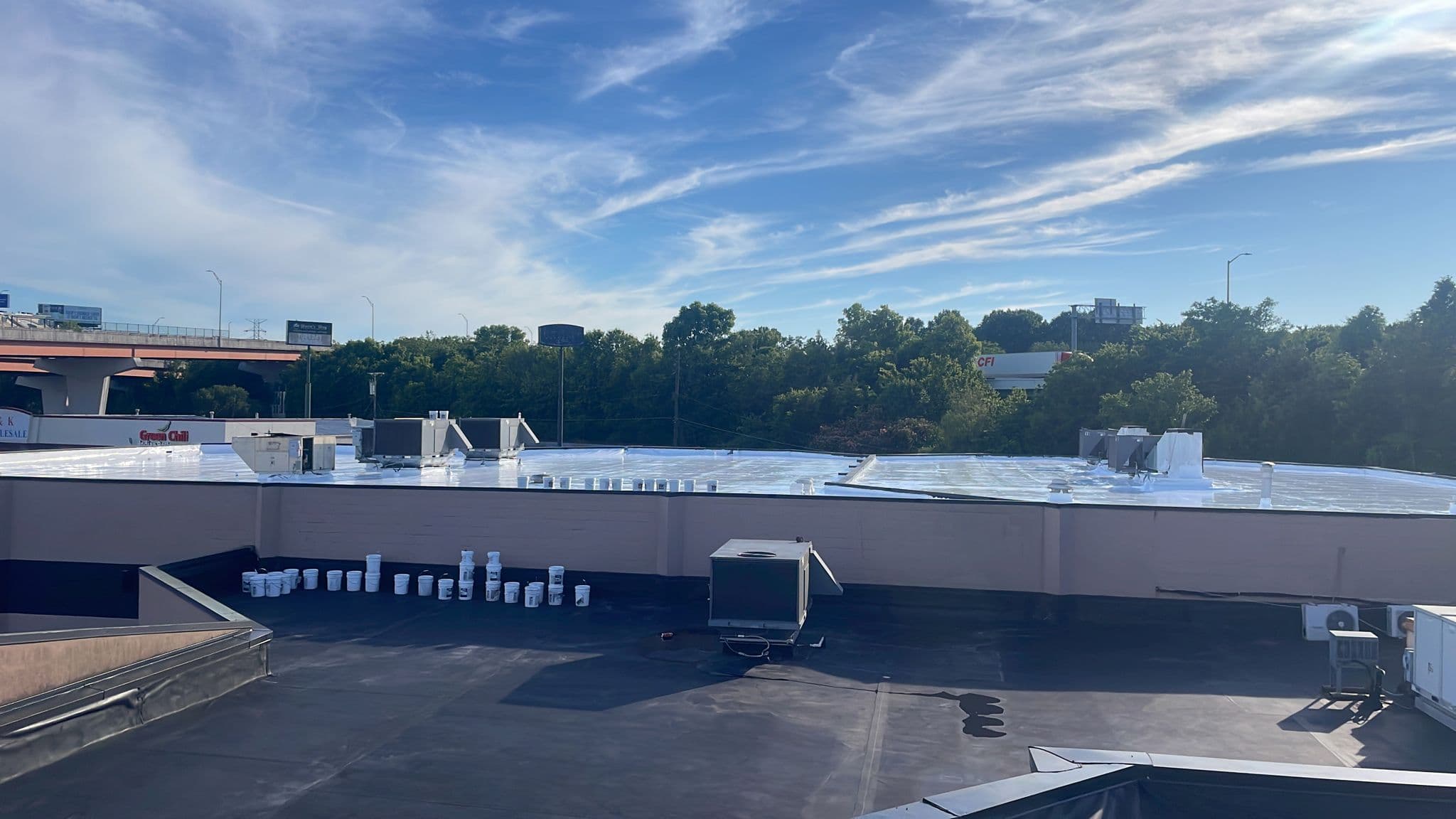
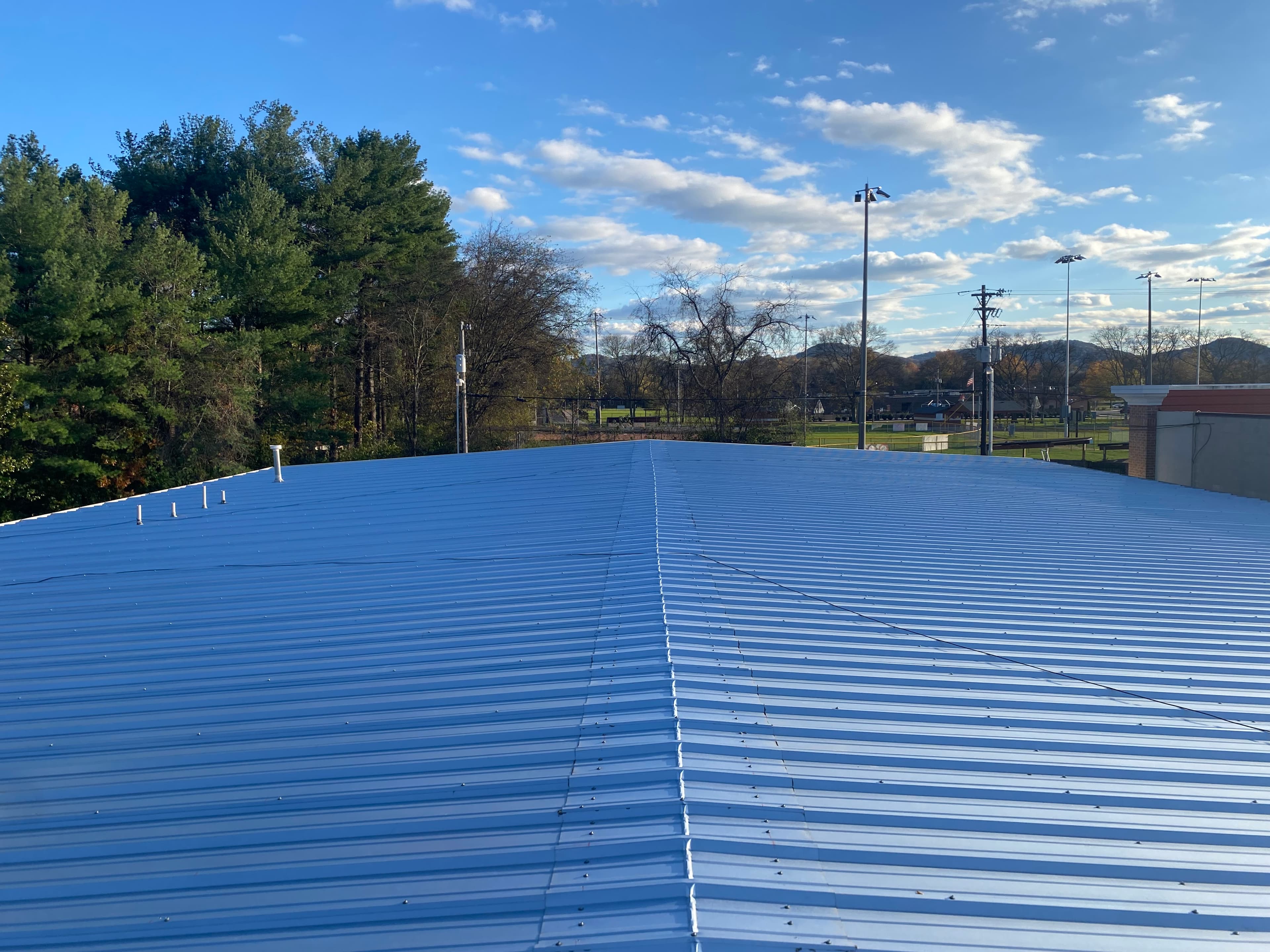
Packaging-manufacturing roofing at Sonoco and Tier-1 Pee Dee industrial
Hartsville's identity as a Tier-1 packaging-manufacturing market is defined by Sonoco Products Company's global headquarters and surrounding manufacturing, research, and distribution footprint. Packaging-industry roofing carries specialized considerations: continuous process-exhaust curbs emitting heat and particulate, paper-fiber and sawdust accumulation, combustible-debris management during hot-work phases, large low-slope fields serving continuous-operation manufacturing, and heavy rooftop mechanical loads tied to production equipment.
Our Hartsville scope addresses each factor explicitly. Drone-based mapping segments large manufacturing roof fields by section, photo indexing captures each process-exhaust curb and penetration, infrared moisture surveys document saturation where suspected, and fiber-accumulation conditions are photographed before and after cleanup. Hot-work permits are coordinated with plant-operations leadership, and fire-watch protocols align with combustible-debris exposure. Every phase closes with a photo-keyed PDF packet. Certificates of Clearance are issued where inspection confirms no damage. Work is performed under Red Door's family of companies' South Carolina general contractor licensure.
- Segmented drone mapping of large manufacturing roof fields
- Process-exhaust curb and penetration documentation
- Combustible-debris and hot-work permit coordination
- Photo-keyed PDF packets sized for corporate risk review
Post-Florence Pee Dee documentation discipline
Hurricane Florence in 2018 remains the defining storm for Darlington County commercial roofing. Many roofs across Hartsville still carry latent effects - saturated insulation, patched seams, re-sealed flashings, and dried but unremediated interior ceiling staining. Differentiating chronic post-Florence wear from fresh storm damage is a documentation discipline, and that discipline is the foundation of our Hartsville commercial practice.
Pre-season, we establish a dated photo-keyed PDF baseline on every engaged roof. Core cuts and infrared moisture surveys are performed where saturation is suspected. Post-event, triage inspections produce an initial photo-keyed PDF report within three to five business days with Xactimate-ready scope. Temporary weather-tight measures are coordinated in parallel. Carrier makes the final determination on coverage - we produce the defensible evidence record.
- Dated pre-season baseline photo-keyed PDFs
- Core cuts and infrared moisture surveys on suspect low-slope fields
- Post-event triage with three- to five-day initial deliverables
- Xactimate-ready scope documentation for carrier review
Healthcare, educational, and multifamily roofing in Hartsville
Carolina Pines Regional Medical Center anchors Hartsville's healthcare roofing demand, and its campus imposes clean-corridor, ambulance-path, odor and noise, and HVAC fresh-air-intake constraints on every roofing phase. Our healthcare scope aligns each shift with clinical operations, documents each phase with photo-keyed PDFs, and coordinates with facilities and infection-control leadership. Coker University's historic campus adds educational roofing demand with its own mix of architectural detailing, academic-calendar phasing, and historic-building preservation sensitivities.
Multifamily roofing in Hartsville serves Sonoco employees, Carolina Pines staff, Coker students and employees, and regional commuters. Our multifamily workflow uses phased scheduling, bilingual tenant notices where appropriate, parking and access coordination with property management, and photo-keyed PDF documentation per building. Certificates of Clearance are issued where inspection confirms no pre-existing storm damage. All work is performed under Red Door's family of companies' South Carolina general contractor licensure with no guarantees on carrier outcomes.
- Clean-corridor protocols at Carolina Pines Regional Medical Center
- Academic-calendar phasing at Coker University
- Historic-campus architectural preservation
- Tenant-notice workflows for Hartsville multifamily
Process-exhaust, fiber-accumulation, and hot-work protocols
Packaging-manufacturing roofing at Sonoco's Hartsville complex and at similar Pee Dee paper and fiber facilities introduces specialized roof-field conditions that standard commercial roofing scope does not encounter. Process-exhaust curbs emit sustained heat, humidity, and particulate that accelerate membrane degradation in the immediate curb vicinity. Paper-fiber, sawdust, and cellulose accumulation across the roof field creates an ongoing combustible-debris condition that must be actively managed during hot-work phases - torch-applied modified bitumen, hot-air welding on single-ply, and any open-flame operation requires fire-watch protocols, pre-cleaning sweeps, and documented post-phase debris inspection.
Our Hartsville scope treats process-exhaust, fiber-accumulation, and hot-work protocols as first-class project elements. Pre-project planning includes a site-specific fire-watch plan, debris-sweep cadence, and hot-work permit coordination with plant-operations leadership. Photo-keyed PDF documentation captures debris conditions before and after each sweep, process-exhaust curb condition pre and post phase, and fire-watch sign-offs. Membrane specifications in the immediate process-exhaust curb zone often use upgraded heat-tolerant flashing chemistries. Every phase closes with a photo-keyed PDF packet sized for corporate risk review. All work is performed under Red Door's family of companies' South Carolina general contractor licensure.
- Site-specific fire-watch and debris-sweep protocols
- Pre and post-phase process-exhaust curb photography
- Heat-tolerant flashing chemistries in curb zones
- Photo-keyed PDF packets sized for corporate risk review
Why Hartsville Property Owners Choose Red Door Roofing
30+ years, Red Door family
Built on 30 years of commercial experience across the Southeast. Notable clients include Best Western, Harbor Freight, Tractor Supply, and Vanderbilt Medical Clinic.
Carrier-ready documentation
Photo-keyed inspection reports formatted for Hartsville-area adjuster and lender workflows. No guarantees on claim outcomes - the carrier calls that.
Tenant-in-place phasing
Multifamily work phased by building block with tenant-notice templates, noise windows, and operations- team documentation. Tenants stay in place.
No-obligation inspection
If our Hartsville inspection finds no qualifying damage, we issue a Certificate of Clearance - suitable for lender, insurer, and asset-manager files. No further commitment.
Hartsville Commercial Roofing FAQs
What makes packaging-manufacturing roofing different from standard industrial roofing?
How do you phase a reroof on an occupied corporate headquarters campus?
Can you support historic campus roofing at Coker University?
What is the post-Florence roof condition profile for Darlington County commercial buildings?
How do you approach roofing on Sonoco Products manufacturing and corporate buildings?
Can you support the Carolina Pines Regional Medical Center campus?
Do you handle educational roofing at Coker University and surrounding schools?
What is a Certificate of Clearance and when do you issue one in Hartsville?
How quickly can you respond after a Pee Dee severe-weather or named-storm event?
Are you licensed for commercial roofing in Hartsville and Darlington County?
Nearby South Carolina Cities We Also Serve
Our commercial roofing coverage extends across South Carolina. These three Hartsville-adjacent cities are part of our routine service footprint.
Need a Hartsville inspection?
Call us directly at 1-855-GO4REDD or request a no-obligation inspection online. Most Hartsville-area inspections are scheduled within days of the request.
Request InspectionSchedule a Hartsville Roof Inspection
No obligation. Documented findings you can use for insurance, lender, or asset-manager records.
30+ Years of Red Door Family Experience · 16 States
Free · No obligation · No follow-up sales calls