
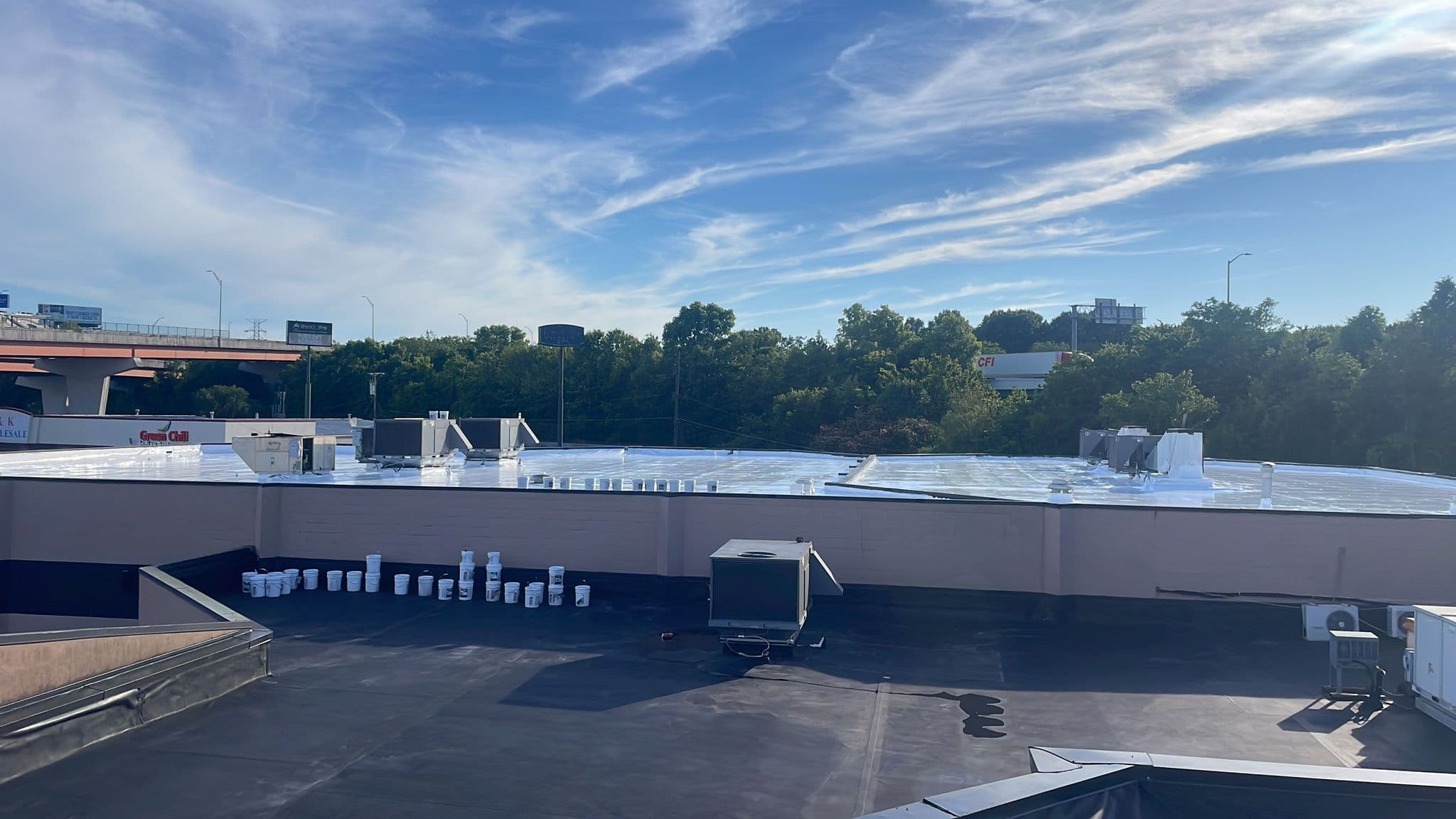
Commercial Roofing in Dalton, Georgia
Inspection, documentation, and insurance-supported roof replacement for commercial and multifamily properties across Dalton.
Commercial & Multifamily Roofing Across the Dalton, GA MSA
Dalton is Northwest Georgia's carpet-manufacturing capital and the anchor of Whitfield County's commercial tax base, with Shaw Industries, Mohawk Industries, Engineered Floors, and Beaulieu headquartered or major-plant operational across the I-75 North corridor. The carpet and flooring complex drives an unusual commercial roof inventory - tilt-wall distribution centers with dense single-ply membrane fields, older mill structures on modified bitumen and metal, dye-house buildings with heavy exhaust-stack penetration density, and corporate campus office stock on asphalt and single-ply. Hamilton Medical Center and its surrounding medical office buildings anchor the healthcare corridor, Dalton State College contributes institutional roof stock, and hospitality around the I-75 exit clusters layers in franchise-brand commercial. Multifamily concentrates along Walnut Avenue, Cleveland Highway, and the Shugart Road corridor in garden-style and low-rise configurations. The Northwest Georgia Trade and Convention Center and Walnut Square Mall anchor the retail and event-venue commercial corridor, and supplier-tier industrial - yarn extrusion, backing manufacturers, logistics sequencing for the broader Dalton-Calhoun carpet complex - fills out the Whitfield County industrial inventory.
Red Door Roofing serves commercial, industrial, and multifamily property owners across Dalton and Whitfield County - the undisputed Carpet Capital of the World and Northwest Georgia's dominant manufacturing market. Our inspection, documentation, and replacement workflow is built specifically for the way Dalton's carpet-manufacturing campuses, distribution centers, medical facilities, hospitality properties, and garden-style multifamily portfolios actually operate. When a spring supercell pushes across the Whitfield County ridge line or a late-summer tropical remnant crawls up from the Gulf and stalls against the Appalachian foothills, commercial roof assemblies along the I-75 North corridor and the US-41 spine can accumulate hail bruising, membrane lacerations, coping-cap displacement, and fastener-line impact that may qualify under carrier policy language. Our photo-keyed PDF inspection reports are built specifically for how Georgia adjusters, carrier desk reviewers, lenders, and asset managers actually work - every slope, every drain, every curb, every rooftop HVAC and dye-house exhaust penetration, every parapet-to-coping transition, documented to a building or unit reference. Dalton's carpet-manufacturing rooftops are unusual assemblies - they carry dye-house exhaust stacks, fiber-processing ventilation runs, extruder relief penetrations, compressed-air infrastructure, and tightly-grouped curb fields that most standard inspection templates miss. We inspect the entire rooftop ecosystem, not just the field membrane. When our inspection finds no qualifying damage, we issue a Certificate of Clearance suitable for lender, insurer, or asset-manager files at no cost or obligation - this is a frequent outcome in Whitfield County and we would rather tell you the roof is sound than sell you a replacement you do not need. Red Door Roofing operates across Dalton under the Red Door family of companies' Georgia general contractor licensure with specific experience on single-ply TPO and PVC, EPDM, modified bitumen, standing-seam metal, and asphalt shingle systems common across carpet-mill headquarters campuses, distribution-center tilt-wall stock, Hamilton Medical Center medical-office adjacencies, hospitality along the I-75 exit clusters, and multifamily between Walnut Avenue, Cleveland Highway, and the Shugart Road corridor. We never guarantee an insurance outcome - the carrier always makes the final determination on coverage and scope - but we document the claim the way adjusters expect to see it documented and we stay engaged with the carrier scope conversation end-to-end so property managers and owners do not carry the documentation burden alone.
Dalton Business Parks & Office Districts We Serve
Our commercial roofing work in Dalton concentrates around the metro's largest office parks and corporate districts. Each of these business parks contains multiple commercial and mixed-use tenants where tenant-in-place scheduling, after-hours production windows, and coordinated material staging matter as much as the roof scope itself. Commercial-grade flat roof systems and pitched multifamily assemblies are both well represented across these parks - our inspections walk every roof section, every transition, and every drain to build a complete condition document suitable for carrier, lender, and asset-manager review.
- Carbondale Business Park
- Crown Pointe Business Park
- Dalton Industrial Boulevard corridor
- Lakeshore Business Park
- Callahan Road industrial complex
- North Dalton Bypass industrial area
- Walnut Square commercial district
- I-75 Exit 333 commercial cluster
Primary Dalton Commercial Corridors
Dalton's commercial and multifamily stock clusters along a handful of primary corridors. Our inspection and replacement work tracks along these corridors where commercial density, tenant complexity, and storm exposure concentrate. Routing and material staging around these corridors is part of every Dalton project plan - peak commuter hours, event calendars, and fire-lane requirements all factor into how we schedule.
- I-75 North (exits 326-336)
- US-41 / Thornton Avenue spine
- Walnut Avenue retail and office corridor
- Cleveland Highway (SR-71) commercial
- Dug Gap Battle Road / Shugart Road industrial
- Chattanooga Road north commercial
Dalton Multifamily Districts
Multifamily roof replacement demands phased scheduling so tenants stay in place. Our work across Dalton's multifamily districts follows building-by-building production schedules with tenant-notice templates and noise-window coordination per property. Asset managers receive portfolio-level closeout documentation; property managers receive a phased Gantt-style schedule they can share with residents and operations teams; leasing teams receive advance notice for unit-turn and move-in coordination.
- Walnut Avenue multifamily belt
- Cleveland Highway garden-style corridor
- Shugart Road multifamily cluster
- Dug Gap Road workforce-housing corridor
- North Dalton multifamily near Dalton State
Dalton Storm & Severe-Weather History
Whitfield County sits in Northwest Georgia's spring supercell corridor with NOAA SPC records showing recurring hail and wind events each year, concentrated in the March-through-May window with a secondary late-summer tropical-remnant channel. The Appalachian foothill topography channels storm cells along the I-75 North corridor, and carpet-manufacturing rooftops with high equipment density are particularly exposed to exhaust-stack flashing damage and curb-edge uplift. Commercial owners should expect at least one documented claim-triggering weather window per year on average and should maintain a documented inspection cadence to avoid cumulative-damage disputes with carriers.
Dalton sits in Northwest Georgia's spring supercell corridor where the terrain pushes storm cells against the Appalachian foothills with documented recurring hail and wind exposure through the March-through-May peak window and a secondary late-summer tropical-remnant channel. The 2011-04-27 Super Outbreak drove EF3 and EF4 damage across the NE Alabama and NW Georgia corridor with hail and wind fields that touched Whitfield County commercial rooftops and remains the reference event for how a major outbreak can impact the carpet-manufacturing corridor. The 2017-09-11 Tropical Storm Irma remnants pushed an extended multi-hour wind field through the I-75 corridor that produced multifamily and industrial claims across the market, and because Irma's remnant field behaved like a sustained frontal wind rather than a burst-storm, damage signatures focused on coping-cap displacement and progressive fastener-line impact rather than hail bruising. The 2019-03-03 severe weather outbreak generated supercell activity across North Georgia with documented hail reports in the Dalton-Calhoun corridor. The 2024-03-14 spring thunderstorm cycle produced another wave of commercial and multifamily claims activity across Whitfield and surrounding counties. Carpet-manufacturing campuses, dye-house structures, and fiber-processing buildings tend to accumulate damage differently than standard commercial stock because of the density of rooftop equipment and the vulnerability of exhaust-stack flashings and reinforced curbs. Our documented workflow inspects the full rooftop envelope - field membrane, perimeter, coping, parapet-to-wall transitions, penetration field, rooftop HVAC, and dye-house or extruder exhaust assemblies - and produces the photo-keyed PDF that Georgia carriers expect to see before engaging a scope negotiation. We never guarantee the carrier outcome but we document the storm the way the carrier will review it, and cumulative-damage disputes with carriers are dramatically easier to avoid when the inspection cadence is documented before the storm rather than reconstructed after.
Notable documented Dalton-area events
2011-04-27 · Super Outbreak - EF3/EF4 regional
Historic April 2011 Super Outbreak drove extensive NW GA and NE AL damage with hail and wind fields touching Whitfield County commercial rooftops
2017-09-11 · Tropical Storm Irma remnants
Extended multi-hour wind field pushed up the I-75 corridor through Dalton, producing multifamily and industrial claims
2019-03-03 · Severe weather outbreak
Supercell activity across North Georgia with documented hail in the Dalton-Calhoun carpet corridor
2024-03-14 · Spring thunderstorm cycle
Wave of commercial and multifamily claims activity across Whitfield and surrounding counties
Insurance Process in Dalton
Georgia commercial policies in Dalton typically carry one to five percent wind and hail deductibles that attach per-building rather than per-occurrence. Carpet-manufacturing campuses and large multifamily assets can see material dollar exposure at deductible attachment, and the per-building attachment on a multi-building campus means a single storm can trigger multiple deductible applications if multiple buildings cross the attachment threshold. We never guarantee coverage, scope, or approval outcomes - the carrier and policy language make the final determination - but we document the claim to the standard Georgia adjusters and desk reviewers expect.
Whitfield County commercial lenders and carriers expect photo-keyed PDF inspection reports with slope-by-slope documentation, drain and scupper conditions, and penetration-field context. Certificates of Clearance are an accepted reference document for sound roofs and are used in lender renewal, asset-manager portfolio review, and carrier underwriting files across the Dalton carpet-corridor commercial market.
Commercial Roof Systems Common in Dalton
Dalton commercial and industrial roof stock is dominated by single-ply TPO and PVC on tilt-wall distribution, modified bitumen and standing-seam metal on older mill and dye-house structures, EPDM on 1980s-1990s commercial buildings, and asphalt shingles on medical office, hospitality, and multifamily. Rooftop equipment density on carpet-manufacturing campuses drives complex flashing and curb detail requirements, and chemical-resistant membrane specification is common on dye-house process-side rooftops where chemical-exposure conditions apply.
Dalton Landmarks & Properties We've Served Near
Our commercial and multifamily roofing work crosses paths with Dalton's most recognizable properties and corridors. These landmarks anchor the commercial districts we work in daily - they're not just tourism references, they're the neighborhoods where property managers ask us to inspect multifamily, retail, hospitality, and office stock.
- Hamilton Medical Center
- Dalton State College
- Prater's Mill
- Creative Arts Guild
- Northwest Georgia Trade and Convention Center
- Walnut Square Mall
- Dalton Freight Depot
- Rocky Face Ridge Park
Property Types We Serve in Dalton
- Hamilton Medical Center campus
- Dalton State College
- Northwest Georgia Trade and Convention Center
- Walnut Square Mall
What a Dalton Commercial Roof Inspection Includes
Every Dalton commercial inspection we perform produces a photo-keyed PDF report built for the way Georgia adjusters, lenders, and asset managers actually work. We walk the full roof system - every slope, every drain, every penetration, every transition - and document what we see with photos referenced to a building or unit location. No generic stock photos. No marketing filler. Just the evidence a carrier needs to make a scope determination on a real commercial property.
On multifamily buildings we document building-by-building, which matters because a 300-unit Dalton complex may show damage concentrated on two of eight roofs. Adjusters want that level of granularity, and the documentation protects the owner from a blanket-scope claim that gets pared back in review.
The inspection report identifies your existing roof system (TPO, EPDM, PVC, modified bitumen, BUR, asphalt shingle, metal, or a mixed portfolio), estimates remaining useful life, flags flashing and penetration condition, and notes any observed damage with date-of-loss alignment where applicable. We also call out situations where we recommend repair rather than replacement - our business is not built on upselling.
Working With Dalton Adjusters and Carriers
Most Dalton commercial claims don't fail on the damage - they fail on documentation gaps or scope- supplement misunderstandings with the adjuster. Our inspection reports are formatted to match what Dalton-area commercial adjusters routinely request: photo-keyed damage evidence, roof-system identification, a priced scope against local labor and material norms, and a repair-vs-replacement recommendation grounded in observed condition.
When an adjuster's initial scope misses legitimate work - underlayment, code-required upgrades, perimeter metal, additional penetrations - we submit a supplement with supporting documentation. Reasonable supplements with good evidence are typically approved. We don't submit questionable supplements, and we don't push scope that wasn't clearly warranted by what we photographed. Dalton adjusters are experienced, and credibility is the currency we operate on.
Typical Dalton Commercial Roof Project Timeline
A typical Dalton commercial roof project runs 30–120 days from inspection to installation completion. Here's how that calendar breaks down on a mid-size property:
- Week 1: on-site inspection, photo-keyed report delivered to owner
- Weeks 2–3: claim filed, adjuster assigned, on-roof walk with adjuster + contractor
- Weeks 3–6: initial scope received, supplement filed for any missed work, approved scope returned
- Weeks 6–10: material procurement, tenant-notice distribution, phased production schedule built
- Weeks 10–16: on-roof production, daily photo documentation, weekly progress check-ins
- Weeks 16–17: final walk, punch-list completion, closeout documentation to lender and carrier
Multifamily properties in Dalton with 100–300 units typically run on the longer end of that range; smaller commercial buildings close faster. Material lead times on TPO, EPDM, and PVC are the usual timeline variables. We share a phased Gantt schedule so operations, leasing, and asset-management teams can plan around the work.
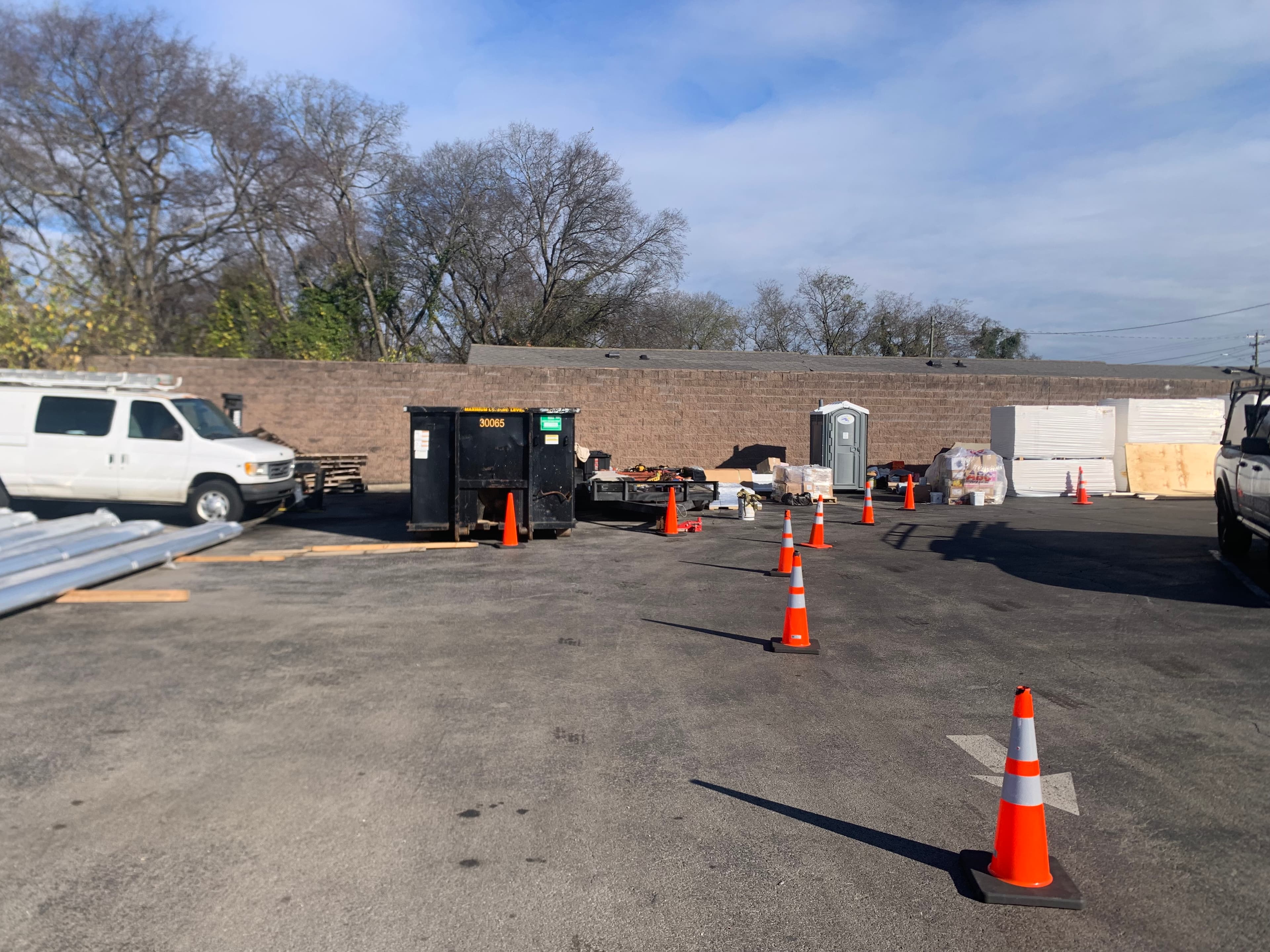
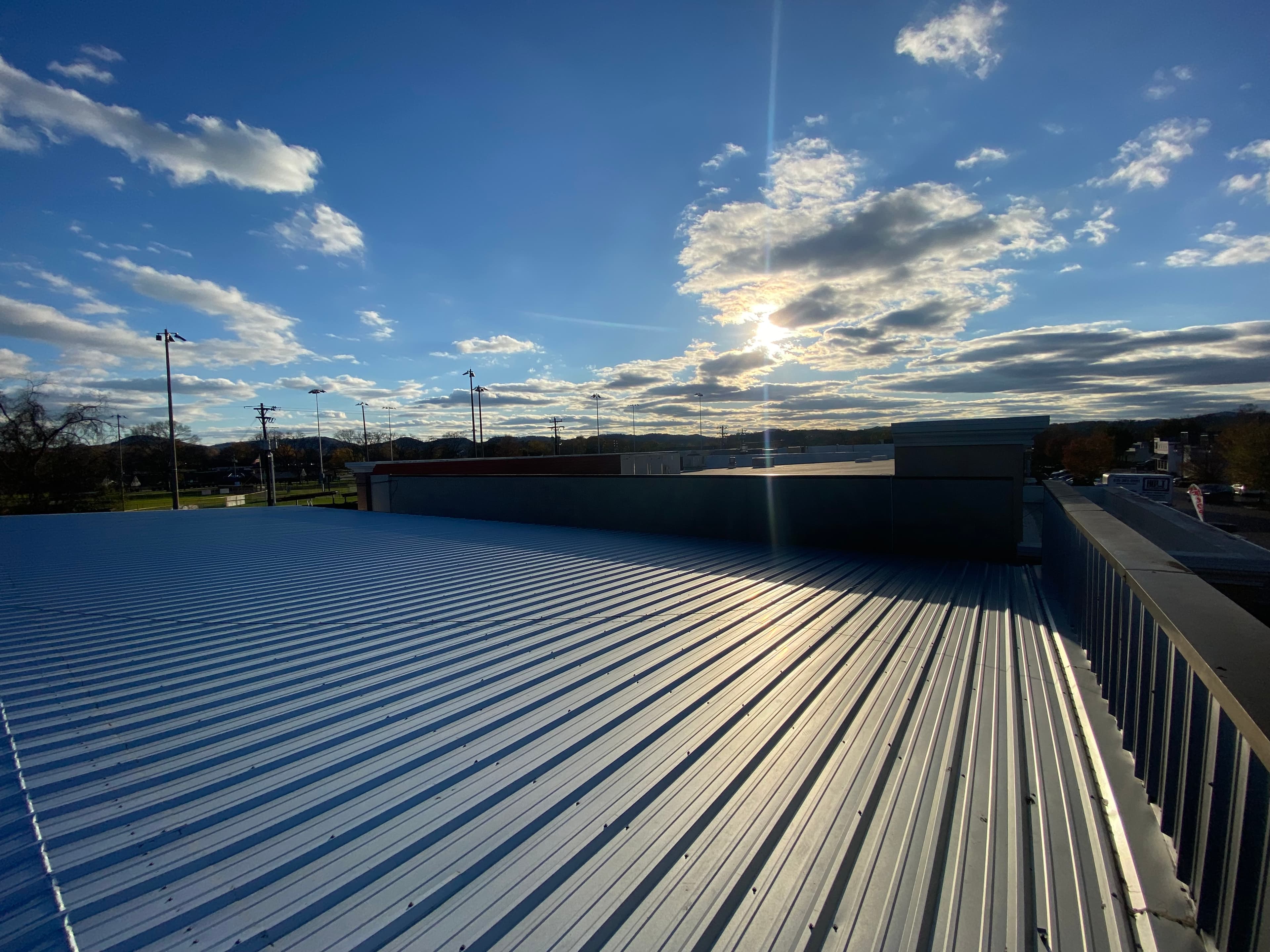
Carpet-manufacturing campus rooftops - the Dalton commercial signature
Dalton's carpet and flooring industry - Shaw Industries, Mohawk Industries, Engineered Floors, Beaulieu, and a deep bench of tier-two manufacturers and tier-one suppliers - sets the commercial roofing profile for the entire Whitfield County market. These rooftops are not standard tilt-wall commercial. Dye-house buildings carry exhaust-stack densities most standard templates miss, with make-up air units and process-relief penetrations clustered tightly around production zones. Fiber-processing buildings run extruder relief penetrations and compressed-air infrastructure through the deck. Corporate-campus office stock layers in single-ply TPO or asphalt shingle over lighter decks with full rooftop HVAC fields. Our Dalton inspection workflow addresses each of these rooftop ecosystems separately, not as a single undifferentiated envelope.
The photo-keyed PDF report we produce for a Dalton carpet-manufacturing rooftop is organized so a carrier desk reviewer can reconcile every penetration, every flashing detail, every curb edge, and every field-membrane course to a plan reference. This matters because carpet-manufacturing campuses carry material deductible exposure under Georgia commercial wind and hail policies, and cumulative-damage disputes with carriers are the single biggest documentation risk for facility managers who do not maintain a documented inspection cadence. We prefer to be the documentation partner rather than the replacement vendor where the roof is sound - a Certificate of Clearance outcome is a frequent and welcome result on Dalton inspections.
- Dye-house exhaust-stack flashing inspected to each penetration
- Fiber-processing extruder relief penetrations documented per-plan
- Tilt-wall distribution parapet-to-coping transitions photographed per run
Storm cadence and claim documentation workflow
Whitfield County commercial property owners should plan for at least one documented storm-claim window per calendar year on average. The March-through-May spring supercell window is the primary exposure. Late-summer tropical-remnant activity - Irma 2017 being the reference event - produces an extended multi-hour wind field that behaves differently than a short-duration supercell and produces different damage signatures. Our post-storm inspection workflow moves across the Walnut Avenue, Cleveland Highway, Shugart Road, and I-75 corridor multifamily and commercial stock first, then carpet-manufacturing campuses, then hospitality and retail.
Our claim documentation workflow is structured so the carrier desk reviewer can work through the claim efficiently. Every roof area is photographed to a plan or elevation reference, every penetration gets a condition status, and every impact or displacement observation is keyed to a coordinate on the plan. We never guarantee the coverage outcome - Georgia carrier policy language and the assigned adjuster make the final determination - but we have consistently found that thorough documentation shortens cycle time and reduces scope disputes on Whitfield County commercial claims.
- Photo-keyed PDF delivered within seven to ten business days
- Per-building documentation on multifamily portfolios
- Certificate of Clearance where no qualifying damage is found
Hamilton Medical Center adjacencies and the NW Georgia healthcare corridor
Hamilton Medical Center is the anchor of the Northwest Georgia healthcare market and carries a surrounding medical office and ambulatory-services corridor that operates with infection-control and patient-access sensitivity. Our Hamilton adjacency work is scoped with facility-team coordination on staging, rooftop work hours, noise-generating operations, and dust or fume management. Rooftop systems across the adjacency are most often single-ply TPO over medical office and asphalt shingle over smaller professional-building stock. Ambulatory-surgery adjacencies run their own distinct workflow requirements, with procedure-day continuity as a non-negotiable constraint.
We document Hamilton adjacency inspections to a standard compatible with hospital-system facility review and lender renewal. The photo-keyed PDF report includes slope-by-slope documentation, drain and scupper function, penetration-field context, parapet and coping detail, and a specific infection-control-sensitivity note on any rooftop work that could affect HVAC air intake paths. Healthcare adjacencies tend to run conservative replacement and repair scopes - the facility-team preference is continuity over disruption - so we scope repairs and phased replacements compatible with patient-access workflows and hospital-system capital planning cycles that often run on multi-year budget horizons.
Multifamily phasing and tenant-notice workflow on Walnut, Cleveland, and Shugart corridor properties
Dalton's multifamily inventory concentrates along the Walnut Avenue, Cleveland Highway, and Shugart Road corridors in garden-style and low-rise configurations. Phased replacement on a garden-style portfolio requires tenant-facing notice workflow, dry-in-by-nightfall staging on every production day, and coordinated staging plans on parking and amenity buffers so residents continue to have access to their parking spaces and common-area amenities through the production cycle. Our phased-replacement workflow is designed so tenants are not displaced and property managers are not burdened with continuous tenant-complaint management during production.
Each Dalton multifamily project carries a per-building schedule with estimated dry-in dates, a daily tenant-facing notice protocol with forty-eight-hour and twenty-four-hour advance notice of work windows on each specific building, and photo-documentation progress reporting to the property manager on each production day. The final close-out package is a photo-keyed PDF organized per-building with a unit-level damage-and-repair reference, drain and scupper final condition, parapet and coping final condition, and warranty activation documentation. Property managers use this package for lender renewal, asset-manager portfolio review, and as a baseline reference for the next inspection cadence cycle.
- Forty-eight-hour and twenty-four-hour tenant notice protocol
- Dry-in-by-nightfall staging on every production day
- Per-building close-out package for lender and asset-manager files
Why Dalton Property Owners Choose Red Door Roofing
30+ years, Red Door family
Built on 30 years of commercial experience across the Southeast. Notable clients include Best Western, Harbor Freight, Tractor Supply, and Vanderbilt Medical Clinic.
Carrier-ready documentation
Photo-keyed inspection reports formatted for Dalton-area adjuster and lender workflows. No guarantees on claim outcomes - the carrier calls that.
Tenant-in-place phasing
Multifamily work phased by building block with tenant-notice templates, noise windows, and operations- team documentation. Tenants stay in place.
No-obligation inspection
If our Dalton inspection finds no qualifying damage, we issue a Certificate of Clearance - suitable for lender, insurer, and asset-manager files. No further commitment.
Dalton Commercial Roofing FAQs
How do you inspect a dye-house roof with heavy exhaust-stack density?
Do you work on tilt-wall distribution centers in the Dalton carpet corridor?
Can Red Door Roofing phase a large Dalton multifamily replacement without displacing tenants?
What is your turnaround on a Hamilton Medical Center adjacency roof?
How fast can Red Door Roofing inspect a Dalton carpet-mill rooftop after a storm?
Do you document Dalton multifamily storm claims the way Georgia carriers expect?
What happens if your Dalton inspection finds no qualifying storm damage?
Which commercial roof systems do you install on Dalton carpet-manufacturing campuses?
Is Red Door Roofing licensed to operate on Dalton commercial properties?
How do you handle carrier deductibles on Dalton commercial claims?
Nearby Georgia Cities We Also Serve
Our commercial roofing coverage extends across Georgia. These three Dalton-adjacent cities are part of our routine service footprint.
Need a Dalton inspection?
Call us directly at 1-855-GO4REDD or request a no-obligation inspection online. Most Dalton-area inspections are scheduled within days of the request.
Request InspectionSchedule a Dalton Roof Inspection
No obligation. Documented findings you can use for insurance, lender, or asset-manager records.
30+ Years of Red Door Family Experience · 16 States
Free · No obligation · No follow-up sales calls